

Spring is here with a freshness in the air. All the world is turning green. It’s time to learn some new dulcimer music. I enjoy the challenge of coming up with dulcimer arrangments for a tunes which I don’t know. It is a way for me to channel my creative energy. Lately, I have been intrigued with a rather unusual tuning for the mountain dulcimer — DGD, capo 1 — which places the dulcimer in the key of A minor. Since it requires you to retune the dulcimer, add a capo and learn a new scale on the fretboard, this tuning is not often used. However, there is a unique sound when a tune is played in A minor. It is rewarding to play something in a new way on the dulcimer. I opened the massive fiddle tune book, “The Fiddler’s Fakebook,” to see what I could come up with. The page randomly turned to an Irish reel, “The Congress,” a tune in A-Dorian. Home run! This is great and I came up with a spritely arrangement for the dulcimer of this very modal and sort of mystical sounding Irish tune. And, in my arrangements, the tablature rarely goes above the fourth fret!

The Congress Reel
There are many places to go to learn new music. I have several of these “reference” books with hundreds of tunes and a melody line for each one. “The Fiddler’s Fakebook” contains all sorts of tunes — not just Irish ones — and it is probably all a person needs. However, the tunes are written for fiddlers and sometimes are more complicated. The other Irish tune books shown have a simplier versions of the songs, especially “Irish Session Tunes.”
Since I wasn’t familiar with the basic tune, I turned to YouTube where you can find just about anything. I listened to several variations of “The Congress.” An internet search provided background information as well as more variations of the tune. In fact, one WEB site of Irish music called, “The Session,” contained 20 written variations of this tune.
The name, “The Congress Reel,” or just, “The Congress,” is derived from the composer, Joe Mills. Apparently, he introduced the tune in honor of the Eucharistic Congress in Dublin, in 1932, which is a gathering of the Catholic Church. It unclear whether or not Mills actually composed the tune or just gave the name to an older tune. It does not appear to be copyrighted.
The Eucharistic Congress is held in a different international city each year. In Dublin in 1932, the Congress was attended by Catholic clergy, religious dignitaries and laity. The high point of the Congress was the open air mass in front of the High Alter erected in Dublin’s Phoenix Park on June 26, 1932, where approximately one million people attended this ceremony. The event was described as “the largest congregation ever known at Mass.”

Dulcimer Tuning — DGD – Capo 1 – to play in A Minor Key
The basic melody to “The Congress Reel” is similar in the 20 listings on “The Session” site with subtle variations. Some had runs which went up the scale, other variations included lower notes. Some variations eliminated or changed the ornaments, embellishments and “frilly” notes. In other words, no two listings were identical. It gave me a chance to “pick and choose” my notes to fit the dulcimer. So, my tune follows the basic melody but includes elements of several of the variations. It is totally very achievable on the dulcimer.
To play in this tuning in the key of A minor, you must re-tune your dulcimer. This is easy to do. From the DAD tuning, lower the middle string one note from “A” to “G”. This is a minor change, and you don’t have to turn the tuning peg very far to lower the string. Then place the capo on at the first fret. Simple enough — you are now in A minor.
The unique aspect of this tuning is that the scale is based out of the middle string — not the melody string. The A minor scale is related to the C major scale — it consists of the same notes except that the A minor scale begins and ends with “A” rather than “C”. These notes are found on the middle string and there are no sharps or flats in A minor.
Here is the fretboard and notes. The dark vertical line is where the capo is placed. This tablature number now becomes the “zero” fret.

There are several places on the fretboard where the A minor scale can be placed. Play it entirely on the middle string. Alternately, play this scale across the strings as I did in my arrangements. In several places, I used the 4th fret on the bass string for “A” rather than the 0 fret on the middle string. When strumming, it is easier to hear the “A” note this way.
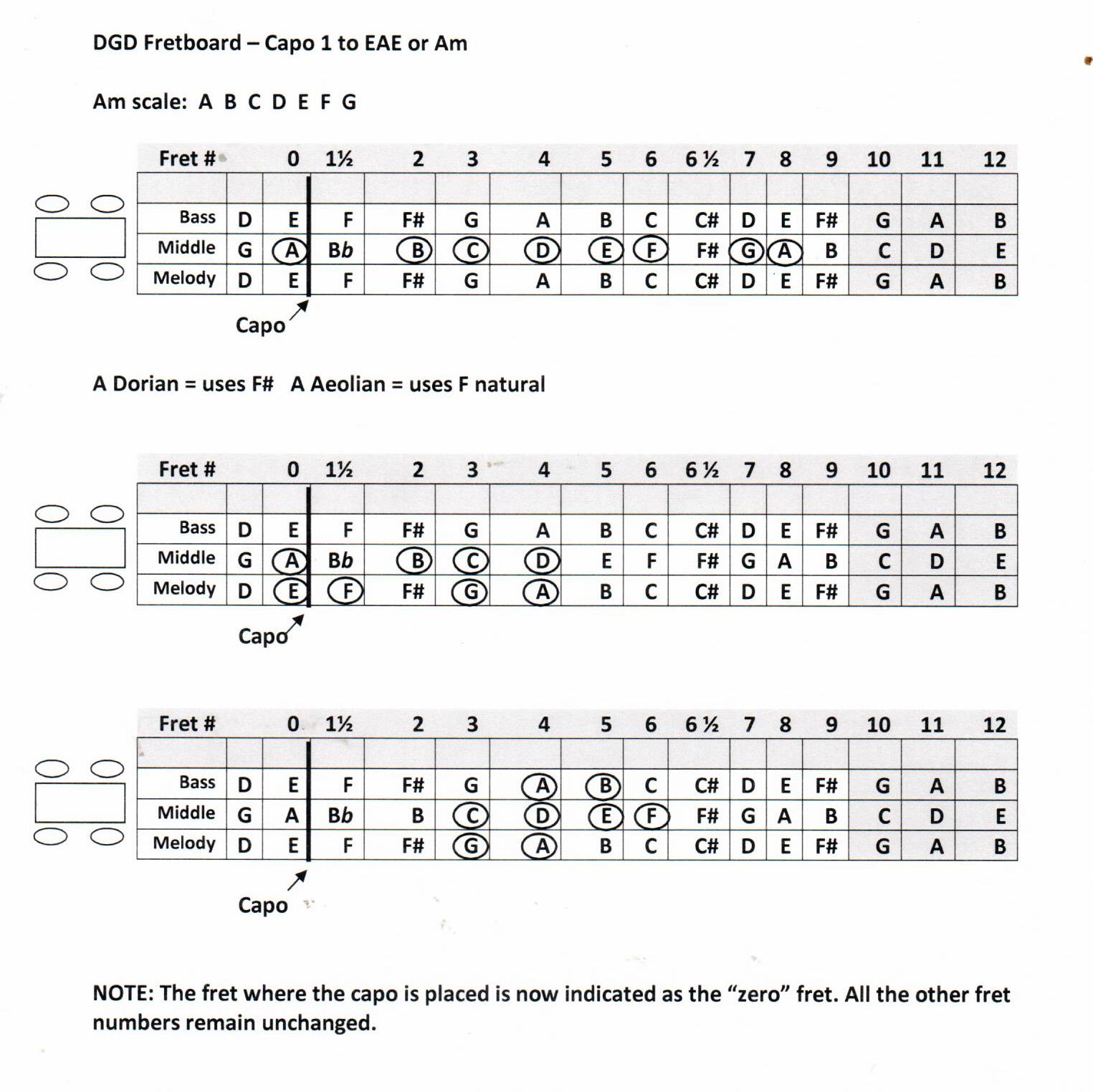
“The Congress Reel” is written in the modal tuning of A-Dorian which is slightly different than A minor. The A-Dorian scale includes F# rather than F-natural. So, the key signature for this tune is shown as one sharp. Fortunately, this note is readily available on the fretboard. Another modal tuning, A-Aeolian, uses the F-natural note.
Using my Finale computer notation program, I arranged with two alternate fingerings for “The Congress Reel.” Although one says “strummed” and the second one says “flatpicked” either style of playing can be used on these arrangements. The notes are identical; some of the frets change between the melody, middle and bass strings. None of the fret numbers go past the fifth fret on the strummed version and they only reach the fourth fret on the flatpicked version.
My experiment with re-tuning my dulcimer and adding a capo worked great. “The Congress Reel” sounds very “Irish” to me, with sort of a mystical, modal tone. Can’t wait to try some other tunes in the Key of A minor. It has a very distinctive tone, quite different from E-minor or D-minor tunes in my assessment. Another way to expand playing on the traditional mountain dulcimer.


Here are PDF files of the tune which you can download and play.
And flatpicked.

It’s spring! Here’s a rare Jackson & Perkin’s heirloom rose.
 Dulcimer Jambalaya
Hi Joe! I see you use Finale for your tab and it looks great! I just bought a copy and am trying to figure out some of the basics. I wonder if you could give me some tips – like how do you handle the capo, how did you get the tuning/capo tuning letters to appear at the start of the tab line? I come from a strong Tabledit background and I can already see that Finale doesn’t have the built-in support for mountain dulcimer that is in Tabledit, but on the other hand it has a whole lot of other settings and options that aren’t in Tabledit. It’s going to be a learning curve!
LikeLiked by 1 person
Hello, welcome to Finale. Yes, it is a learning curve, but then I use one tune for the template for the next song, so once you get everything set up, typing in a song goes quickly. I have version 25.3, so can’t vouch if anything has changed with Finale 27 — I know the default font is one I no longer have on my computer. Boo. For handling the capo tunes, I don’t do many capo songs and just manually change “1” fret to “0” with speedy entry tool or what ever fret number is appropriate. For the tuning/capo letters, that is in Document, Document Options, Cleft, Cleft designer Tool. Design the tuning/capo letters that you want as well as the position and hit okay. I think there is also a place in Windows, score manager to do this or sometihng that you set initially there. Good luck. I love Finale and have been using it since version 1.0, so have been using it for quite a while.
LikeLike
Do you actually specify capo 1 anywhere in the tab settings? Or just put some text in saying capo 1. I could only find something about capo for chords (obviously meant for guitars and the like) in the manuals. Thank you so much for these answers. It will speed me along without beating my head against the wall 😄
LikeLike
My apologies for calling you Joe! I saw that name at the top of the tab, but I see Maylee is at the bottom. You must be part of Helen Bankston and Peggy Broussard’s group. I know them from Dulcimer U and from Pat Clark’s Send In The Music jam. So when you have a capo’d piece, is there something you can set in the tablature settings, or do you just put a text box saying “Capo 1” and write the tab accordingly? The only thing I can find about capos in the manual has to do with capo’d chords for guitars and the like. Thank you so much for these tips; it will keep me from banging my head against the wall.
LikeLiked by 1 person
Hello, I don’t spend much time on the intricacies of Finale and capo’d tunes. If there is a way to do it in the tab settings, I haven’t figured it out yet. I add “capo1” or etc. by either using a text block or the expression tool which attaches the word “capo 1” to a note. That way, if you shift the music around on the page, the word moves, too. With a text block. you have to go back and move to block. Yes, Peggy, Helen and I are part of the same group down here in Louisiana. Hope this helps. Maylee
LikeLike