
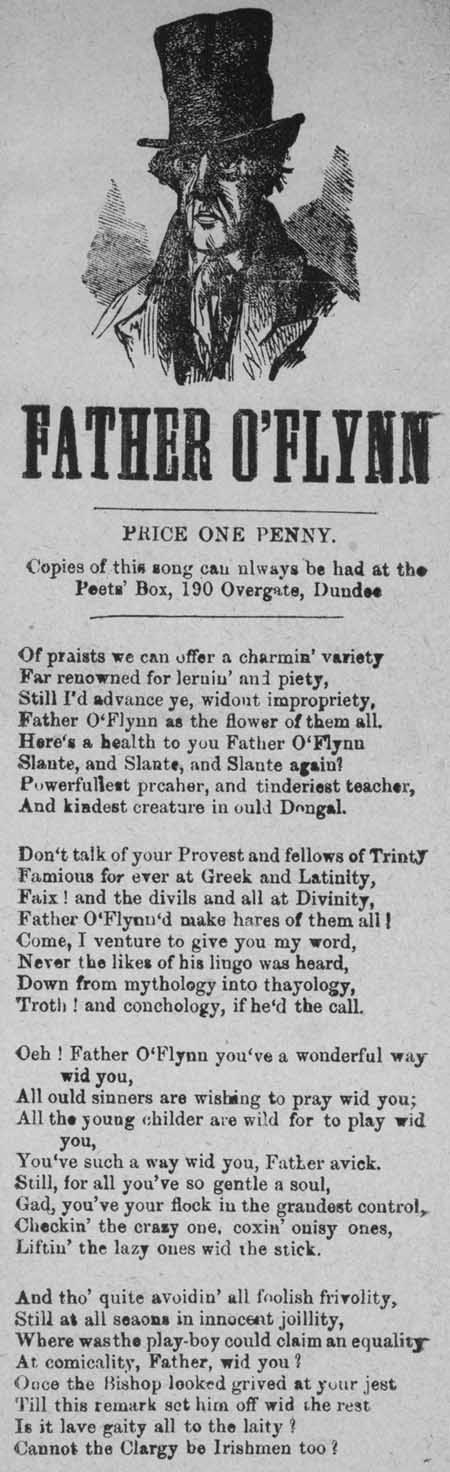
Here’s a lively Irish jig, “Father O’Flynn,” for St. Patrick’s Day to play on the dulcimer. I noticed the tune while browsing through an Irish penny whistle book. Now, I couldn’t pass up a tune with such an Irish-sounding name. The tune name is actually “The Top of Cork Road.” In 1882, humorous words were added and published about a beloved priest, Father Michael Walsh, who was from County Cork and became parish priest in Sneen, County Kerry. Eventually, both the tune and song became known as “Father O’Flynn.” What caught my attention was that the tune includes several “arpeggio” chord patterns in the melody. And, when played across the strings on the lower octave — from melody to bass string — the majority of the notes fall on only the first two frets. Yey! It is quite achievable on the dulcimer and is a fun one to fingerpick.

About the Tune
“Father O’Flynn” was published on a broadside in 1882. At that time, is was rare that mustical notation was included as the tunes were ones known to the public. It is believed that the insiration for the song was Catholic priest, Father Michael Walsh (c1793 – 1866). Father Walsh was also an enthusiastic musician who wrote a number of tunes. The priest liked to hunt, shoot and fish and was somewhat lax on his paperwork duties. In fact, Father Walsh took his gun, powder-horn and hunting periphenalia wherever he went, much to the dismay of his superiors. The priest kept a hawk, crow and about nine dogs including greyhounds for coursing (hunting by sight — not scent), pointers and retrievers. Although he sometimes received the ire of his superiors, he was beloved by his parishioners, spoke Irish and helped represent them in the local courts as well as performing his clerical duties.
The composer of the song was Alfred Perceval Graves (1846 – 1931). A.P. Graves was the son of a well-to-do Protestant Anglican Bishop of Limerick. The bishop, wife and servants came to Kerry each year to spend their summers. A.P. Graves and the family befriended the Caltholic priest, and A.P. eventually wrote the lyrics to this and other songs.
A.P. Graves, unfortunately, sold the rights to his songs to his publisher. The publisher made a fortune off of this particular song, but Graves recieved only a small amount of money for the original publication. As A.P. Graves later told his son, the lesson is not to sell all your songs in one lot.

Fingerpicking Styles
Why fingerpick on the dulcimer? I have grown to enjoy this style of playing the dulcimer. It makes for a welcome change from fast strumming all those fiddle tunes. In my opinion, fingerpicking is an expressive way to play the dulcimer and makes for smoother playing than using a pick. From a dexterity standpoint, fingerpicking is much easier for me and allows me to develop speed with playing.
Not all tunes are meant to be fingerpicked. Many songs work much better when strummed. l search for tunes which fit into a fingepicking style rather than “forcing” a tune into a fingerpicked mode. This tune works perfectly, with the “arpeggio” chord patterns in the melody.
There are different styles of fingerpicking the dulcimer. For example, fingerpicking only the chords as an accompaniment to singing a song is one style. Another method is the chord-melody arrangement which means to fingerpick the melody and fill in extra notes. With “Father O’Flynn,” the style is simply to fingerpick the melody notes of the song. Let a second person play the chords.

Playing “Father O’Flynn” on the dulcimer
The Irish tune, “Father O’Flynn,” is an enjoyable one to play on the dulcimer as well as the penny whistle. I’m certainly not an expert on Irish music and, therefore, have given it my best “American” slant. But, I love these Irish tunes and find that they give an expanded dimension to playing the dulcimer.
In my arrangement, it is intended to play only melody notes rather than strumming across the strings, while using an occasional a “brush” or “pluck” to play across all the strings. This is not necessarily a “jam” tune where everybody plays the tune together. It is difficult to keep “in unison” as a group on this jig.
“Father O’Flynn” is an Irish jig, or a dance tune, and can be played at a lively pace. I can pick up quite a bit of speed while fingepricking the “arpeggio” melody chords, as well as using hammer-on’s, pull-off’s and slides.
Jigs. Jigs are written in 6/8 time signature. To my ear, I hear a “pineapple-pineapple” rhythm or two sets of three beats per measure. Try to gently emphasize the first beat of each measure. There are many subtle variations to the melody of this tune, and I followed the one which I found in the penny whistle book. It includes a “G” chord which is sometimes omitted in some of the tune variations. As usual, I omitted a few notes which helps make it easier to play on the dulcimer. Why not? Lots of these additional notes are intricacies of fiddle players.
Left Hand. By playing the tune across the strings on the lower octave — melody to bass string– rather than up and down the fretboard, your left hand doesn’t move most of the time. Almost all the notes are on the zero, first and second frets. It is possible to assign left-hand fingers to a fret and leave them in place for most of the tune.
Furthermore, you can pre-position your fingers on the frets some of the time. For example, your left-hand finger can be placed on the second bass fret before you even begin to play.
Right Hand. To fingerpick the melody of this tune, I assign my right hand pointer, middle and ring fingers to the melody, middle and bass strings, respectively. In this tune, I keep my thumb out of the way. I try to keep these fingers on the same strings, as much as possible.
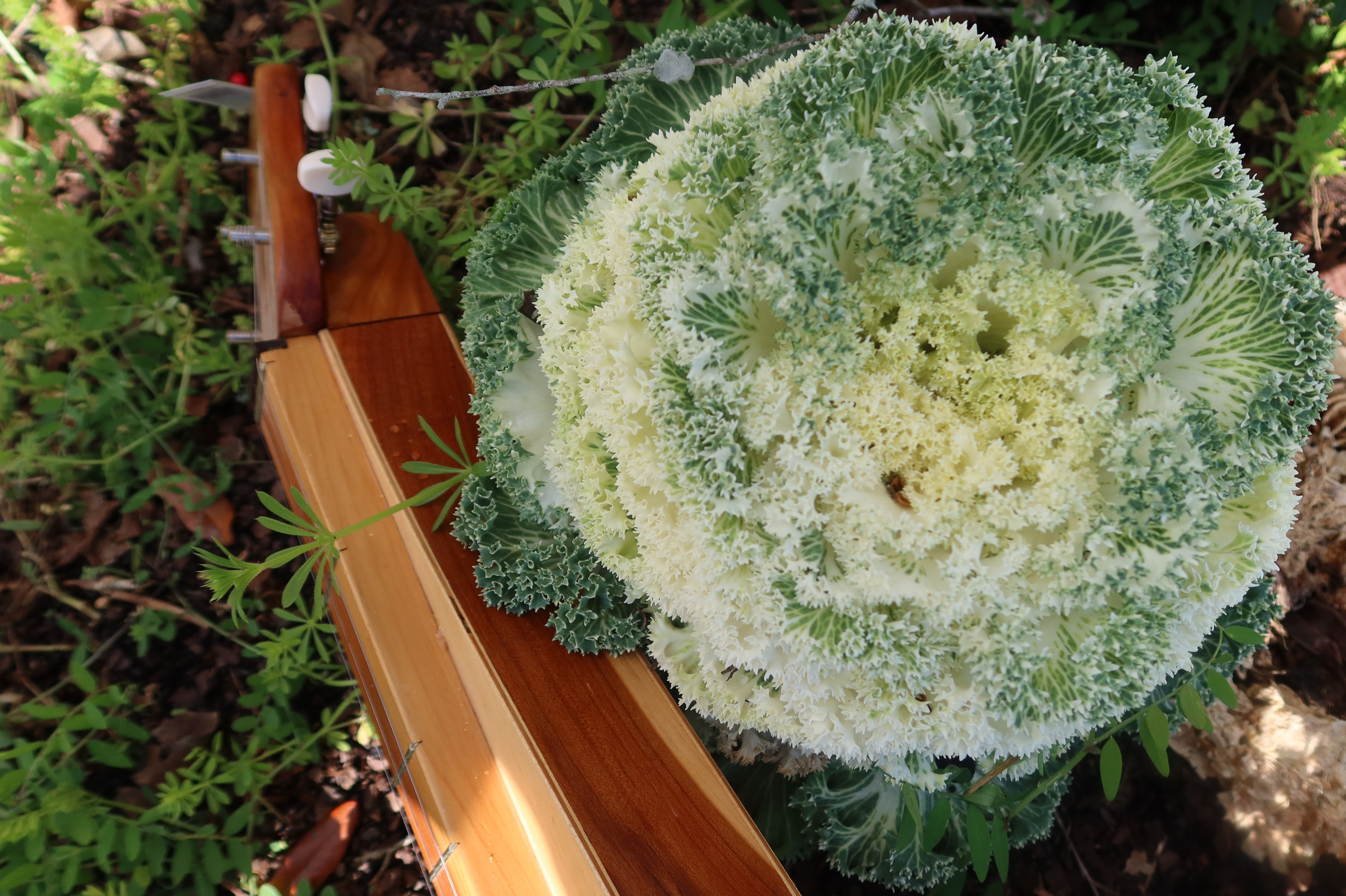
Which Dulcimer? If you have a choice of dulcimers to play, I suggest selecting one which allows for easier use of playing ornaments. My favorite dulcimer for playing ornaments is actually a very inexpensive one with a laminated top and pine laminated back which was made from a kit. Look closely to see the laminated wood and pine fretboard. The sound and playability on this dulcimer is fine and the small size makes it easy for me to carry around the house. It does not have a 1-1/2 fret, but you don’t need that fret to play this tune.
Not all dulcimers are alike and it is easier to play hammer’on’s, pull’off’s and slides on some dulcimers. Using these ornaments wherever possible helps make for smooth and faster playing. In my tablature arrangement, I included some suggestions in the first line of the song for these ornaments. Continue these ornaments throughout the song.
St. Patrick’s Day will soon be here. Let’s enjoy some new Irish tunes. I hope you will add this lively jig to your repertoire. And try fingerpicking the tune while a second person plays the chords. It’s a peppy tune on the dulcimer. I have included a PDF file for you to download, share with friends and play. The tab is played an octave lower than the written notes.

References:
 Dulcimer Jambalaya