

Here’s a catchy, upbeat song for the Fourth of July to play on the dulcimer. “Yankee Doodle Boy” or “I’m a Yankee Doodle Dandy” was written in 1904 by George Cohan for a Broadway musical, “Little Johnny Jones.” The musical is about a fictional American jockey who rides a horse named “Yankee Doodle” in the English Derby. It is a story of deception, love and intrigue. The lyrics don’t have anything to do with the Fourth of July other than the jockey was born on the Fourth of July. However, with a name like “Yankee Doodle Boy,” the song popped into my head when I was searching for patriotic songs to play on this holiday. “Yankee Doodle Dandy” is a challenging song to play on the dulcimer, but intermediate dulcimer players can do it. If you like a challenge, then give this Tin Pan Alley Broadway musical tune a spin this summer.

About the Tin Pan Alley
The Tin Pan Alley referred to music publishers and songwriters whose businesses were located in a small district of Manhattan beginning in 1885 and until the drepression. The salesmen at these music publishers banged on their twangy pianos, trying to sell popular songs and sheet music of the day. One journalist stated it sounded like alot of pans being banged in an alley — the term stuck. This time period pre-dated phonographs and radios, and the way to spread music at the time was to sell sheet music. Aspiring songwriters brought in their music scores to these music publishers in an attempt to sell their songs. Initially, Tin Pan Alley promoted and specialized in melodramatic ballads and comic novelty songs. Over the years, it came to include popular music styles such as ragtime music, jazz and blues which amateur singers in small town bands could perform from printed music.
“Yankee Doodle” vs “Yankee Doodle Boy”

I associate the song, “Yankee Doodle,” with our American Revolution in the 1700s. This song was a favorite of British soldiers who came to our country. The song was “stolen” by American Revolutionary War soldiers who added new words. Soon it became popular with American troops.
Here we are at the Boston Tea Party Museum on a replica of a British sailing ship. The guides told the story of overthrowing the tea in the Boston Harbor to protest paying taxes, one of the events which led to the American Revolution. These daring colonists were truely patriots of our country and we can thank their bravery for getting us where we are today.
“Yankee Doodle Boy” is an entirely different tune although it does incorporate a little of the melody of the “Yankee Doodle” tune into the song. “Yankee Doodle Boy” was written in 1904 for a Broadway musical by George M. Cohan.

George M. Cohan
George M. Cohan (1878 – 1942) was a prolific Broadway musician — both a performer (singer, actor and dancer) — composer and producer. He wrote more than 50 shows, plays and musicals and published more than 300 songs. Well-known songs include “Over There,” “Give My regards to Broadway,” “You’re a Grand Old Flag,” and “Yankee Doodle Boy.” Cohan was a significant force in the development of American musical theater. He was called “the greatest single figure the American theatre ever produced” by the New York Times newspaper in a tribute written at his death. What a contrast Times Square and the theatre district in New York City is today from the early days of Cohan’s career!

Cohan was born on July 3, 1878, into a family of vaudeville musicians. He appeared in shows as an infant and began performing at eight years old. George Cohan and his sister joined the family act and the family was billed as “The Four Cohans.” The family traveled the vaudeville circuit for most of the year. Cohan spent summers with his gandmother in Massachusetts which he loved. It wasn’t long, while in his teens. before Cohan began writing songs for the family’s act in vaudeville and minstrel shows. He soon began his professional career of writing songs and musicals professionally. “Little Jolnny Johns” was Cohan’s first full-length Broadway musical.
Challenges of diatonic tablature and “I’m a Yankee Doodle Dandy”
The dulcimer has limitations, especially when playing many of these Tin Pan Alley songs of the early 1900s. You really need some of the missing notes — accidentals (sharps and flats) — of a chromatic piano to play these tunes to their full potential. However, we can improvise on the dulcimer and can often find something that approximates the original tune. You must to be able to play chords, especially barre chords, and stretch to play the melody across the strings, etc. to successfully navigate these tunes.
Playing “I’m a Yankee Doodle Dandy” on the dulcimer is challenging for several reasons.
- First, there’s a key change between the verse and the chorus. Like the typical format of many Tin Pan Alley Broadway songs of this era, the song includes both a verse and a refrain. The verse sets up the dramatic tone of the song. Then comes the rousing chorus. The key change makes it difficult to arrange the song on the dulcimer. Since the refrain is more familiar than the verse in “Yankee Doodle Boy,” I left out the verse. That’s a project for another time.
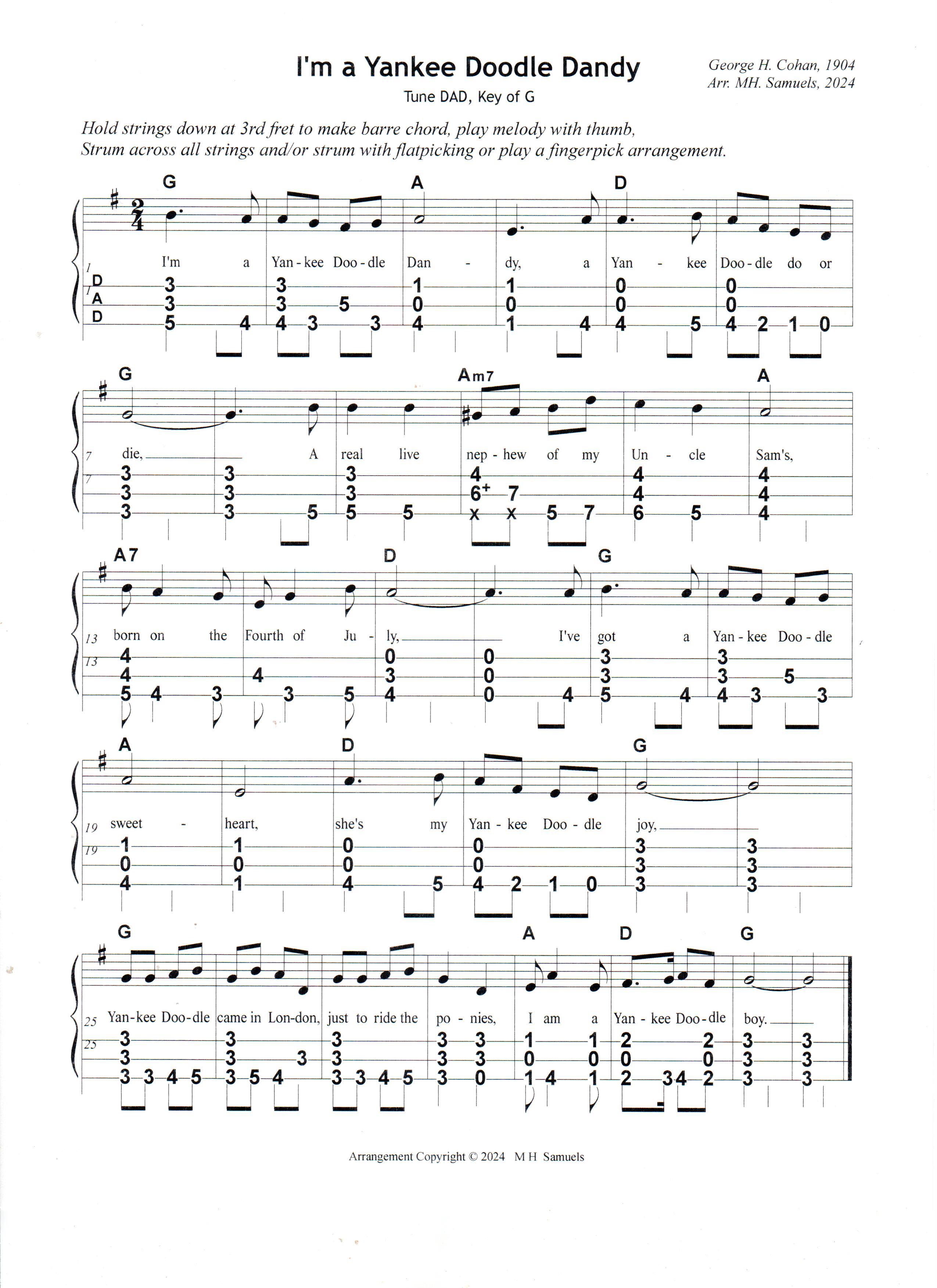
- Secondly, the tune contains a note which doen’t fall on the diatonic scale of the dulcimer. If you omit that note, then you lose some of the character of the song. I discovered that you can play this song in the Key of G — while tuned to DAD. Then that note — G# — shows up on the middle string at the 6-1/2 fret.
- The song is melodic. There are no drones in this song. You must play all the notes to make the chords and make this sound like a “contemporary” song.
Moving capo — Give you thumb a workout to play in the Key of G while tuned to DAD
Playing in other keys while tuned to DAD simply extends the range of music that a person can play on the dulcimer. Once you learn to use your fingers as a capo to change keys, then another world of music possibilities opens up.
This tune is set in the Key of G while tuned to Key to D. To play this song, skip the capo. Use your fingers to make a barre chord at the third fret. Use your thumb to move around frets to play the melody notes while holding down the barre chord. Your thumb gets a workout. It takes alot of dexterity, but it is the only way I could find to arrange this tune.
Why skip the capo? Simply put, you lose the lower notes of the dulcimer which give those deep, pleasing tones and extras melody and harmony frets. No need to have the dulcimer sound like a Tin Pan Alley piano.
Arranging “Yankee Doodle Dandy” for the dulcimer
Here is my arrangement of “Yankee Doodle Dandy” for the dulcimer. The dulcimer is tuned to DAD. However, it is arranged in the Key of G. You must hold down all the frets shown in the tablature to make the song work — there are no drones in this song. Use your pinky, ring and middle fingers to make the barre “3” fret capo. Then use your thumb and index finger to play the melody.
Rhythm
Many of Cohan’s songs were patriotic tunes and have that “march” feel. This song is written in 2/4 time signature — like a person “marching.” Every other beat is emphasized. So, fill in strums to keep the rhythm going and emphasize the first beat of the measure.
Enjoy this Broadway Musical Tune
This is a challenging arrangement. Strum and pick; and adapt it to your own style of playing. That includes fingerpicking the tune!
Enjoy this Broadway musical tune on the Fourth of July. Other than persistant Yankee patriotism to our country and occasional quips belittling the English, the musical really doesn’t pertain to the holiday at all. However, that’s not stopping me from playing the song on July 4th. It is rewarding to play “contemporary” music on the dulcimer!
References:
Tin Pan Alley and Music Publishing
 Dulcimer Jambalaya