


I have always enjoyed the tune, “Fisher’s Hornpipe,” with British origins. Over the years, it has become a popular fiddle tune all across our American continent, including Giles County, Virginia, where the above photo was take. This is one of those songs that “grows” on you; I can play it over and over for hours. For a fiddler or penny whistle player, this snappy tune really flies. For the dulcimer, I slow it down a bit.

“Somewhere in the Middle”
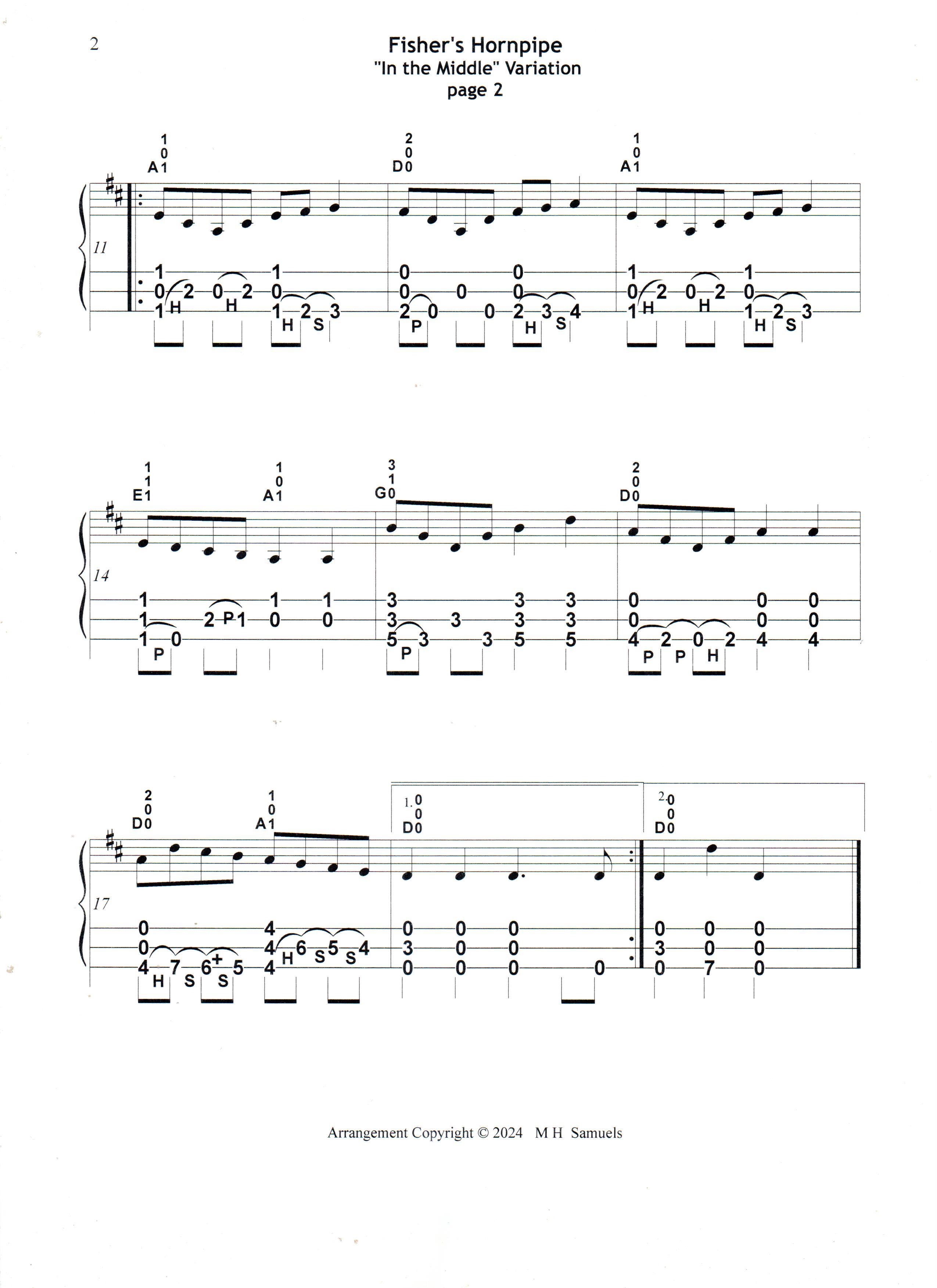
“Fisher’s Hornpipe” includes lots of eighth notes and runs up and down the scale making it both melodic and alot of fun to play. However, the fast tempo of this fiddle tune — along with all the notes — can be confounding for dulcimer players. To make playing it manageable, one solution is to simplify the tune by eliminating some of the notes which crowd the melody. So, my arrangement is “somewhere in the middle.” It is not the easiest dulcimer arrangement possible, but definitely is simpler than the traditional song. In my tablature, I included chords and suggested fingerings above the standard music line for a second player to strum. This helps fill out the song and provides rhythm.
About Fisher’s Hornpipe
Fisher’s Hornpipe is a traditional British dance tune. It appears that the tune was composed and published in 1779 by James A. Fishar, a professional violinist and ballet master at Covent Garden, London. This is reasonable since hornpipes were popular on the stages of London and Ireland during this time period as a showcase for fancy step-dancing. So the tune was probably named after the composer — rather than having anything to do with fishing.
The tune gained popularity in the British Isles and was included in many tune manuscript books of that era in England and Ireland. The song made its way across the ocean to North America — spreading throughout the Northeast, Canada, Midwest, Texas and down into the Appalachian mountains. It was first published in this country in New England in the circa 1780 copybook of fife-major John Greenwood, who served in the 15th Massachusetts Regiment. This led one source (see 2nd reference) to suggest that the tune was used for a fife-and-drum march.
Here is Henry Reed’s version of Fisher’s Hornpipe in G collected by Alan Jabbour for the Library of Congress. This fiddler is from the southwestern Virginia mountains.

As time went along, “Fisher’s Hornpipe” became a standard in the repertoire of old-time fiddler and bluegrass players, losing the connection to dancing. “Fisher’s Hornpipe” was so popular that it was used in fiddle competitions — whomever played the best version won the competition. Alan Jabbour, folk song musicologist of the Southern Appalachian mountains, collected a version of “Fiddler’s Hornpipe” from Herry Reed (1884 – 1968), famed fiddler from Giles County, Virginia, in 1966 for the Library of Congress. Jabbour, wrote — referring to Fisher’s Hornpipe — “By the year 1800 the tune was already in widespread circulation…. Popular collections of the 19th century printed it regularly, and by the 20th century it had survived to become one of the most popular hornpipe tunes in Great Britain and America.” (see 2nd reference)
Here we are at a rest stop along the interstate in Giles County, Virginia, on a trip several years ago. I can just hear a fiddler playing in the mountains.

In the Library of Congress collection, Jabbour’s entry includes an audio of Reed playing “Fisher’s Hornpipe.” It sounds alot like the tune which I tabbed out but Reed plays it at a very fast tempo!
Fisher’s Hornpipe for Fiddle
A hornpipe is traditionally a dance tune. It can be played either slow or fast — depending on the pace of the dancers. “Fisher’s Hornpipe” is usually played at a quick tempo by old-time fiddle players and bluegrass bands who are not playing it as a dance tune. The quick tempo makes it challenging for dulcimer players; hence my abridged version.
There are many ways to play these old, traditional tunes such as “Fisher’s Hornpipe.” Alot of the melodic runs depend upon the bowing pattern of the fiddler and the key of the song. The basic melody is usually the same, but the melodic runs and other “filler” notes can vary quite a bit.
“Fiisher’s Hornpipe” is often played in the Key of F. It can also be played in either the Key of D or G. Sometimes the tune is played with the traditional hornpipe “lilt” and otherwise with a “straight” rhythm. All these subtle differences can make music sound like a completely different song.

Adapting Fisher’s Hornpipe for Dulcimer
My process for simplifying a song is to eliminate some of the notes but still leave enough so that you can recognize the melody. I tend to omit notes at end of measures so that I can “catch up” and move my hand to reach the next notes. Perhaps a little odd, but it works for me.
As with many other fiddle tunes, you can reach and play some notes on the middle and bass strings rather than going up and down the fretboard. This helps with speed. For example, by placing your hand correctly in the first measure — you don’t have to move your hand at all to reach all the notes. This is also true of several measures in the second part of the song.
With fast-tempo songs, playing ornaments — hammer-on’s, pull-off’s and slides — helps with speed. At least, omitting stums — rather than picking all the notes — helps me play faster.
The ornaments are just suggestions — sometimes I play them; other times I omit them entirely. When strumming, play with a “back and forth” motion or “alternating strum” or “windshield wiper” strum.
This fast tempo song doesn’t make the best jam tune — it is difficult to keep together — but it can make a great duet and small ensemble or band tune. In my tablature, I include chord with fingerings suggestions to add rhythm to the song.
Enjoy this traditional, old-time fiddle and bluegrass tune which originated in the British Isles and made it to our country in the 1700s. It is still with us, and largely in the same format. I hope you will like it as much as I do — and will play it for hours at a time!

References:
https://www.loc.gov/item/afcreed000143/
Alan Jabbour’s commentary retarding “Fisher’s Hornpipe” in Library of Congress collection:
The hornpipe seems to have developed in the later eighteenth century as a solo fancy dance, with the dancer typically accompanied by a 4/4 tune played on the newly democratized violin at a somewhat slower tempo than a reel. (The hornpipe of earlier British tradition in 3/2 time is a different genre with the same name.) One of the earliest and most widely circulated of all modern hornpipe tunes is “Fisher’s Hornpipe.” Its name is sometimes taken as a tribute to fishermen as an occupational group, but in fact it is the name of the original composer; the tune first appears in J. Fishar’s Sixteen Cotillons, Twelve Allemands and Twelve Hornpipes (London, ca. 1780), p. 48. Fishar was, as the title page explains, “Principal Dancer and Ballet Master at the Theatre Royal, Covent Garden.”By the beginning of the nineteenth century the tune was already appearing in manuscript tunebooks from America, and it has appeared in countless published tunebooks since then, often set in the key of F. American Fiddle Tunes (Library of Congress, AFS L62) contains further discussion and citations. Henry Reed’s sets illustrate nicely the two keys in which traditional sets are usually played–either in G (AFS 13033b07) or in D (here). A comparison of the two illustrates how a tune varies to fit the range and fingering patterns dictated by the key. Yet another set in this collection, played on a C-harmonica (AFS 13705a49), is something of a harmonica tour de force.
Alan
– Performed by Henry Reed, fiddle.
 Dulcimer Jambalaya