
Sometimes a song or performance just sticks with you. Years ago, I listened to Leo Kretzner, a dulcimer player and workshop leader from California, sing and play a bluesy version of “Old Man at the Mill.” It was an unlikely song to play in blues style — but I loved it! I was a brand new dulcimer player; the song was mesmerizing. How did Kretzner achieve that slow, sad bluesy mood? The answer is two things: Kretzner bent the fourth fret on the middle string to create a minor-third and he also played the C-natural note on the bass string. Bending a string can be a useful technique for a dulcimer player for several reasons — you can achieve that bluesy tone and it also allows you to play notes which don’t normally fall on a dulcimer’s fretboard. I contacted Leo Kretzner and he gave me permission to reprint his song. In fact, he also teaches a workshop on string-bending techniques.

I’m not sure if the above old barn-type structure was ever a mill; but it sure does remind me of a mill and of this mournful song. It is an old building, dam and waterfall which I happened upon during a drive in rural Shenandoah Valley at Briery Springs, Virginia.
About the tune “Old Man at the Mill”
“Old Man at the Mill” is a old, old folk song with many words and versions. Antecedents of the song can be traced to England and early America. Some musicologists suggest that it was a play-party dance tune since the lyrics suggest dance moves. Other music historians interpret the circle of the mill in religious terms. It appears to be related to songs such as “Leatherwing Bat.” Each verse features a different bird and their poignant commentary about love and courtship. (The lyrics to “Old Man at the Mill” are included at the end of this blog post.)
Leo Kretzner’s version was recorded and popularized by Clarence Ashley in the 1960’s on the album, “Old-Time Music at Clarence Ashley’s,” of the Folkways label. Clarence Ashley, born in 1895 in Bristol, Tennessee, played both the clawhammer banjo and guitar. He was quite a musician. As a young boy he played in traveling medicine shows in the area. Over the years, he played old-time American music in many string bands. He was “re-discovered” during the 1950s and 1960s folk revival and began playing his repertoire of tunes again, touring and performing at folk festivals. Doc Watson toured with Ashley — and this is how the country first got to know Doc Watson.
In March 2013, the Library of Congress added the album, Old Time Music at Clarence Ashley’s, to the National Recording Registry. This registry is a list of sound recordings which “are culturally, historically, or aesthetically significant, and inform or reflect life” in America.
You can purchase this album at Smithsonian Folkways. (See Reference)
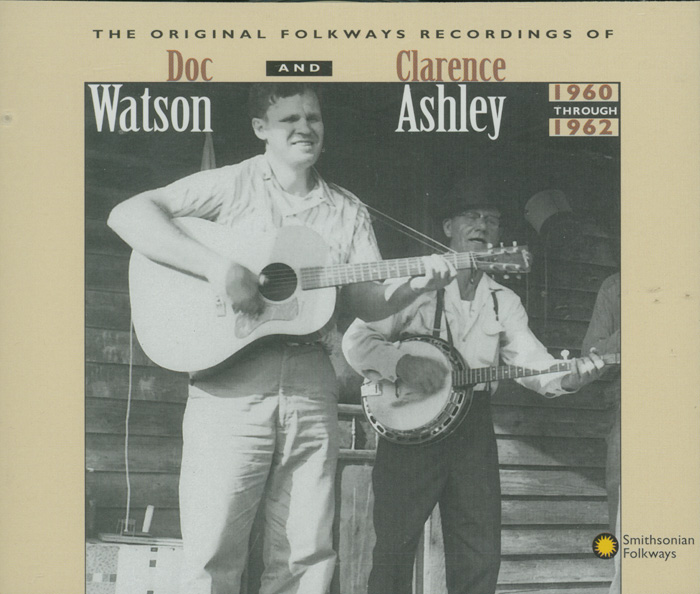
Folkways records is one of the earliest companies to release albums of world music. It also supported American folk music such as recordings by Woody Guthrie, Pete Seeger and Lead Belly. Folkways was founded in 1948 by Moses Asch and Marian Distler. In 1987, they sold the recording company, along with all their master tapes, to the the Smithsonian Institution. The non-profit label is now known as Smithsonian Folkways Recordings. Asch never deleted a single title from the Folkways catalog. The music is all still there!
About Leo Kretzner
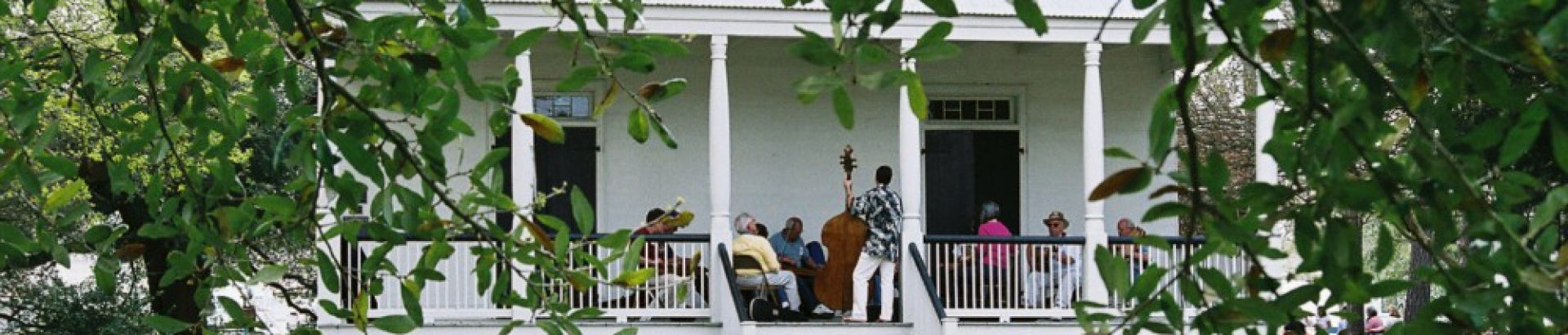
I first heard the song, “Old Man at the Mill,” played the Bayou Dulcimer Festival in Covington, Louisiana. The Bayou Dulcimer Festival is one of those memorable, iconic dulcimer festivals. It was held at a rather obscure Knights of Columbus camp out in the woods north of Lake Pontchartrain. You had to really want to go to this festival to find it along those back country roads. This was the year 2000 and I had just started learning the dulcimer. I sat on the grass in the afternoon and listened to Leo Kretzner — one of the festival’s featured performers — sing the lyrics while he played the dulcimer. He managed to achieve a very bluesy sound on the dulcimer as his deep voice rang out the song. I could have listened all afternoon. How did Kretzner get the bluesy sound? Well, he bent the 4th fret on the middle string. (And he also played the 6th fret — or C-natural note — on the bass string.)
Leo Kretzner is one of those wonderful dulcimer players who has been a major innovator in playing the dulcimer. He states that he first met the dulcimer in 1975 and “the dulcimer hasn’t been the same since.” He has adapted many styles of playing to the dulcimer, playing everything from Celtic jigs and reels to blues and rock as well as more traditional Appalachian styles of music. I haven’t run across Kretzner since that Bayou Dulcimer Festival, but know that he has been an active dulcimer performer and workshop teacher throughout the years in the dulcimer scene. I located the original tab from the festival and was able to E-mail Kretzner to get permission to use it on this blog post.

Bending a string on the dulcimer
Bending a string on the dulcimer takes a little practice; but it is a useful technique. It allows you to play a note which doesn’t normally fall on one of the frets in the DAD tuning (or other tunings). For example, I think of “Sentimental Journey,” a big band song from the 1940s, as needing just that one extra note and fret on the dulcimer to play the entire song. (You can get the “extra” note by bending the middle string at the 10th fret.)
Bending a string also allows you to achieve a bluesy sound. The pitch of the note modules to the the flatted note giving it that moaning minor song. In the DAD tuning and the Key of D, the 3rd scale note (which is the 4+ fret on the middle string) provides that modulation to the minor, F natural tone and blues feeling.
How to bend a string
Bending a string raises the pitch of the note. Leo Kretzner states that it is easiest to bend the middle string. In his version of “Old Man at the Mill”, Kretzner bends the fourth fret on the middle string. That makes it the F-natural note and the flatted or whiny note.
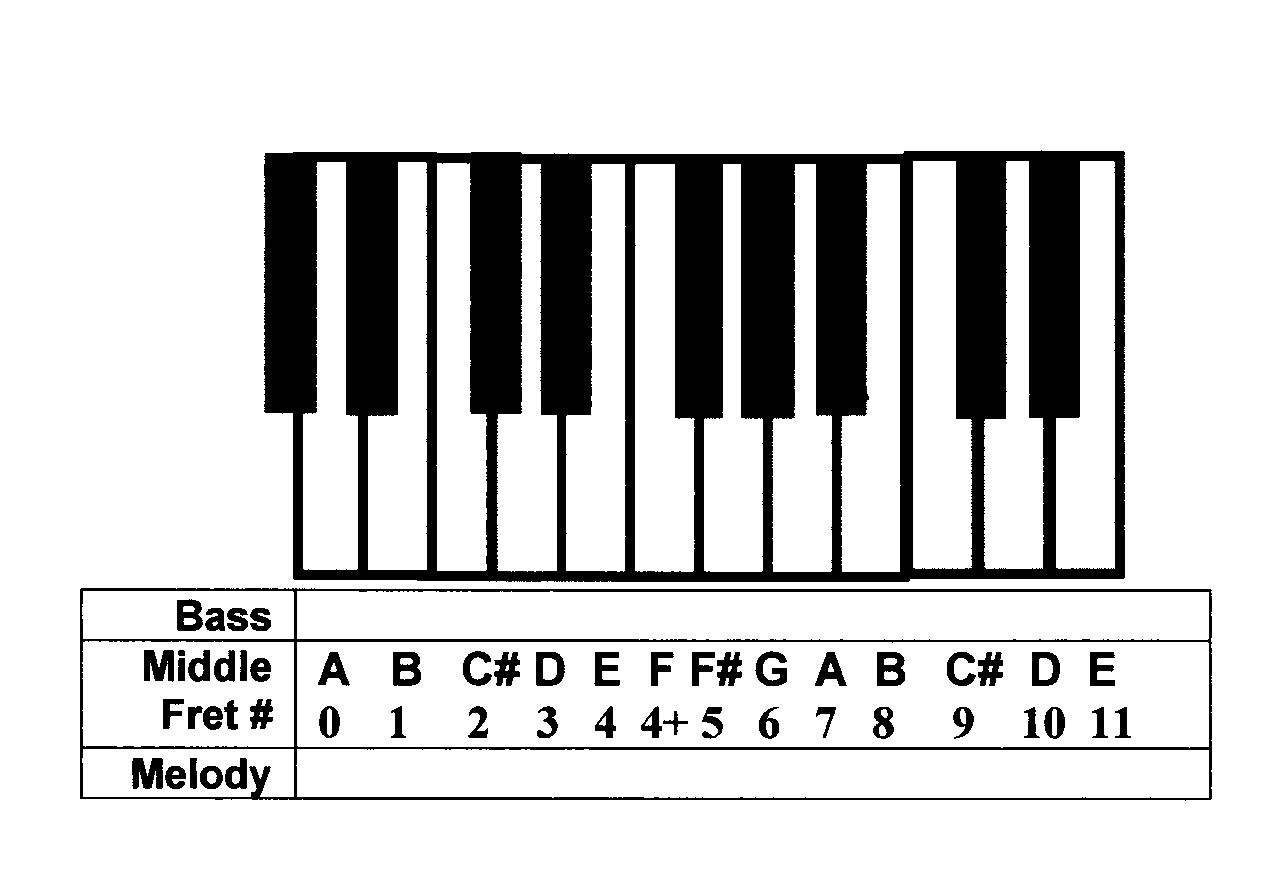
Bending the string shortens the string so that the note sounds higher. For example, on the middle string, bending the string at the 4th fret raises pitch from “E” to “F”. The bent string is shown as 4+.
To bend the string “Hold the string down, pluck it and pull it toward you and keep holding down; or pull then pluck.” (Keo Kretzner) You have to apply firm, steady pressure to the string and really pull the string towards you to increase the pitch of the note. Give it some practice!
What about the 1-1/2 fret on the melody string?
A dulcimer tuned to DAD, which has an added 1-1/2 fret, actually has the “F-natural” note of the melody string, 1-1/2 fret. But you don’t get the whiny, bluesy feeling just by playing this fret. It is bending the string which gives the blues mood. You could also play the 1st fret and bend it to the 1+ fret. But, that’s harder to do than bending the middle string.
Enjoy the tune
Here’s the tablature for Leo Kretzner’s version of “Old Man at the Mill.” It is “bluesy” — it includes the bent 4th middle string. Old-time string bands really don’t play “bluesy” versions of “Old Man at the Mill” so You-Tube recordings will probably sound different. But, I love Kretzner’s version and could play this song over and over.
To listen to Leo sing the song, take one of his “String-Bending” workshops at a festival somewhere! Leo Kretzner has also published several compact disks recordings of his music and he has a You-Tube channel showing videos of his music. Contact Leo at his WEB site to get more information on his recordings. You won’t be disappointed.
A PDF file which can be downloaded follows.
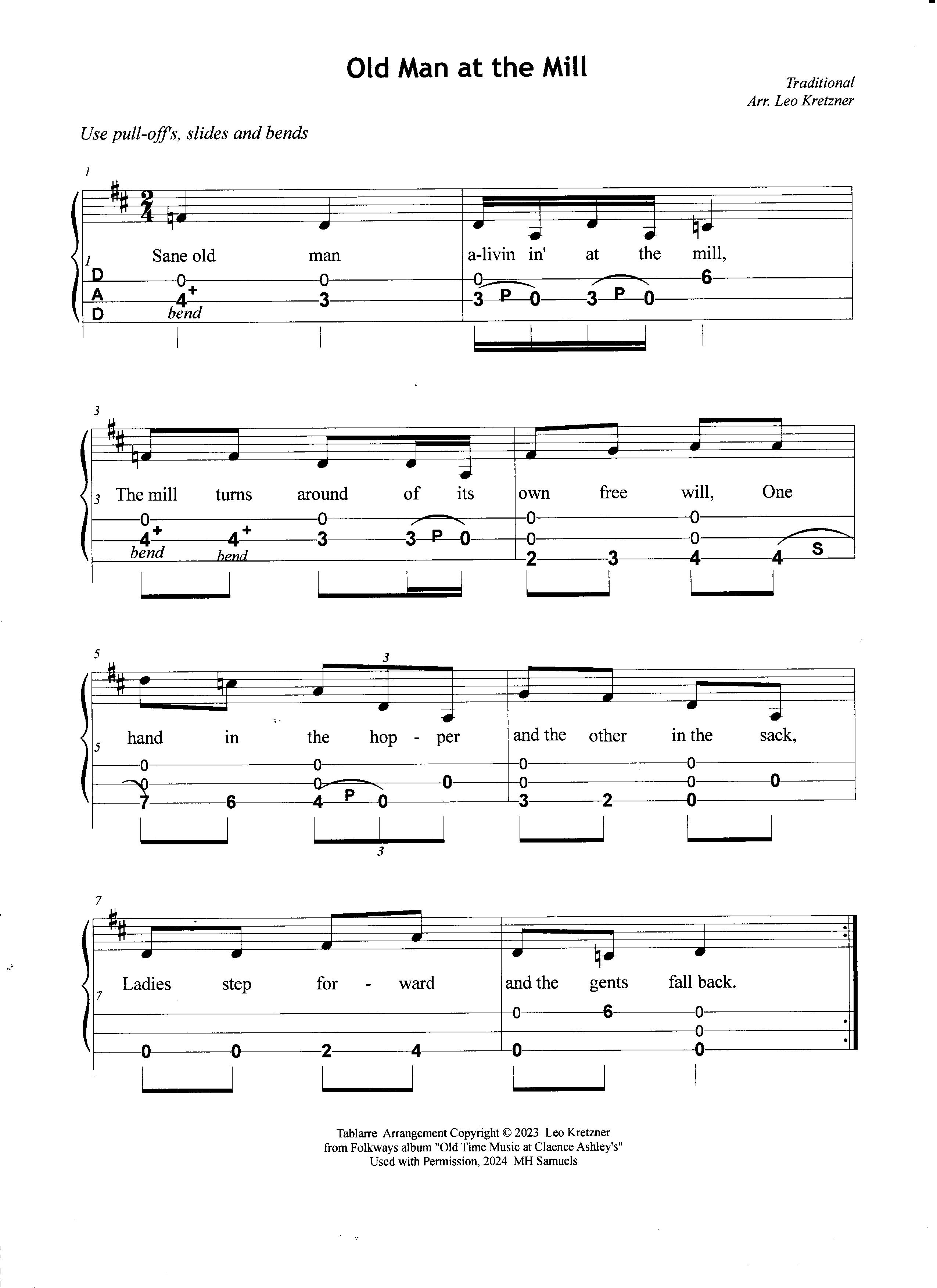
Here’s a PDF file to download and play. Used with permission.
Lyrics:
Refrain:
Same old man a-living at the mill
The mill turns around of its own free will
One hand in the hopper and the other in the sack
Ladies step forward and the gents fall back
“Down” said an owl and with its head all white
“Lonesome day and a lonesome night”
Thought I heard some pretty girl say
“Court all night and you sleep next day”
(Refrain)
Then said a raven, and she flew
“If I was a young man, I’d have two”
One for to git and the other for to sew
“I’d have a string to my bow, bow, bow”
(Refrain)
My old man’s in Kalamazoo
And he don’t wear no “yes, I do”
First to the left and then to the right
This old mill grinds day and night
(Refrain)
References:
https://www.leokretznermusic.com/
https://folkways.si.edu/search?query=clarence+ashley
 Dulcimer Jambalaya