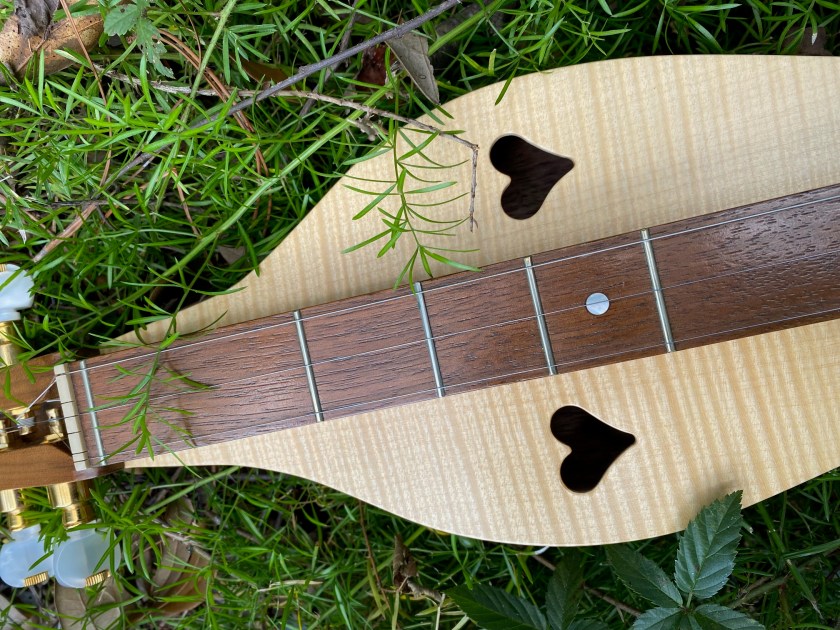
In our modern topsy-turvy world, we can all use a little joy. And dulcimer players are lucky, as music fills that purpose. I love traditional waltz tunes with their rhythmic, uplifting beat. The Kaiser-Walzer, (Emperor Waltz) Op.437, composed by Johann, Strauss, Jr, is one of these elegant, classical Viennese waltzes. The waltz was composed in 1889 by Strauss to celebrate the merger of the German and Austrian imperial dynasties. The entire Kaiser-Waltzer orchestral work takes about 10 minutes to play. That’s a little ambitious for the mountain dulcimer. As luck would have it, I found a “excerpt” of the musical composition in a delightful tablature book, “Three-String Orchestra; Classical Music Interpretations for Solo Lap Dulcimer,” by Shelley Stevens. Shelley somehow manages to simplify classical pieces for the dulcimer but still keeps them true to the source. Her arrangement of this waltz is “spot on” and Stevens gave me permission to use it in this blog post. Plus, I added an “oom-pah-pah” waltz rhythm part for a second dulcimer. Here is a painting of the young Emperor of Austria, Franz Joseph I. In addition to his friendship with the German Kaiser, this waltz celebrates 40th anniversary of the coronation of Franz Jospeh I.

About Shelley Stevens’ Dulcimer Tablature Books
Shelley Stevens is a dulcimer player, instructor and performer from Ohio. She was one of the first persons in the 2000s to write and self-publish tablature books for mountain dulcimer which made any sense. Somehow, Stevens managed to simplify tunes so that novice and intermediate players had interesting arrangements to play which were still within their skill level. However, the music was not “stripped-down” tablature. Stevens included chords and notes across all the strings making the arrangements full and rich-sounding. Her series of “A Baker’s Dozen” are now classic tab books which we still use over and over. These are small books of 13 songs each in a variety of genres — Hymns, Celtic, Christmas, Rounds and Duets, Jam Tunes, Fiddle Tunes and on and on. Plus, Sevens wrote other books, too, including an extensive tablature book of Stephen Foster tunes, a book using the 1-1/2 fret and a Baritone and Soprano Duets book. My favorite is, “Three String Orchestra,” which consists of classical music arranged for the dulcimer.
When I last checked, it appears that Stevens’ personal WEB site is no longer active. However, Folkcraft Instruments sells her books in addition to Mel Bay, Inc (music publisher). Plus, the McSpadden Dulcimer Shoppe has stock of several of her books as does Amazon. Stevens’ books are worth purchasing; let’s support dulcimer artists!

About Johann Strauss, Jr.
Johann Strauss, Jr. (1825 – 1889) is known as the “Waltz King.” He composed over 500 pieces including 150 waltzes. Most of his works were light, popular pieces such as Viennese waltzes, polkas, marches, quadrilles and operettas as opposed to full length orchestral pieces. His most well-known compositon is probaby the “Blue Danube” waltz. Johann Strauss, Jr’s two brothers and father were also musicians, but Strauss, Jr. was the best-known of the family.
Born into a musical family in Vienna, Austria, his father was a composer, bandmaster, music entreprenaneur, imperial and royal court ball music director. The father did not want his young son to follow in his footsteps — knowing the rigors of being a musician. For example, when he found his young son secretly practicing the violin, the son received a beating. After the elder Strauss abondoned the family, the boy’s mother encouraged him to continue his musical training. However, the father was forever angry about competing professionally with his son and an intense rivalry continued through their adult lifes especially during the tumultuous revolutions in the Austrian empire.

Johann, Strauss, Jr. was considered a “pop” star of his times. He composed, performed the violin and conducted orchestras. His orchestra toured the continent to Germany, Poland, England and Russia receiving great popularity. Strauss, Jr. also toured in America in 1872. He came to Boston as part of the 18-day World’s Peace Jubilee and International Music Festival. At this festival Strauss, Jr. participated in a mega concert which included sub-conductors, multiple bands and 1000 musicians. (This was at the invitation of military bandmaster, Patrick Gilmore, best know for composing “When Johnny Comes Marching Home.”)
Johann, Jr’s professional achievements grew after his father passed away. Eventually he was appointed to the covented position of KK Hofballmusikdirektor (Music Director of the Royal Court Balls), in 1863.
The Kaiser-Walzer, Op, 437
The Kaiser-Walzer, (Emperor Waltz) Op.437, was composed in 1889 by Strauss to celebrate the merger of the German and Austrian imperial dynasties, the Habsburg in Vienna and the Hohenzollern in Berlin. It was intended as a symbolic “toast of friendship” by the Emperor of Austria, Franz Joseph I, when he visited the German Emperor Wilhelm II in Berlin. It also celebrated the 40th anniversary of Franz Josef I’s coronation and to mark his friendship with Wilhelm II. The waltz was first performed in Berlin on October 21, 1889. The original piano edition cover featured an image of the Austrian Imperial Crown. Here are the two emperors meeting.

The original title by Johann Strauss, Jr. was “Hand in Hand.” However, in those days, the publisher gave a musical work its name. Strauss’ publisher, Fritz Simrock, who was in Berlin, suggested the title Kaiser-Walzer, since the title could allude to either monarch, thus satisfying all their vanities. The original cover of the piano edition bore the illustration of the Austrian Imperial Crown.
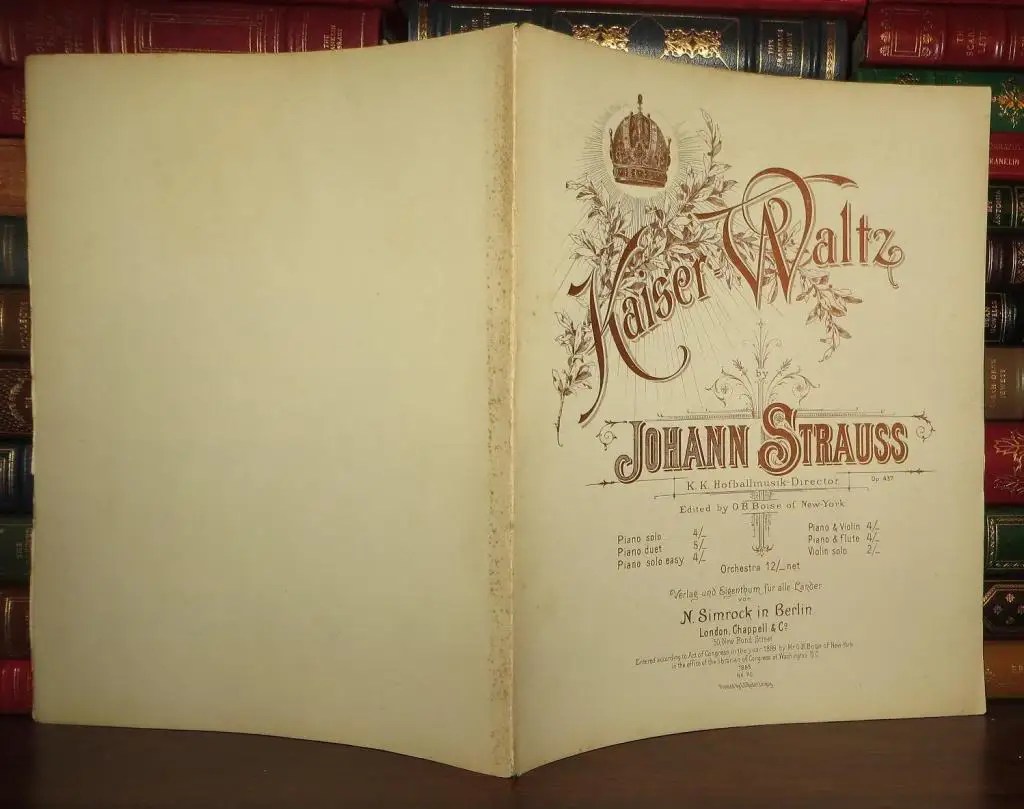
Kaiser-Walzer, Op. 437 (Emperor Waltz)\
I have always been interested in what “Op.” means when listed as part of an orchestral work’s title. And, I discovered that this refers to the sequential order of when the musical piece was written. Hence, this waltz was Strauss, Jr’s 437 composition and was composed towards the end of his career.
This piece begins with with a Prussian march complete with snare drums (most likely to appeal to the German Kaiser monach.) A lyrical cello solo leads into the main section of Viennese waltzes. In this section, Strauss, Jr. includes a variety of short, but elegant folk waltzes, Some are soaring and floating, some nostalgic and a bit mournful, some are bright and lifting. The snare drum adds some march-like flavor to the waltz. The primary theme returns at the end after a sequence of colorful dances.
The entire orchestral piece is about 10 minutes in length. Shelley Stevens arranged just a small part of the piece for the dulcimer which is at about the 5 minute mark if you are watching a YouTube video.
Arrangement of the Kaiser-Waltzer for mountain dulcimer
Waltzes are written in 3/4 time signature — three beats per measure. “Waltz” means “to roll or revolve” and it is a ballroom and folk dance. The melody seems to have a flowing rhythm while the dancers rise and fall. In the music score, usually there is one chord per measure. The first beat of the measure is pronounced with a low bass note. This gives an “omm-pah-pah” waltz beat.
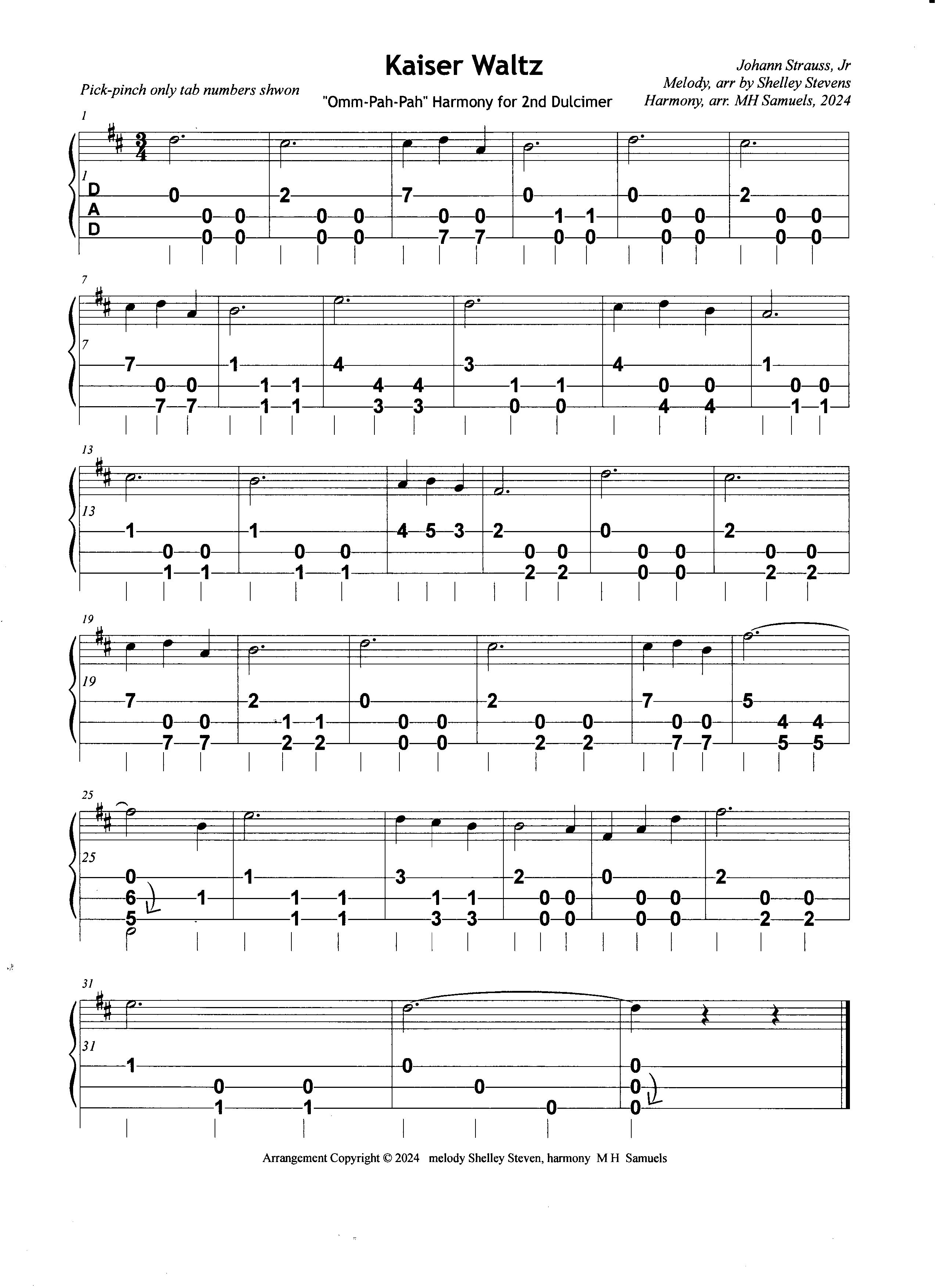
Stevens provides a very simple, but effective arrangement for the dulcimer of this short excerpt. Her interpertation includes interesting harmonies and dissonant tones — not traditional three-note chords. (I tried to use my computer software to analyze her tab and name the chords; but they were too complex to include.) I love Stevens’ work and couldn’t improve upon her arrangement. I have included her original tab from the “Three-String Orchestra” tab book with her permission. (I recommend purchasing her book as the other classical pieces in the book are great, too.)
To provide an “oom-pah-pah” musical flair to this tune, I arranged a part for a second dulcimer. I used very simple harmonizing notes to play along with the melody. To play these harmony notes, pick the bass string on the first beat and pinch (or strum) the middle and melody strings on the the next two notes in the measure. This second dulcimer part helps fill out the dulcimer arrangement and provides the waltz rhythm. Again, there really aren’t chords here, just some bass notes and harmonies.
I love this smooth, melodic waltz. The full length orchestral version is uplifting — it is difficult not to feel happy when you finish listening. When played on the dulcimer, the waltz is a also brings joy — both to the persons playing the dulcimers and the listeners. It is a gentle diversion from all the fast-strummed fiddle tunes! And, these waltzes help me stay grounded in our fast-paced world. I will add it to my list of “favorite waltzes” which includes several great waltzes written by Texas country-style fiddlers. Enjoy.
PDF files — which can be downloaded for your enjoyment — follow these image files of Shelley Stevens’ melody and my harmony.

References:
https://en.wikipedia.org/wiki/Johann_Strauss_II
https://www.britannica.com/biography/Johann-Strauss-II
 Dulcimer Jambalaya