
Most dulcimer players begin learning the mountain dulcimer in either DAD or DAA tuning and playing in the Key of D. However, many fiddle tunes, gospel tunes and hymns are written and played in other keys, especially the Key of G. I decided to re-visit playing the dulcimer in the Key of G using a simple fiddle tune, “Groundhog.” Since “Groundhog Day” is on February 2, this is a fitting time to learn and and play this song. It is a fun and easy, short tune with many silly verses. I tuned my dulcimer to DGD to play in the Key of G. You can also play this tune on a baritone dulcimer tuned to GDG. However, things quickly get confusing when discussing these two seemingly contradictory tunings, so this post discusses only the DGD tuning.

Here’s the garden where our groundhog found his lunch. (Read on.)
About Groundhog Day and Our Resident Groundhog
This year, Groundhog Day is February 2, 2025, which is a Sunday. Every year on this day, the people of Punxsutawney, Pennsylvania, gather in Gobbler’s Knob to watch a groundhog, “Phil”, emerge from his burrow and notice his shadow. Folklore goes that if the groundhog does see his shadow, then we will have six more weeks of bad weather and groundhog will return to his hole. If he does not see his shadow, he will stay above ground and an early spring will come! I’m hoping for an early spring, so let’s hope for a cloudy day.
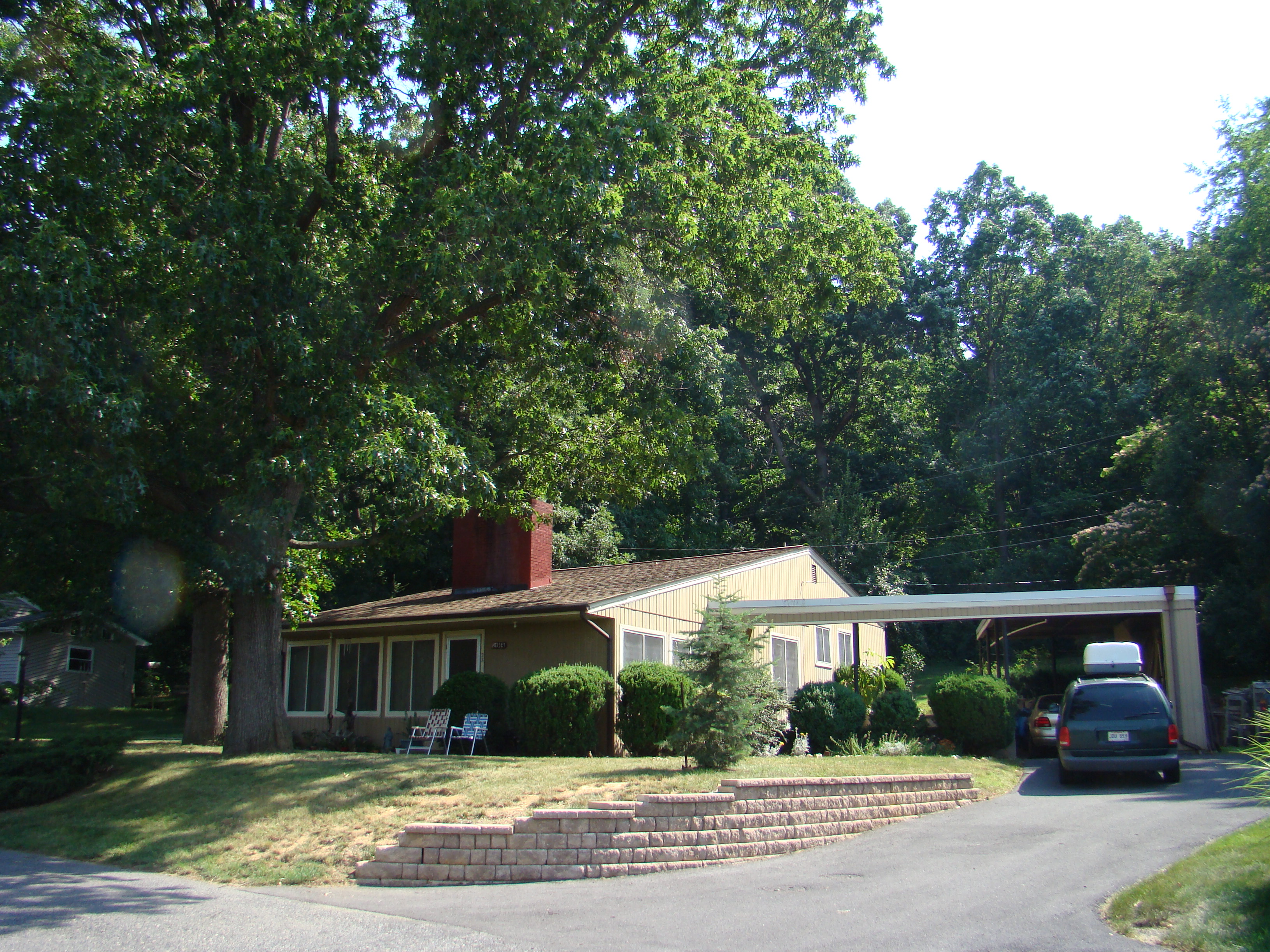
I have my own groundhog story. Whenever I think of groundhogs, I think of the one which surprised me during a visit to my parent’s home in rural western Virginia. Although they had lived in that house for over 50 years, I never knew that groundhogs lived there, too. They had chipmunks, squirrels and skunks; but groundhogs were quite unusual. My father had a large wood pile next to his house (used for heating his Franklin stove in the winter) and also a very large compost pile at the edge of the garden at the other end of the lot. A groundhog, or “woodchuck”, had taken up residence in the wood pile. He would run back and forth to the compost pile for “lunch.” He was a shy thing; but several times we caught sight of him as he was running up the driveway. He certainly looked large and healthy — much larger than any squirrel; apparently the compost pile provided a good diet. I was always curious about how he got into my father’s wood pile as that was the only groundhog we saw in all those years. You can just make out the woodpile in the far right of this photo.
Groundhogs are rodents, a member of the family Sciuridae, belonging to the group of large ground squirrels known as marmots. I don’t know if this rodent did any damage to the yard or garden. He just seemed to exist there peacefully. And, we had no interest in catching him and cooking him as the lyrics to “Groundhog” suggest. Did this groundhog see his shadow on Groundhog Day? Who knows; but apparently the folklore and groundhogs are correct more often than they are wrong in predicting the future weather of spring.
Playing in the Key of G in DGD Tuning
There are several methods to play in the Key of G on a dulcimer. All have advantages and disadvantages. For example, with a standard dulcimer, retuning strings to DGD can seem like a daunting task. Plus, you have to learn new chords and frets to play a song. And, there are fewer chord choices in DGD tuning which is a distinct disadvantage.
However, there are advantages to playing in DGD. It is easy to play songs (after you conquer the tuning issue). The melody to many gospel, folk and fiddle tunes can often be played entirely on the first string, the melody string. No need to cross over to the middle string. The melody shines out and is not “muddled” by the drones of the other strings. Several simple chords in this tuning which allow you to harmonize as you sing and add a second “voice.” It is much easier to sing many songs in the Key of G. Have you ever been able to hit all the notes to sing “Silent Night” in DAD tuning? (I have included links to past blog posts with tablature for Silent Night, and Itsy Bitsy Spider in DGD at the end of this post.)
Here we go. Here are several tips to remember when playing in DGD:
1. It is actually very easy to retune to get to DGD. With a dulcimer tuned to DAD — leave the melody and bass strings alone. Only the middle string needs to be re-tuned. And, retune only one note. To lower the string one note, you usually only have to turn the tuning peg for about half a turn, Just a small amount.

2. Use a tuner to check the string pitch. Because this tuning and combination of pitches is not as familiar to our ears, it is harder to tell how to get the dulcimer “in pitch.” However, it is very easy to tell if the dulcimer is “out of pitch.” The song won’t sound right if you are tuned incorrectly.
I use a little inexpensive “Snark” tuner which I found on Amazon. You don’t need an expensive tuner. Cheap ones work and this one costs about $20. (I have several of these tuners.) I don’t use my cell phone to tune my dulcimer since it picks up ambient tones in the room as well as the dulcimer strings. Doesn’t work for me.

3. The scale in DGD tuning goes from the 3rd to 10th frets. “Home base” or the key note of the scale is now the third fret. (In DAD tuning the scale went from the 0 to 7th frets.) A nice perk to this scale is that often all the melody notes are on the melody (first) string. The notes “sound out” clearly and don’t cross to the middle string.
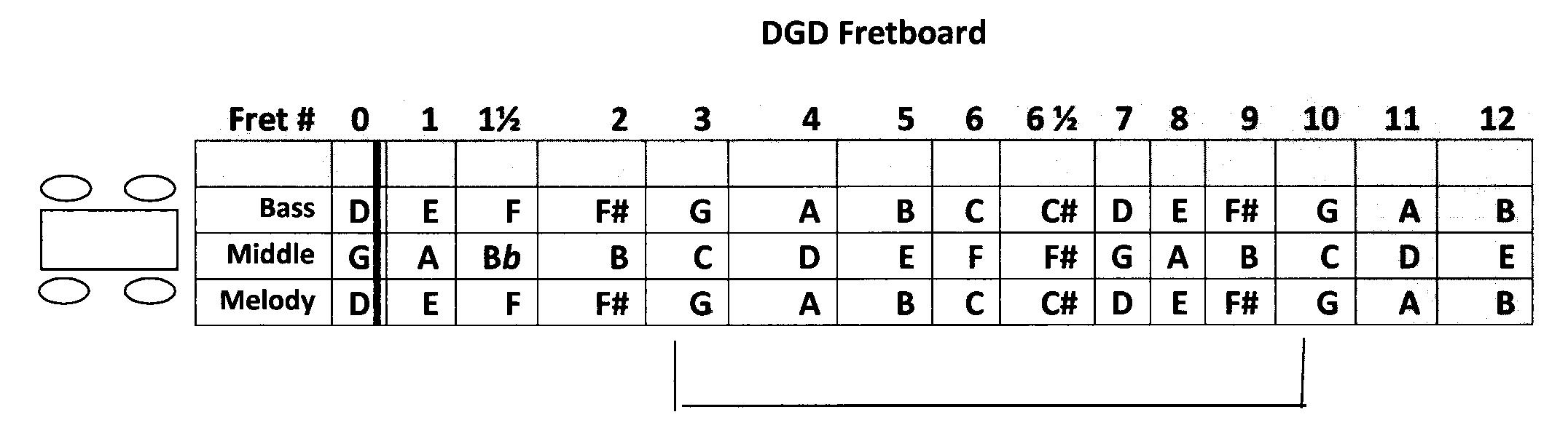
4. The scale uses the “6” fret rather than the “6-1/2” fret.
5. Since we’re in the Key of G, the three main chords are now “G”, “C” and “D”. These are the I, IV and V chords. Learn several simple fingerings for these chords.

6. DGD is also called a 1-4-8 tuning because it uses the 1 scale step (do), 4 scale step (fa), and next octave or 8 scale step (do). [do=1, re=2, me=3, fa=4, sol=5, la=6, ti=7, do=8]
6. To play in the Key of G, and especially learn the “new” chords, it is helpful just to jump into this tuning and mentally block out DAD and the “D”, “G”, and “A” chords. It is comparable to learning a new language. Start with simple songs — such as “Groundhog” — and keep going.
7. This tuning is sometimes called “Reverse Ionian.” You will see this term used in many older dulcimer tablature books. I am not sure how this term evolved. However, now the “G” string — which is the key note (or lowest note) of the “G” scale — is on the middle string rather than the bass string. Hence, it is “reversed.” Just me guessing here.

About the tune, “Groundhog”
There are several songs entitled, “Groundhog,” or, “Old Groundhog,” which have been recorded over the years. I used a traditional Appalachian tune version which I found in “The Traditional Tune Archive.” I have also heard this particular song played by several dulcimer players.
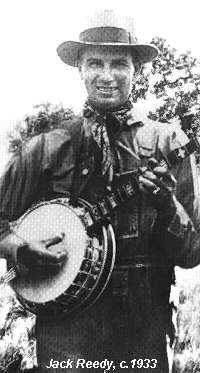
This tune is a well-known folk song and it hails from the Southern Appalachian mountains. The Library of Congress recorded fourteen versions of the melody — both sung and played — before 1940. A banjo player, Jack Reedy, along with his band — Jack Reedy and His Walker Mountain String Band — recorded “Groundhog” for Brunswick Records in February, 1928, at Ashland, Kentucky. Jack Reedy was from Smyth County in southwest Virginia. Here’s what the “The Traditional Tune Archive” says about Jack Reedy: “His finger-picked banjo style predated the popular bluegrass style by fifteen years, and he kept playing longer than many early country musicians, trying to sustain himself as a professional musician. Like many, he needed a day job to make ends meet, and he worked off and on in furniture factories. Reedy toured vaudeville circuits in the 1930’s, and did radio work in Bristol, Tenn., and Bluefield, W.Va., and died of a heart attack in the latter town.”
Here is Jack Reedy in about 1933. Reedy recorded Groundhog in 1928, hence the song is in the public domain. (Songs written in 1928 entered the public domain in January 2024.)
I used the song from “The Traditional Tune Archive” as a starting point (although their version actually came from Frank Proffitt) and came up with my own simplified arrangement and two variations. As with many fiddle tunes, the tune includes extra notes which a fiddler adds to fill in the basic tune. In the spirit of keeping things easy, I started start with a very basic version.
I also have included the original lyrics at the end of this post since the lyrics tell the “story.”
The song is very short — the entire song is only eight measures. For my dulcimer tablature, I have included three variations:
- “A”. Basic Tune in DGD,
- “B”. Tune in DGD with harmony notes included,
- “C”. Tune in DGD with “embellishments” — hammer-on’s, pull-off’s and slides.
Mix and match; all three variations are the same song. They can be played together. Add in the lyrics at the bottom of this post to get the “feel” of a groundhog adventure.
For a duet, I included a baritone dulcimer (tuned to GDG – Key of G) tune arrangement with three variations at the end of this post.
Enjoy the song about a groundhog. The lyrics give the impression that the groundog gave quite a chase and provided a tasty meal. No thanks!
This is an easy tune to learn on the dulcimer in DGD tuning. Let’s enjoy a new way to play the dulcimer in 2025.
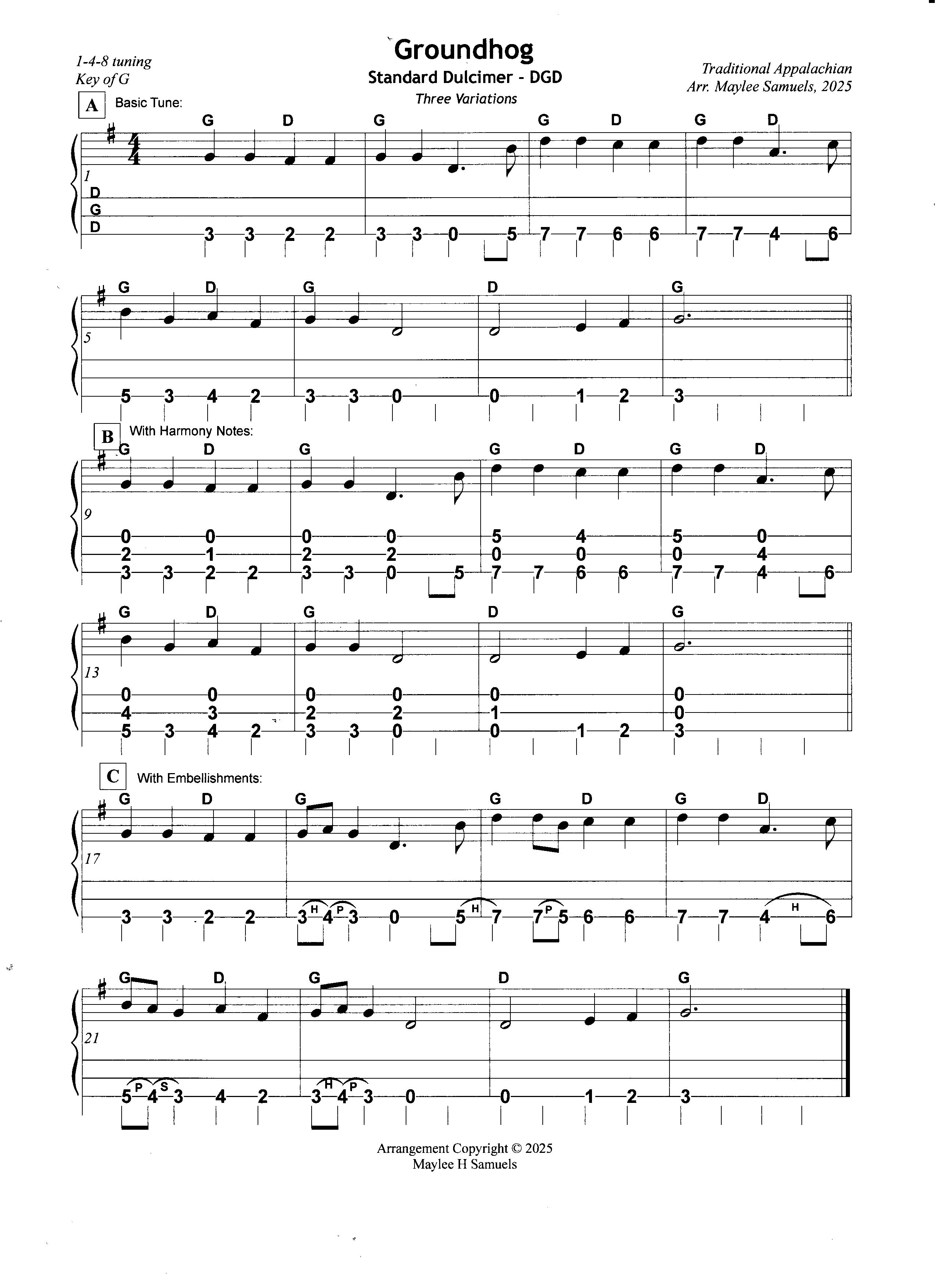
Here is a PDF file of “Groundhog” in DGD to download and play:
For baritone and ginger dulcimers tuned to GDG, here is a basic arrangement and two variations. Look carefully, the melody notes are the same as the standard dulcimer with the DGD arrangements. The two dulcimers (DGD and GDG) can be played together. On the second variation “B, I placed the tab numbers on the bass and middle strings. The third version “C” includes filler notes and embellishments — hammer-on’s and pull-off’s:

A PDF file of the baritone and ginger dulcimer tab tuned to GDG. Please download, print and enjoy playing:
And the lyrics:
Shoulder up your guns and call out your dog,
Shoulder up your guns and whistle up your dogs;
Goin’ up the holler for to catch a groundhog,
Ground-Hog.
Yonder come Sally with a ten-foot pole,
Run here Sally with a ten-foot pole;
Get this groundhog out of his hole,
Ground-Hog.
Come here boys, come here quick,
Come here boys, come here quick;
This old groundhog thinks he’s sick
Ground-Hog.
Yonder come Molly with a smile and a grin,
Yonder come Molly with a smile and a grin;
Groundhog gravy all over her chin,
Ground-Hog.
Yonder comes Jane, walkin’ on a cane,
Yonder comes Betty, walkin’ on a cane;
Before she’d eat those ground hog brains,
Ground-Hog.
Come here boys, come here quick,
Come here boys, come here quick;
This old groundhog plenty slick,
Ground-Hog.
There’s old Molly with a ten-foot pole,
Here comes Molly with a ten-foot pole;
We’ll get this ground hog out of his hole,
Ground-Hog.
Reference:
tunearch.org/wiki/Annotation:Groundhog
Link to Silent NIght in DGD Tuning
Link to the Itsy, Bitsy Spider in DGD Tuning and song in 4/4 time
 Dulcimer Jambalaya