
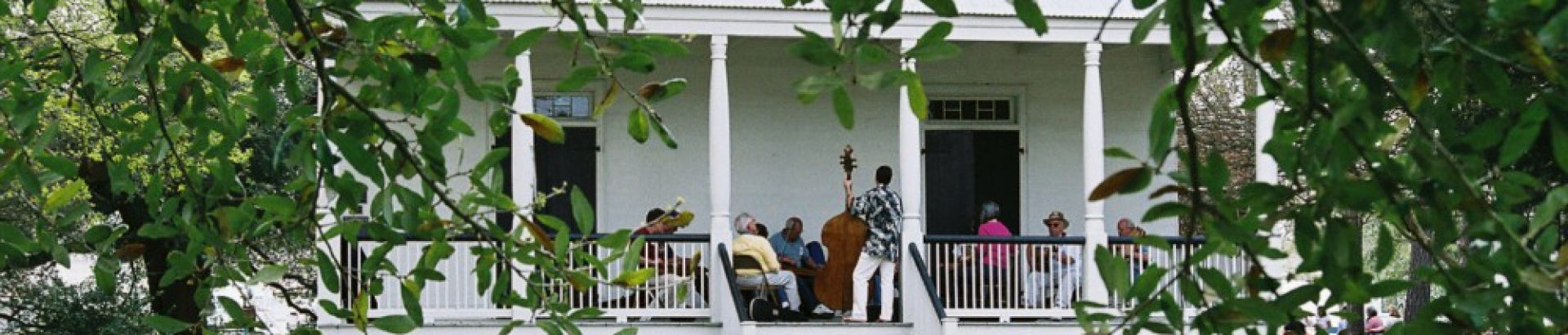

In honor of St. Patrick’s Day, I arranged an Irish Jig, “The Blackthorn Stick,” for the mountain dulcimer. This tune is typically played in the Key of G so I found a way to easily play the jig on a standard dulcimer in DGD tuning. Plus, in the interest of promoting baritone dulcimers, I tabbed out a version in the GDG tuning. This tune appears to be a well-known Irish jig played in Irish jam sessions. I learned to play the song on my penny whistle by listening to a practice MIDI compact disk. The jig is easy to play. However, Irish jigs are written in 6/8 time and are played at a fast clip. Forget the chords and harmony notes on the dulcimer for Irish jigs. Focus on the strum and playing the melody of the tune to get it up to speed. Enjoy!

About the “Blackthorn Stick”
A “Blackthorn Stick” is a walking stick made from the blackthorn tree (Prunus spinosa). This is a small, sturdy deciduous and wild tree found in Ireland. The wood from the blackthorn tree is a dense and sturdy. The tree has long, sharp and spiny thorns, so each walking stick is unique, often sanded down and polished. Blackthorn sticks are sought out for their sophistication, durability, weight, and natural curves. These sticks symbolize Irish heritage and tradition. The tree is frequenlty associated with Celtic folklore related to protection, misfortune and beauty. It’s also linked to fairies, witches, and the Triple Goddess.

Practice Penny Whistle MIDI Compact Disk
Years ago, I acquired a practice compact disk and book containing with 13 Irish tunes. (There was no dulcimer tablature in the accompanying book — it was for other instruments such as the penny whistle.) The compact disk was a MIDI recording, with synthesizer instruments, of each of the tunes. Each tune recording included a back-up band made up of an assortment of MIDI instrument sounds as well as the melody. Each song was played at a very slow, slow, medium and fast tempo. With a MIDI recording, a person can speed up the tempo without changing the pitch. Originally, I purchased the compact disk to play along with my penny whistle. Over the years, I decided to try out playing some of the tunes on my dulcimer and wrote out tablature arrangements for these tunes.
It was so much fun to play along with the recordings and the backup “band.” Plus, playing with the tape — like a jam group of musicians — meant that I had to keep up the pace. It made for great practice discipline. I just loved the music on the compact disk and didn’t mind listening to the tape without playing along! I learned 13 new Irish tunes. The “Blackthorn Stick” is one of my favorites on the compact disk.
Irish Jigs and Strumming – Method used by Grant Olson
The strumming pattern becomes very important when playing Irish jigs. Jigs are written in 6/8 time signature. This means that usually there are two groups of three beats each in a measure. Since the tempo is very fast, the right hand strum must be one which can accommodate a rapid strum.

Although there are many ways to strum in 6/8 signature, I like the method used by dulcimer player, Grant Olson. I took one of his workshops during the last QuaranTUNE fest and learned alot during his Irish Jig workshop. Olson simply strums back and forth, one strum per beat. He doesn’t skip strums or alternate the strum to accommodate changes in note value. Keep strumming, even on the “held” notes.
I use the analogy of a “windshield wiper” motion. Strum back and forth — except in a shorter range of motion. Don’t miss a beat.
Another interesting “tip” from Olson, is that he begins each measure with an inward strum when playing Irish jigs in 6/8 time. This contradicts now many of us strum — going outward on the first downbeat. However, I find that it is much easier to strum stronger, and thus emphasize the first beat of the measure, with an inward strum. Great tip, Grant! However, Olson also mentions that you can go the other way, too, or out-in-out, if that is what you are familiar with doing.
This pattern of strumming is so simple, but deceptively hard for many folks to accomplish. It takes coordination and practice. However, to pick up the tempo, this is the most efficient method of hand motion. Simply strumming only with an outward motion won’t allow you to increase the pace. So, practice, practice, practice.
Here is an example of Grant Olson playing “Swallowtail Jig” using the 6/8 strumming pattern.
2019 National Mountain Dulcimer Champion
Grant Olson won the National Mountain Dulcimer Championship in 2019 when he was 17 years old using a cardboard dulcimer! Go Grant. He is a talented musician and has accomplished so much already, especially fingerpicking and playing a chromatic dulcimer. He has a web page where he sells stick dulcimers which he builds, an newly published C.D. and other dulcimers such as a plywood one — at an affordable price. Grant also gives zoom dulcimer lessons. And he sells dulcimer strings with a ball end. Check out the web page at:
https://www.grantolsondulcimer.com/
Playing the Tune
Olson commented, in the Irish Jig QuaranTUNE class, that Irish jigs often have quite a stretch in terms of the range of melody notes. That statement is true for the Irish song, “The Blackthorn Stick.” The melody goes from the 11th fret to the 1st fret in just 1-1/2 measures.
It is easy to play all these extended notes on the penny whistle, more challenging on a dulcimer. Hence, fingering the left hand can become important. There are many ways to place the frets/notes with your left hand. Use whatever method works for you to reach the notes. This may mean using your thumb frequently to reach the especially high notes and sliding your thumb up and down. The main point to remember is that it doesn’t make sense to add alot of harmony notes on the middle and bass strings. Focus on playing the melody notes as well as the strum.
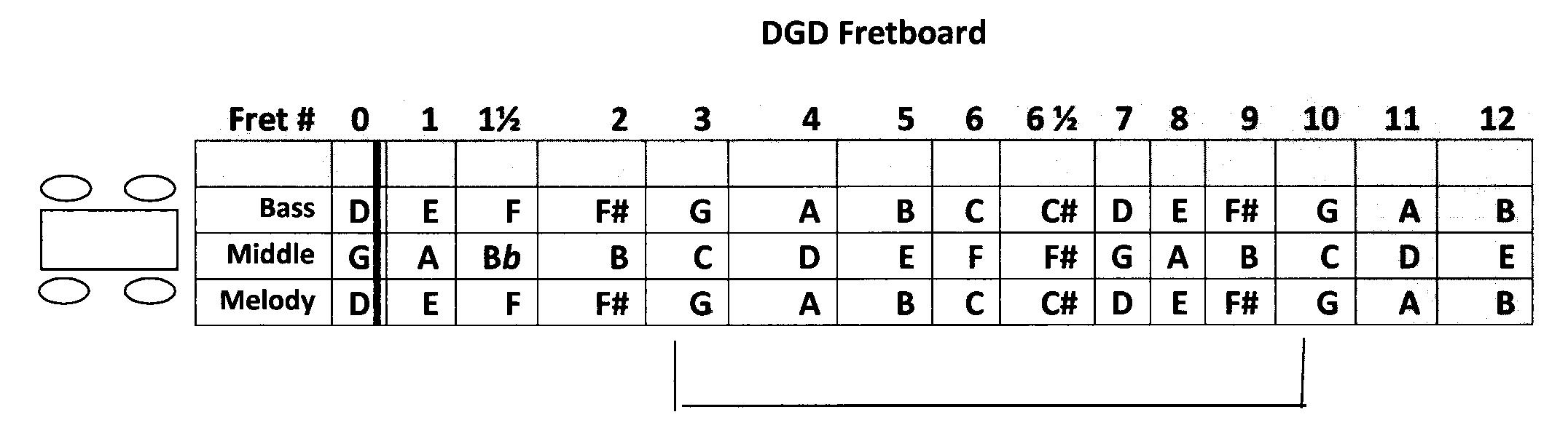
Playing in the Key of G – DGD on Standard Dulcimer
This tune, “The Blackthorn Stick,” is typically played in the Key of G. To play along with the practice tape, I needed to adjust my dulcimer’s tuning to the key of G. Playing in the DGD tuning on a standard dulcimer is so simple to achieve. From a DAD tuning, just change the middle string going down one pitch to the “G” note. (I gave some pointers for how to play in the DGD tuning in my February blog post.)
Playing in the Key of G – Baritone and Ginger Dulcimers tuned to DGD
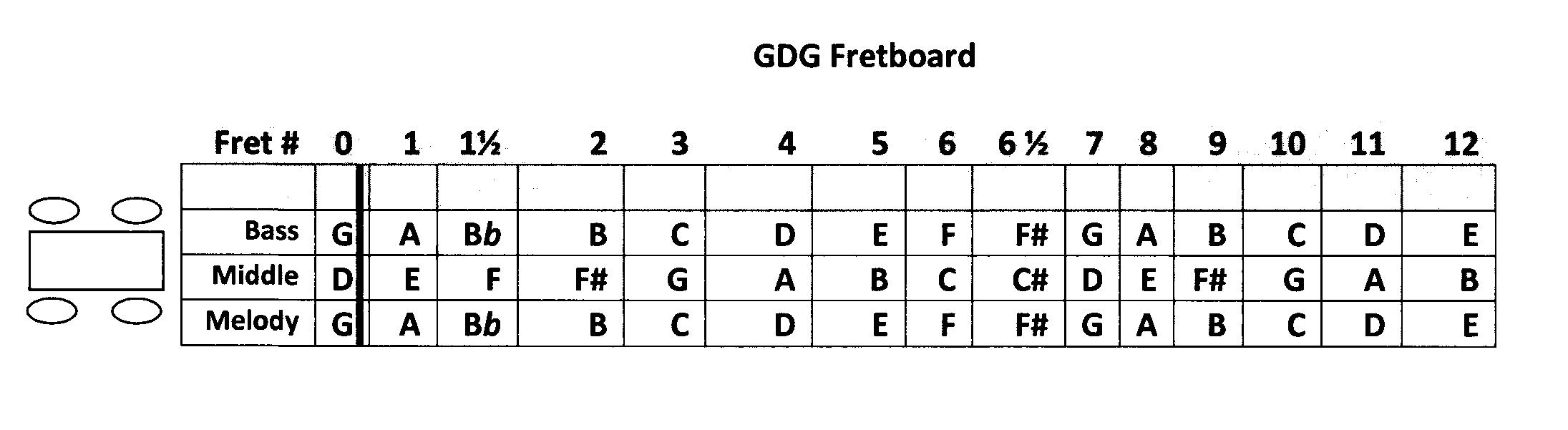
A second way to play in the Key if G on a mountain dulcimer is to use a baritone dulcimer tuned to GDG. You can also play “The Blackthorn Stick” on a ginger dulcimer tuned to GDG.
The disadvantage of a baritone dulcimer is that the sound may become “muddy” with rapid strumming, as the wound bass and middle strings have a deep, mellow pitch. It’s a trade off!
However, there are many great songs which can be played on a baritone dulcimer. Plus, I have included chords and fingerings on my tab for “The Blackthorn Stick” so the baritone dulcimer can play backup chords.
1-5-8 Tunings
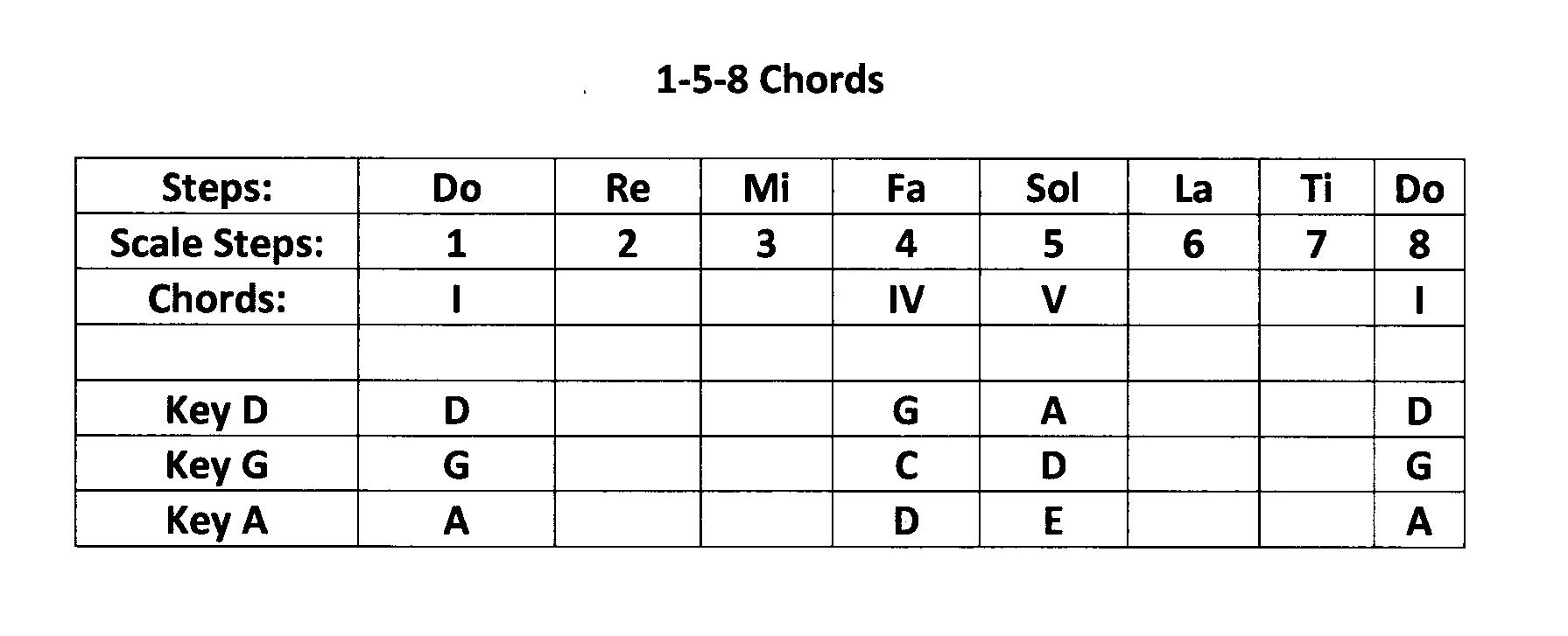
Playing a baritone or ginger dulcimer tuned to GDG means that the same tablature frets are used as the DAD tuning. Both are are 1-5-8 tunings. This means that the first scale pitch (“Do”) is the bass string, the fifth scale pitch (“Fa”) is the middle string and the eight/first scale pitch (“Do”) is the melody string. You don’t have to learn new chord patterns; just new names. The fret numbers of the tunes and chord structures remain the same in both DAD and GDG tunings.
Restringing a Dulcimer
In any event, don’t attempt to retune a standard dulcimer to a low GDG tuning by lowering the pitch of the strings. The strings will become too floppy to play and will probably buzz. Baritone dulcimers usually have thicker, wound strings on the bass and middle strings and higher string gauges. These wound strings often won’t easily fit the bridge and nut of a standard dulcimer. So, to change a standard dulcimer to a baritone one, consult a skilled dulcimer player, luthier or instrument repair technician.
I retuned my Bill Taylor dulcimer, with a 28″ vibrating length, to a baritone one. It is sturdy with a large body. With help, I eventually figured out what string gauges to use. It has a beautiful tone.

Totally by coincidence, I discovered that Grant Olson sells dulcimer strings (with ball ends) on his WEB site. Plus, he has a table to figure out which gauges you need based on vibrating length. Good to know. Contact Grant at his WEB page for details.
Dulcimer Arrangements for both DGD and GDG dulcimers
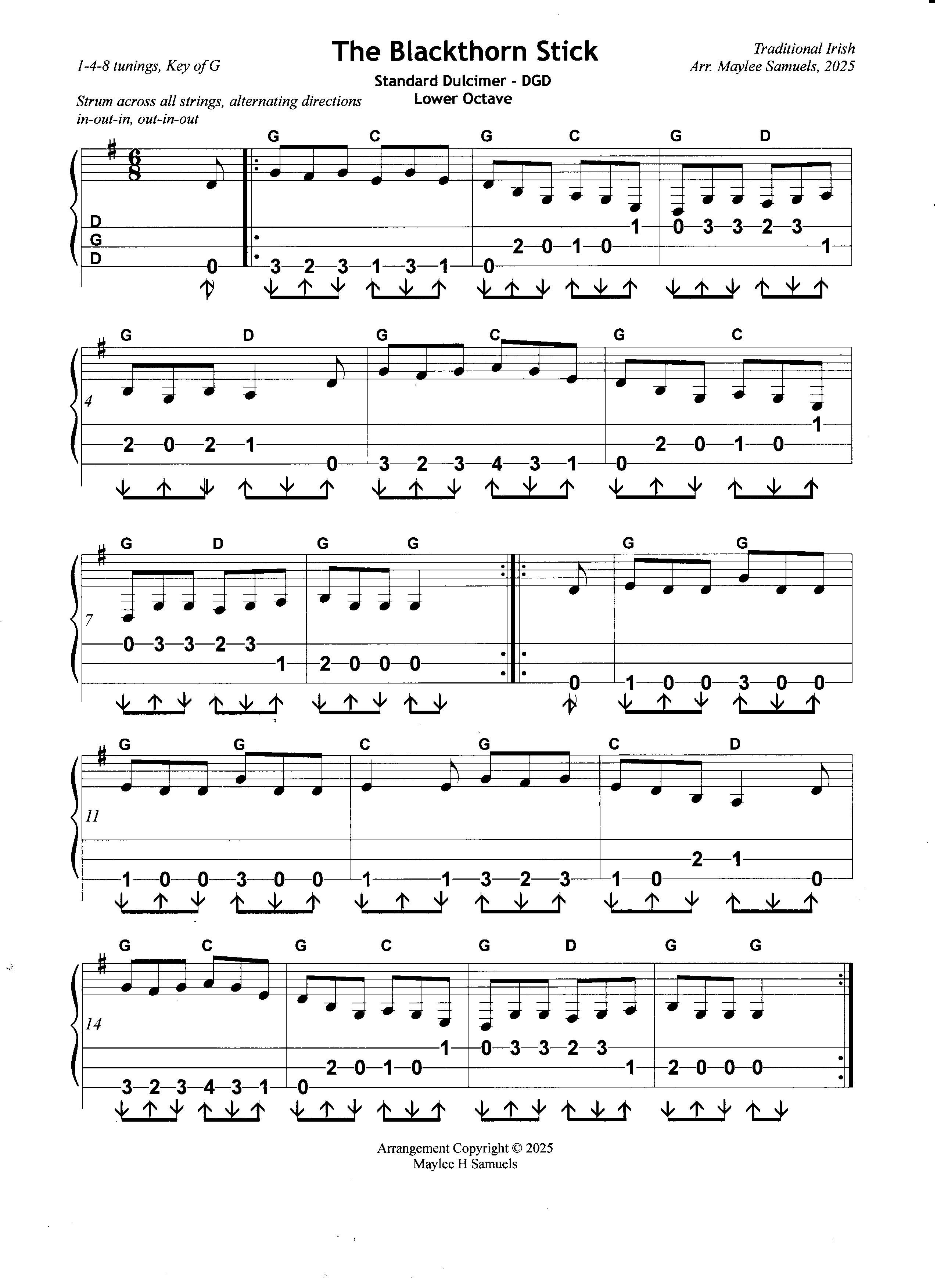
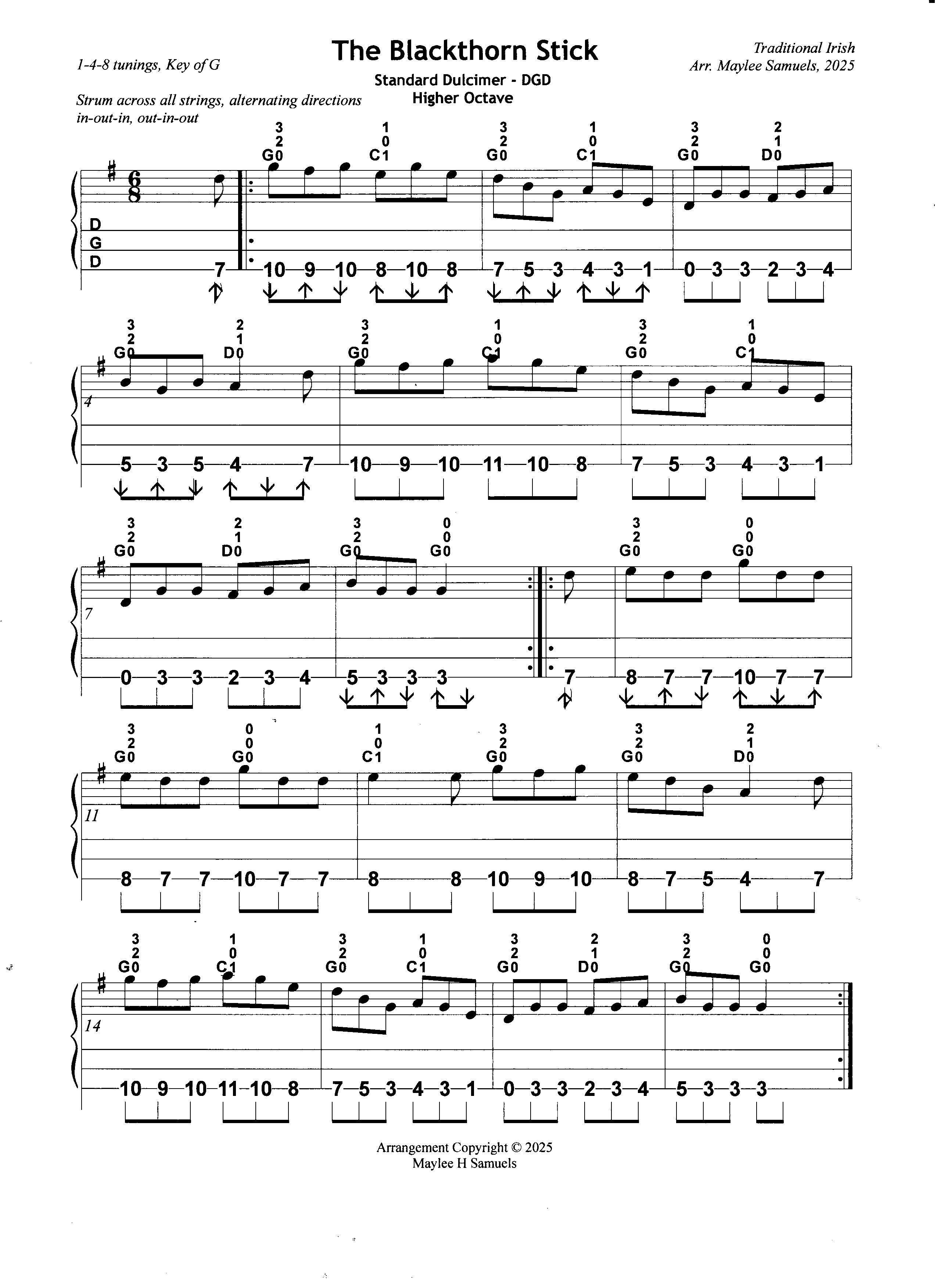
I have arranged this tune for a standard dulcimer in DGD tuning; giving both low and high variations. While many songs fit entirely on the melody string in DGD tuning, this one means that you really have to go up the dulcimer fretboard to play the notes. Playing the lower octave means reaching to the middle string to play the melody notes.
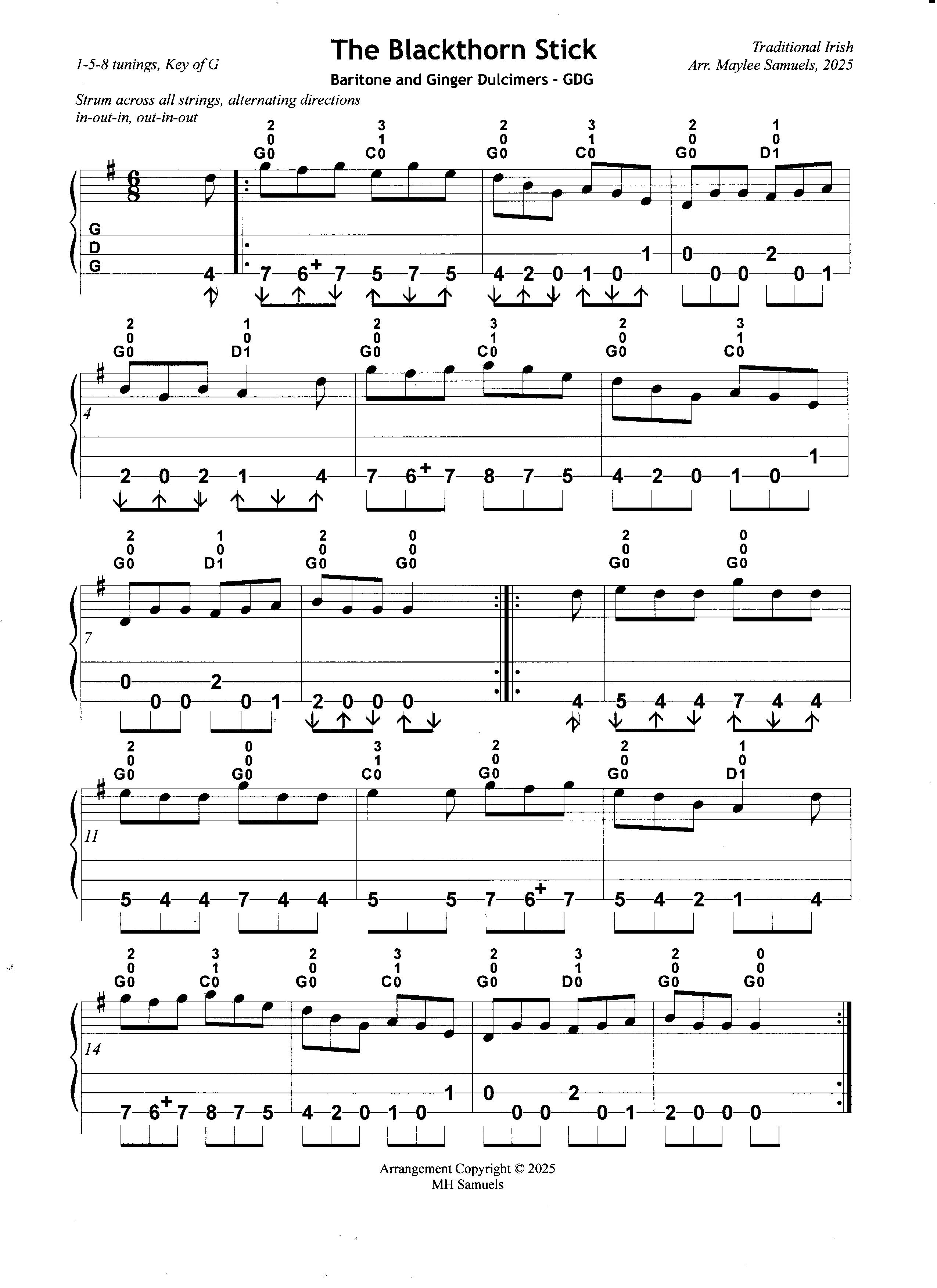
I also arranged this song for a GDG baritone (and ginger) dulcimer. The chord patterns for the G – C- D chords are the same as the D – G – A chords since both are 1-5-8 tunings. Just learn new chord names. So simple! If you want to play this song in the Key of D and a DAD tuning; just use this arrangement including the same chord fingerings.
This is a relatively easy Irish tune to play. Go slow at first, and work up speed. It takes practice to learn the in-and-out strum, but there is a definite advantage to playing jigs in this manner.
Enjoy this tune for St. Patrick’s Day!
Here are the images for the DGD tablature arrangement of “The Blackthorn Stick.” The PDF files which you can download follow and play follow. Please share with friends; just don’t publish or upload to a public site.
And, here is the image for the GDG tablature of baritone and ginger dulcimers.
 Dulcimer Jambalaya