


I love lullabies. And the Irish tune, “The Garton Mother’s Lullaby,” may be one of the most beautiful lullabies which I have ever heard. It is soothing, lifting, rocking and rhythmic. I found it in a book of Irish tunes in March when I was having an Irish “jam” session by myself late one night. Where have I been? I’m so sorry that I have missed out on playing this tune. The song dates to 1904 in Garton, Ireland. The lyrics include several references to Irish mystical figures, such as fairies, which make this an enchanting song. The song is a little high for my soprano voice to sing in DAD tuning and the Key of D. So, I tabbed it out to play in the Key of C on my dulcimer. Oh my, and this opens pandora’s box of how to change keys on the dulcimer. It is one of the most difficult concepts for dulcimer players to grasp. So, here is my non-technical explanation on this subject followed by tablature for “The Garton Mother’s Lullaby” in the keys of D, C and A. And, if you are not interested in the music theory for a non-musical person, then just skip to the end of the post. I have included both the melody and a “rocking” harmony part for a second dulcimer. I could play this tune all night long.

What makes the dulcimer fretboard unique and how can a person change keys on the dulcimer?
New dulcimer players often ask, “Can I play the dulcimer in the Key of C, if my dulcimer is tuned to DAD?” And, “Why does a person play the same tablature numbers in both the Keys of D and C?” These are a tough questions to explain. However, understanding how the dulcimer fretboard is arranged — including advantages and limits — helps a person appreciate what he/she is playing. It makes it easier to understand tablature and various tunings found in many dulcimer books.
Here are some of my “nice to know” explanations of dulcimer tunings in a very. non-technical matter:
1. Dulcimers are often tuned to the Key of D in either a DAD or DAA tuning for several reasons. For example, many fiddle tunes are played in the Key of D and old-time dulcimer players often emulated these fiddle tunes.
2. The manner in which dulcimers are tuned has alot to do with string gauges. Common string gauges work well in the DAD tuning considering the length of the dulcimer fretboard. However, there are limits to string gauges. For example, shorter fretboards use lighter and more flimsy strings. You can’t loosen the strings too much to play in another key or the strings may become floppy and buzz; the tone is probably not as appealing. And, you can’t tighten the strings too much to raise the pitch to a higher key; the strings may break.
3. The dulcimer’s frets make up a 7-step scale on the fretboard called a “diatonic” scale. Compared to a keyboard, the “black keys” are missing. Only the 7 “white keys” make up an octave on the dulcimer fretboard. This “diatonic” scale results in uneven spacing of frets. (Compare this to a guitar with evenly spaced frets and a 12-step chromatic scale.) The uneven fret spacing limits what tunes you can play or, at least how you can play the tunes, on the dulcimer. (Diatonic = “any stepwise arrangement of the seven ‘natural’ pitches (scale degrees) forming an octave.”)
4. In fact, there are only two places where you can play most common and familiar tunes on the dulcimer fretboard — 0 to 7th frets and the 3rd to 10th frets. If you try to play a tune, for example, “Twinkle, Twinkle Little Star”, beginning at the 1st fret, it sounds off pitch. Well, this is a “minor” scale and gives a very melancholic or haunting tone to the song. Not what we are used to hearing in “Twinkle, Twinkle Little Star” and many other familiar tunes.
5. The scale (and the musical key) is named for the first note of the scale. For example, a 7-step diatonic “D” scale begins with the “D” note.
3. Dulcimer’s strings are tuned to DAD for a reason. It is not an accident. The 1st scale tone — “D” note — and 5th scale tone — “A” note — have a special relationship. These string pitches harmonize and are pleasing to our “Western” ears. Just strum across the strings when your dulcimer is tuned to DAD. It sounds pleasing. Hey, we’re playing the dulcimer simply by strumming the strings.
4. Since the string pitches in DAD tuning are the 1st, 5th and 8th (one octave higher) notes of the “D” scale, this tuning is referred to a 1-5-8 tuning. This is an important point to remember. It is all about the relationship of the strings to each other. It impacts everything else regarding how you play tunes on the dulcimer and how you change to different keys.

5. Can you play in the Key of C on the dulcimer? Yes, you can. However, not by starting higher on the fretboard. You must lower all the strings one pitch to change from the Key of D to the Key of C. You are going from the DAD tuning to the CGC tuning. The “0” fret on the melody and bass strings are now the “C” note. The middle string now starts with the “G” note. The CGC tuning maintains the same 1-5-8 tuning relationship as the DAD tuning. (NOTE: A person should be able to loosen the strings one pitch without problems with the strings.)
6. Here’s the concept where folks become baffled. The relationship between the strings in DAD tuning is identical to the strings in CGC tuning. They are both 1-5-8 tunings. These two tunings and all the related tablature and chords are like “cookie cutter” copies of each other. They are like “identical twins.” Because the 1-5-8 string relationship is maintained in both DAD and CGC, every fret that you play for a song in the DAD tuning is the same as in the CGC tuning. You have just moved all the pitches down a bit. The tablature remains the same.
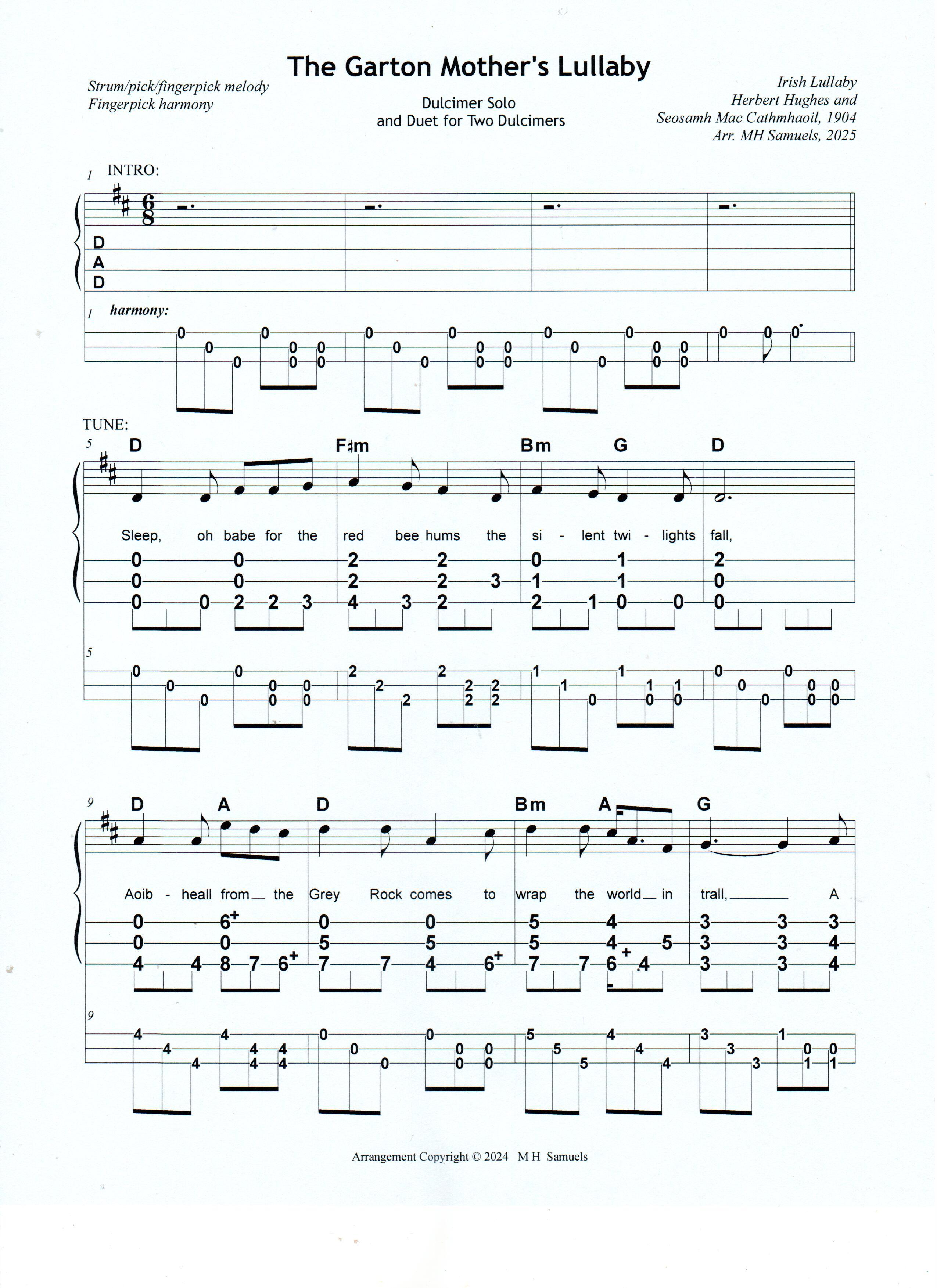
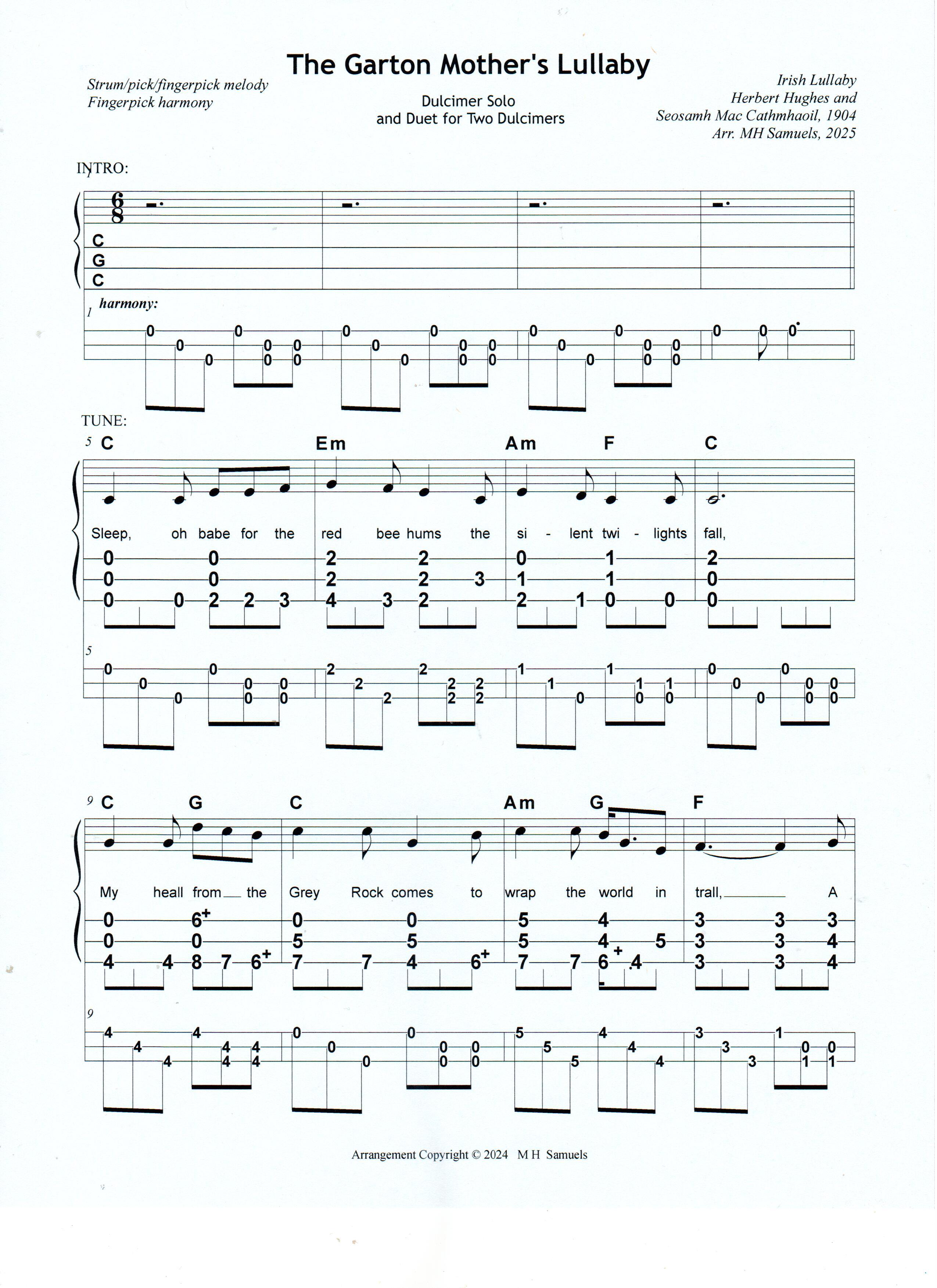
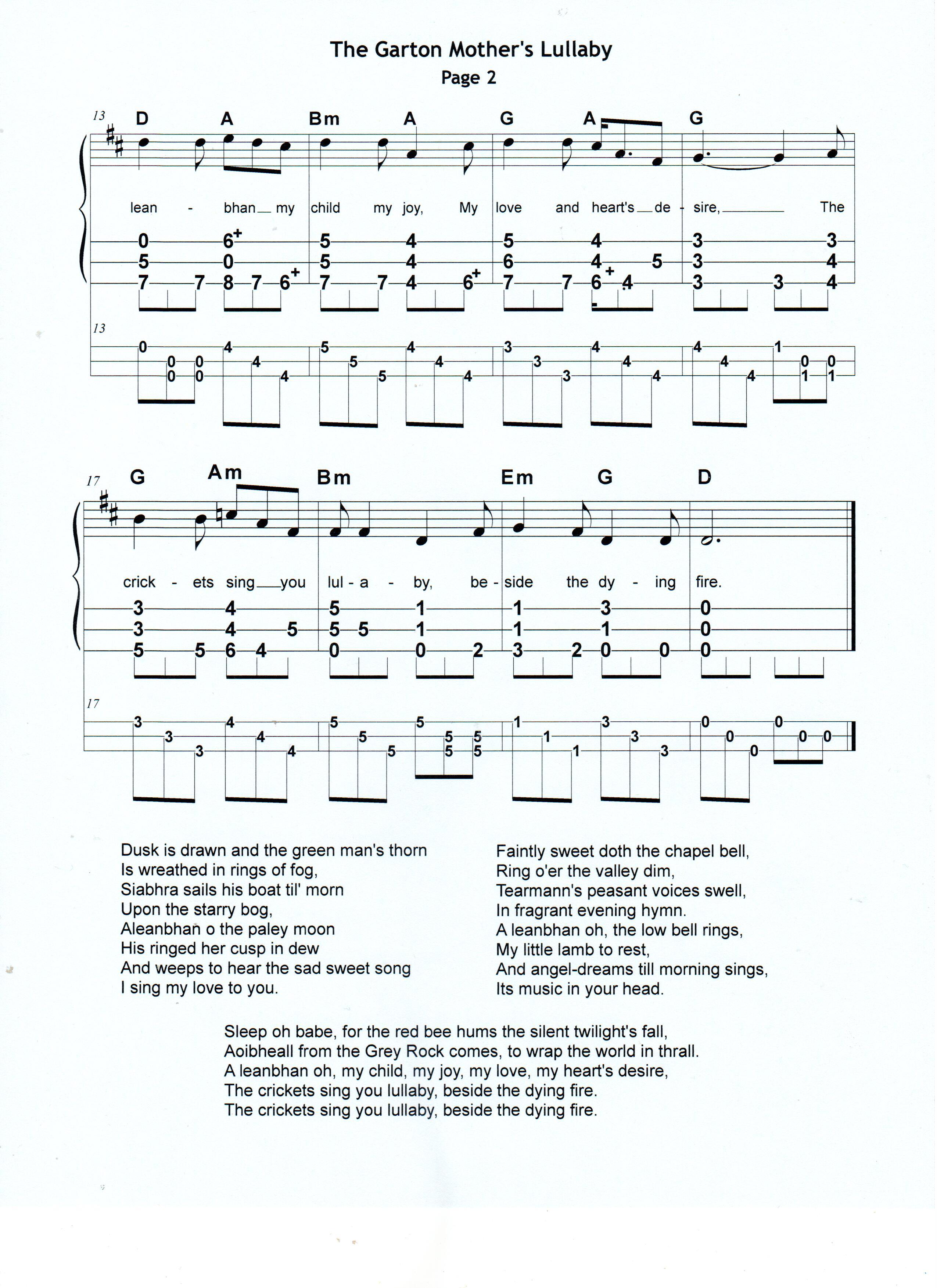
7. Look at the images of the song at the bottom of this blog post, “The Garton Mother’s Lullaby,” in the Keys of D (DAD tuning), Key of C (CGC tuning) and Key of A (AEA tuning). The tablature is identical for each of these keys. They share the same tablature numbers because they all have the 1-5-8 tuning relationships. The standard notes for a piano and chord names reflect the key the song is being played in. And, if the dulcimer strings are tuned to play in the key shown, the tones and fret numbers will match what is being played. Here are some 1-5-8 tunings and how they are often used:
- DAD tuning – standard dulcimer or bass dulcimer
- CGC tuning – standard dulcimer
- AEA tuning – baritone dulcimer
- GDG tuning – ginger dulcimer (travel dulcimer, soprano dulcimer) or baritone dulcimer
8. A person can certainly tune the dulcimer many other ways to many other string pitches. For example, DAA tuning is a 1-5-5 tuning. DGD tuning is often termed a 1-4-8 tuning. DAC tuning can be considered to be a 1-5-7 tuning. Since these tunings have different relationships between the strings, you can’t play the same tablature numbers as DAD, CGC or any of the other the 1-5-8 tunings. These are all different “families” of tunings. They are not “identical twins” to DAD and 1-5-8 tunings.
Tuning a dulcimer “to itself”
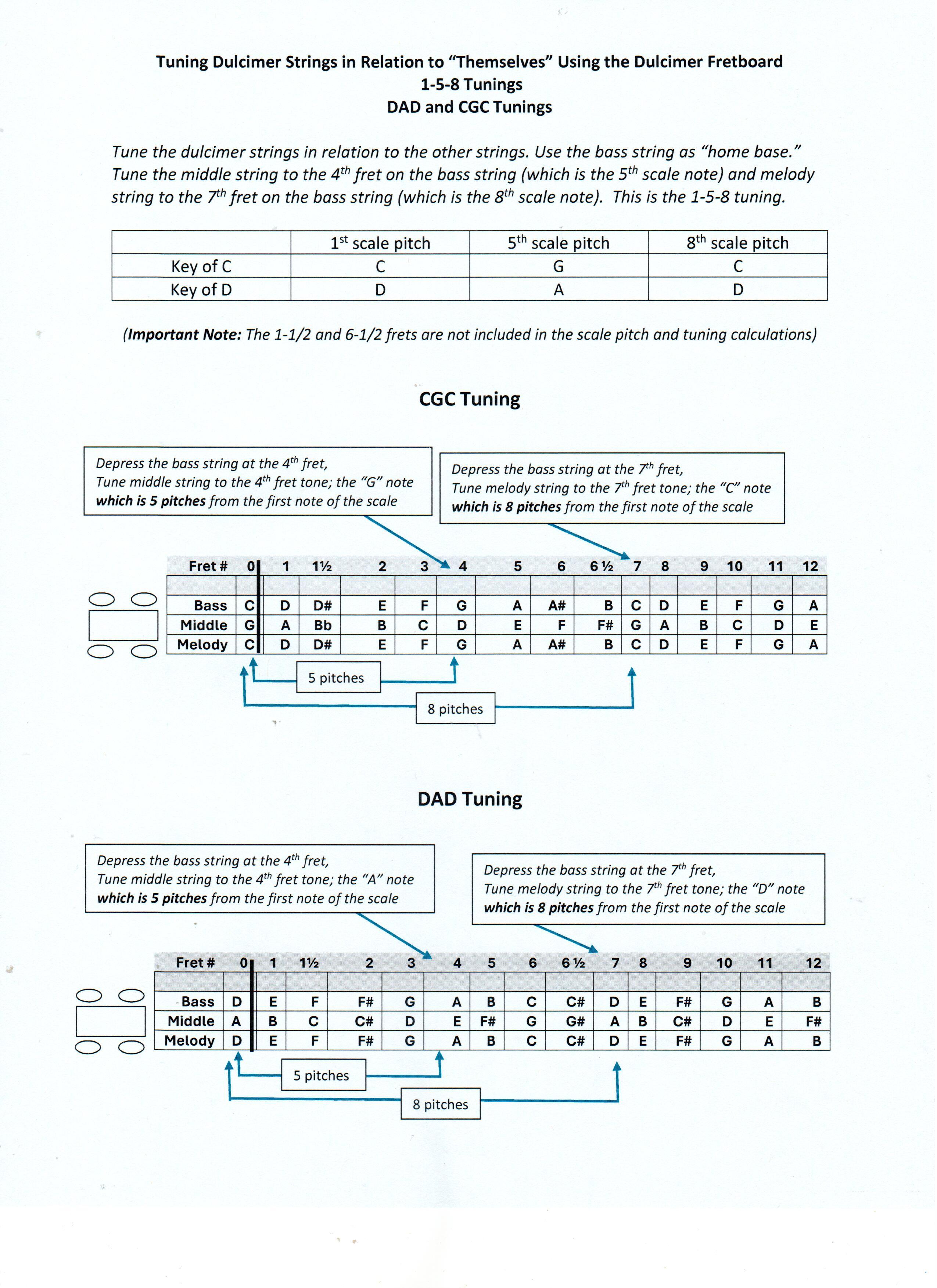
8. Using this knowledge, you can tune the dulcimer “to itself” using the fretboard.
For example, to tune to DAD:
***Tune the bass string to the desired key — for example, for the Key of D, tune it to the “D” note.
***Press the bass string at the 4th fret. Strum the string and listen to the pitch. This is the “A” note. Turn the tuning peg of the middle string and tune to match this pitch. When the bass and middle string sound the same, the middle string is tuned properly to the “A” note.
***Press the bass string at the 7th fret. This is the “D” note; just an octave higher than the open strum on the bass string. Strum the bass string and listen to the pitch. Turn the peg of the melody string to match this pitch.
9. You can do this for CGD for the Key of C, once you have the “C” note on the bass string tuned.
Let it all “sink in”
Sometimes it takes awhile for this information to sink in. However, once I figured all this out; I found it easy to play and arrange music in different keys for different dulcimers (i.e. a baritone dulcimer tuned to AEA or a ginger dulcimer tuned to GDG or a standard dulcimer tuned to either DAD or CGC). All these are 1-5-8 tunings. The are “identical tablature twins” to DAD and each other.
My computer software makes changing keys easy for arranging tablature. I keep the tablature numbers the same, and just change keys on the standard staff. The chord names change automatically to match the new key.

Special Walnut Dulcimer
I am fortunate to have collected several unique dulcimers over the years. One was specially made by McSpadden Dulcimers from a block a walnut wood collected my father. I discovered that the strings gauges and dulcimer fretboard of this all-walnut dulcimer sound wonderful when tuned to CGC. I tried lowering the strings several note pitches to a baritone tuning (GDG tuning). The dulcimer sounded like a fog horn. Tightening the strings to the proper gauge made all the difference in the world. The dulcimer has a deep, resonating sound which is perfect for a lullaby. I enjoy this dulcimer for playing in the Key of C and the CGC tuning.

About the Irish lullaby, “The Garton Mother’s Lullaby”
“The Garton Mother’s Lullaby” was published in 1904 in “Songs of Ulster.” The melody is an old, traditional Irish melody which folk-song and arranger, Herbert Hughes, collected in Donegal. The poem used for the lyrics was written by Irish poet, Jospeh Campbell, writing under the Gaelic form of his name, Seosamh MacCathmhaoil. The two were collaborators, both from Belfast, even though Hughes was Protestant and Campbell was Catholic.
Campbell used Irish folklore and mythical features in the lyrics for the lullaby. The song is about a mother singing her baby to sleep….. “Sleep oh babe, for the red bee hums the silent twilight’s fall….” (I have included 2 of the verses; a 3rd verse is also available on-line.) The lyrics are somewhat difficult to follow, which actually adds to the charm of the lullaby.
Some of these references in the lyrics include:
- Leanbhan, is an old Irish word for “little child.”
- Aoibheall – or Aoibhinn the Beautiful — the queen of the Northern Fairies. She guards the gray rock named “Graghea.”
- Siabhra – generic term for malevolent fairies. (Although we envision fairies of being quite helpful (i.e.”Peter Pan”), Irish fairies are often mischievous and even sometimes wicked.)
- The Green Man – a mystical man who appears to be part of the forest; covered with greens and leaves.
- Tearmann – a village near Gartan in Donegal, in Northwest Ireland.
- Gartan – Gartan means “little garden.” Gartan is also a parish in County Donegal, Ireland.

Arrangement of “The Garton Mother’s Lullaby” for dulcimer
I made an arrangement in DAD tuning which is fairly easy for an intermediate player to play, especially when fingerpicked. This tune is written in 6/8 time. The melody “rises” and “falls” like a rocking motion. Count: 1, 2, 3; 1, 2, 3. I use some beautiful “minor” harmony notes to make this sound like an enthrall tune.
In several measures, the melody travels to the middle string. It was just easier to finger the notes this way. Since I intend this song to be fingerpicked (or flatpicked), only this note should be plucked and there shouldn’t be dissonant tones coming from the other strings.
It is usually wise to hold bass (and middle, melody) strings down to let the music “ring.” It avoids a “choppy” sound. However, in measure #18, there is a long slide down from the 5th fret on middle string (and 5th fret on bass string) to the 1st fret. My bass string “whines” when I move up and down the fretboard. I figured out how to lift up the bass string and just keep pressure on the middle string during the slide from 5th fret to 1st fret; then add the bass string back again. This creates a smooth, continuous sound.
Since this song is easier to sing in the Key of C and perhaps even the Key of A, I have given variations for each of these keys. Remember, the tablature is all the same, including the chord fingerings. Only the notes on the standard staff and chord names change.
Lullabies definitely benefit from an accompanying rhythmic part. I used simple barre chords, (for the most part), which go up and down the fretboard like the lullaby. Flatpick or fingerpick the notes of the chords to achieve a rocking sound. Actually, this harmony part/chords is so beautiful that it could easily be played alone as a “musical break.”
Arrangement of the lullaby in three keys — Key of D, and Key C and Key of A (for a baritone dulcimer)
I hope the information on the dulcimer fretboard, diatonic scale and the 1-5-8 tuning is helpful. The purpose of this “dissertation” was to explain how to retune the dulcimer to different keys while continuing to use the same tablature numbers. I encourage you to assimilate this information — and it may mean reading the section multiple times. However, understanding what the 1-5-8 tuning means can make everything else on reading dulcimer tablature so much easier.
Here are the images of the song in three keys followed by PDF files which you can download, copy, play and share with dulcimer friends. I just ask that you don’t publish or upload the arrangements to a public internet site.
Enjoy this beautiful lullaby!



References:
http://www.classichistory.net/archives/gartan-mothers-lullaby
 Dulcimer Jambalaya