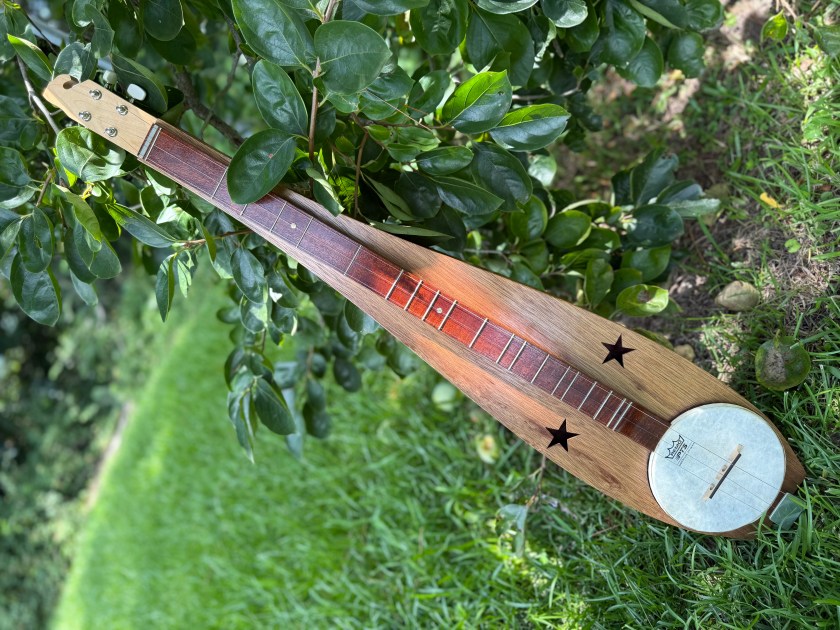
I’ve learned never to say, “never.” After vowing never to purchase another dulcimer, I now own a new musical instrument. This dulcimer, however, is different. (Nice justification.) It is a banjo-dulcimer, which is a hybrid of a banjo head on the body of a dulcimer. It sounds like the real thing — a banjo. The fretboard is like a dulcimer. I have termed it my “special needs” dulcimer. Playing it does require some “coaxing.” The instrument has a very “harsh” tone; not all songs sound good when played on this instrument, especially when strummed. I did found several tunes which fit very well on this dulcimer. These include the cowboy tune, “Home on the Range.” Plus, while trying to figure out how to play this instrument, I recalled that iconic banjo player Béla Fleck.

“Special Needs” Dulcimer
My banjo-dulcimer is made by Doug Thomson of California. This dulcimer was built in 2003; so Doug has been building these dulcimers a long time. In an E-mail to Doug; he says that he currently does not have any for sale; but is planning to build several this fall. (Personal communication.) My dulcimer is pre-owned.
I love this dulcimer and have been playing it non-stop since purchasing it in July. So why do I call it my “special needs” dulcimer? Banjos tend to sound very loud and staccato (i.e. obnoxious). There is literally no sustain. This banjo-dulcimer is no different — it is loud and harsh on the ears.
However, this particular banjo-dulcimer is lovely if you coax it along. It needs a “light” touch. Rather than strumming, I discovered that fingerpicking arpeggio chords — sounding each string individually — brings out the flavor of the song. And I love to fingerpick — hey, this dulcimer must have been made for me.
Doug Thomson recommends that you play the melody string louder and lighten up on the middle and bass strings. Rather strumming fiddle tunes, I am learning the finesse of back-up chords and tunes played in the chord-melody style.

I place my banjo-dulcimer on a dulcimer stand, so that it is securely fastened and doesn’t slide around. I can easily reach my right hand up over top of the strings — like a spider — in the strum hollow. This banjo-dulcimer has a 28.5 inch vibrating length — it is a longer dulcimer. I have the dulcimer centered on my lap across from the “star” sound holes — another reason to have the dulcimer firmly secured.
The bottom of the dulcimer has a round-cut out piece. A blue handkerchief is stuffed inside. This dampens the sound; otherwise it can be annoyingly loud.
Banjo-Dulcimer Names
Banjo-dulcimers are tagged with an assortment of names given by the builders. Here are a few names which I found mentioned on the internet — some of these dulcimers are no longer available and the builder is not active.
LAP-JO® by Folkcraft,
Dulci-Banjo by McSpadden,
Banjomer by June Apple Dulcimers,
BanJammer by Wood-N-Strings Dulcimer Shop and Mike Clemmer,
Banjo-mer by Doug Thomson (The first banjo dulcimer available commercially),
Banj-mo by Dennis DenHartog,
Dulci-jo by Gardners Dulcimer
I have played only the “Banjo-mer” built by Doug Thomson. I guess, however, that all the above instruments can be played in a similar manner since they all have a dulcimer fretboard with a banjo head.
Favorite Banjo Player
I became intrigued with the banjo after listening to Peggy Seeger sing and play, “The Wedding Song.” (I featured that tune on my blog in July.) Could you play that tune on a banjo-dulcimer? Why not try. I became interested in the banjo again and purchased a banjo-dulcimer. Plus, that brought back memories of Béla Fleck.

Béla Anton Leoš Fleck and the Flecktones
Béla Fleck is one of my favorite musicians — a banjo virtuoso. He married a fellow banjo player — Abigail Washburn. Fleck plays the banjo in Scrugg’s style while Washburn plays a clawhammer banjo.
Fleck’s group, “Béla Bela Fleck and the Flecktones,” toured in the early 2000s, coming to New Orleans several times. I heard them perform at the Hard Rock Café and was appropriately “wowed.” The group included Béla Fleck on electric banjo, Victor Wooten — playing a crazy bass guitar — his brother Roy “Futureman” Wooten on a synthetic drum machine — the Drumitar — and Howard Levy on harmonica and keyboards. Their music is described as a jazz fusion combining jazz improvisation, progressive bluegrass, rock classical and funk.
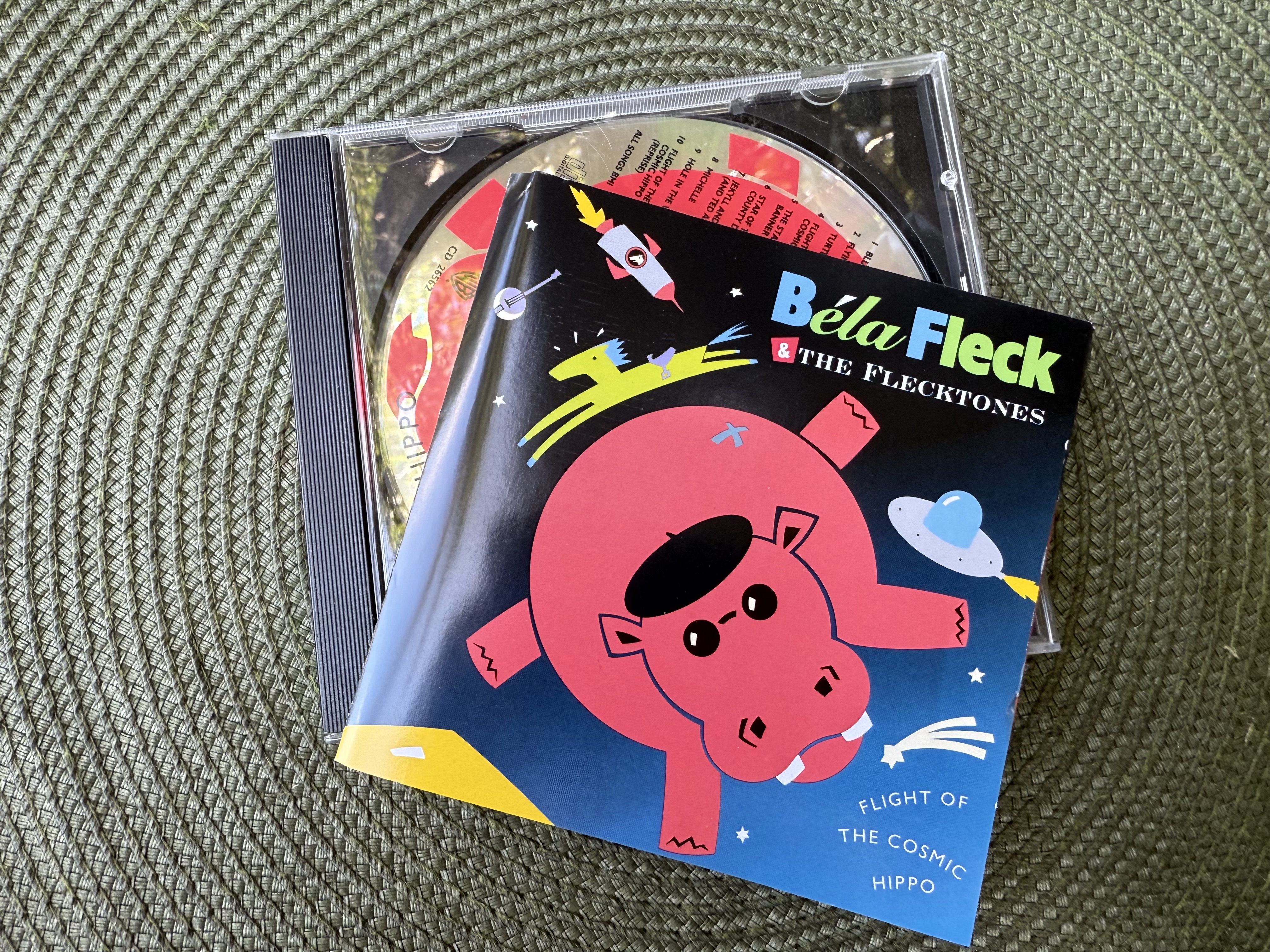
Their rendition of “Star of the County Down” is amazing and is forever imprinted in my mind. Who could envision this Irish folk tune as played with jazz improvisation on bluegrass banjo, funky electric bass, harmonica, keyboards and synthetic drum. I can still picture the album cover of “Flight of the Cosmic Hippo” and could still locate my copy of the compact disk. (Now, that is truly amazing! And, who remembers what a compact disk is?) How I well remember Victor Wooten playing this and other tunes from the album on bass guitar at the Hard Rock Café.
In addition to performing, Fleck is a composer. I was lucky to attend a performance of Béla Fleck as composer with the Louisiana Philharmonic Orchestra in 2014 at the Orpheum Theater. He performed his original work commissioned by LPO: Banjo Concerto No. 3, “Louisiana Concerto,” The full-length orchestral piece contained elements of jazz, gospel, brass band and Cajun music. I was also “wowed.”
Fleck also plays banjo in the bluegrass style. I especially enjoy his recordings of “BlueGrass Sessions” Vol 1 and Vol 2. He put together a stellar cast of musicians to play and improvise with him.

For your information, Fleck has won 17 Grammy Awards and has been nominated 39 times. This includes being nominated in more categories than any other artist. Not bad!
Banjo Ambassador
Béla Fleck is one of those “once in a lifetime” musicians, composers, innovators and virtuosos. I know that I will never achieve his level of excellence. (I still have to win my first Grammy!). However, I can try and play at my own level!
I also describe Béla Fleck as a “Banjo Ambassador.” He hosts an annual, weeklong “Blue Ridge Banjo Camp” at the Brevard Music Center in Brevard, NC. This year the dates are August 12-17, 2025.
Fleck has posted several YouTube videos showing his method of playing the banjo. I watched some of these videos to get an idea of how to play the banjo-dulcimer.
Earl Scrugg’s 3-Fingerpicking Banjo Style of Playing
I could not find any technique books written specifically for playing a banjo-dulcimer. To figure out a method, I browsed the internet and stumbled across some of Béla Fleck’s instructional YouTube videos.
Béla Fleck uses Earl Scrugg’s style of playing the banjo. Scruggs uses a three-finger fingerpicked method for the right hand for sounding out the music on the banjo. Earl Scruggs is generally considered to be the father of this method of banjo playing.
I figured that some of Scrugg’s techniques might be adapted to a three-string dulcimer — especially since Scrugg uses only three fingers for picking. Granted, there are many more possible pitches with a five-string banjo. A banjo-dulcimer is definitely “handicapped”; but perhaps some of the techniques can be transposed to dulcimer.
Béla Fleck uses an open G tuning (gDGBD) on the banjo. The top three strings play a “G” chord — with an open strum. Also, the strings on banjo go from low to high in pitch — playing away from you. This is reversed compared to a dulcimer.
Here are a couple of my take-aways from the YouTube videos shared by Béla Fleck based on Scrugg’s style:
- Fleck uses the first three fingers of the right hand to sound the strings in this style — thumb, index finger and middle finger. The other finger(s) are used as anchors somewhere on the banjo head.
- Fleck uses metal fingerpicks on these three fingers — it appears that he does not use a “guitar” pick when playing in this style. (Shown here are plastic fingerpicks — this is what I have right now.)
- Fleck alternates fingers when fingerpicking. For example, rarely does his thumb play two notes in a row. He might alternate the thumb and index finger, even if it is on the same string.
- Usually the roll begins with the thumb, since it is louder and often the melody note.
- Fleck suggests starting out by learning banjo rolls.

Banjo Rolls – Scruggs Style of playing
The foundation of the “Scruggs” style of playing are banjo rolls in eighth note patterns:
Forward roll — play the last three strings (GBD) away from you,
Backward (or reverse) roll — play each of the these three strings towards you,
Forward-backward roll – play the strings away from you and then back,
Mixed roll – thumb plays every other note.
Then, these rolls can be combined in endless patterns on any string and using any left-hand chord which you choose. Play as fast as you wish. Off you go!
On a banjo-dulcimer, the pitches are reversed; nevertheless, here are banjo rolls transcribed for a dulcimer — as best as I could do.

Arpeggios Patterns on the Dulcimer vs Banjo Rolls
Arpeggio patterns, when played on a dulcimer, look very similar to these banjo rolls. An arpeggio is a technique where the notes of a chords are played one at a time rather than simultaneously. It is a “broken chord.” Banjo rolls represent picking patterns — but essentially these are playing arpeggio patterns.
While there aren’t technique books (that I could find) written specifically for banjo-dulcimers, there are plenty of technique books written on arpeggio patterns for traditional dulcimers. These books can be adapted for a banjo-dulcimer. Two books which I am currently enjoying (quite unrelated to purchasing the banjo-dulcimer) are David Haas’s techniques books, “Beautiful Melodies” and “More Beautiful Melodies.” The books — which can be used independently of each other — have plenty of arpeggio exercises and also tablature for beautiful tunes. I highly recommend them. They can be purchased directly from David Haas as well as internet dulcimer stores, such as Folkroots.

Dave Haas states that he sometimes teaches workshops on playing a banjo-dulcimer at internet festivals such as QuaranTUNE and North Georgia Foothills Dulcimer Association (NGFDA). Plus, he has participated in past Kentucky Music Weeks with banjo-dulcimer workshops. (Personal communication.) Wouldn’t I love to take one of these workshops. Plus, Dave has published other tablature books and compact disk recordings. Worth checking out.
About “Home on the Range“
The cowboy tune, “Home on the Range,” sounds great when played on a banjo-dulcimer. It has lots of sustained notes; making good places to insert “banjo rolls.” Plus, it is a song which most people know. Folks enjoy hearing tunes which they know; plus it is sometimes easier to learn it on the dulcimer if you already know the melody. The song does have quite a few additional verses; I selected ones which I like.
The song, Home on the Range,” dates to 1872 or 1873. Dr Brewster M. Higley wrote the poem after moving to homestead and acquiring land under the Homestead Act in Smith County, Kansas. He wrote the lyrics as a poem, “My Western Home,” published in the Smith County Pioneer. Later the poem was set to music. In 1947, the song became the Kansas state song. There have been several copy write disputes regarding the origins of the song — as there are a number of similar songs and lyrics — eventually it was determined that Higley was the author of the song.
Playing “Home of the Range” in the dulcimer in DAD tuning
- This tune is in 3/4 time signature, not 4/4 time. I had to adapt the “reverse banjo rolls” to match the 3/4 time.
- I have included a duet arrangement. Although you can play both parts on a banjo-dulcimer; I intended the first part for a standard dulcimer.
- If you want to sing and play chords; chord examples are included inside the ovals above the standard staff. To strum the banjo-dulcimer, try using a clawhammer banjo style.
- The banjo-dulcimer part is a stand-alone arrangement in the chord-melody style; it includes both the melody and “banjo rolls.” The banjo rolls are primarily “reverse rolls” — or towards your body.
- Some of the notes in the banjo-dulcimer part don’t entirely match the melody — this is intentional — the music flows better.
- For the traditional dulcimer part, the melody notes are in larger and darker font. Harmony notes are in lighter font.
- For the traditional dulcimer part, an “X” means “don’t strum.” Othewise you will need to fill in the sustained notes with strums so that the song does not sound disjointed.
I am loving my “new” banjo-dulcimer and member of my dulcimer family. I find that the right-hand technique is so important as the strings just don’t have sustain (hey, it’s a banjo!). You really need to pluck cleanly to get a good tone with this dulcimer.
I hope you will enjoy this arrangement of “Home on the Range.” Please download and play, copy and share — I just ask the you don’t publish it or upload to a public internet site.
Here are Jpeg images of the song. Following these, are PDF files which can be downloaded.


Here is the PDF file which can be downloaded and printed.
 Dulcimer Jambalaya