
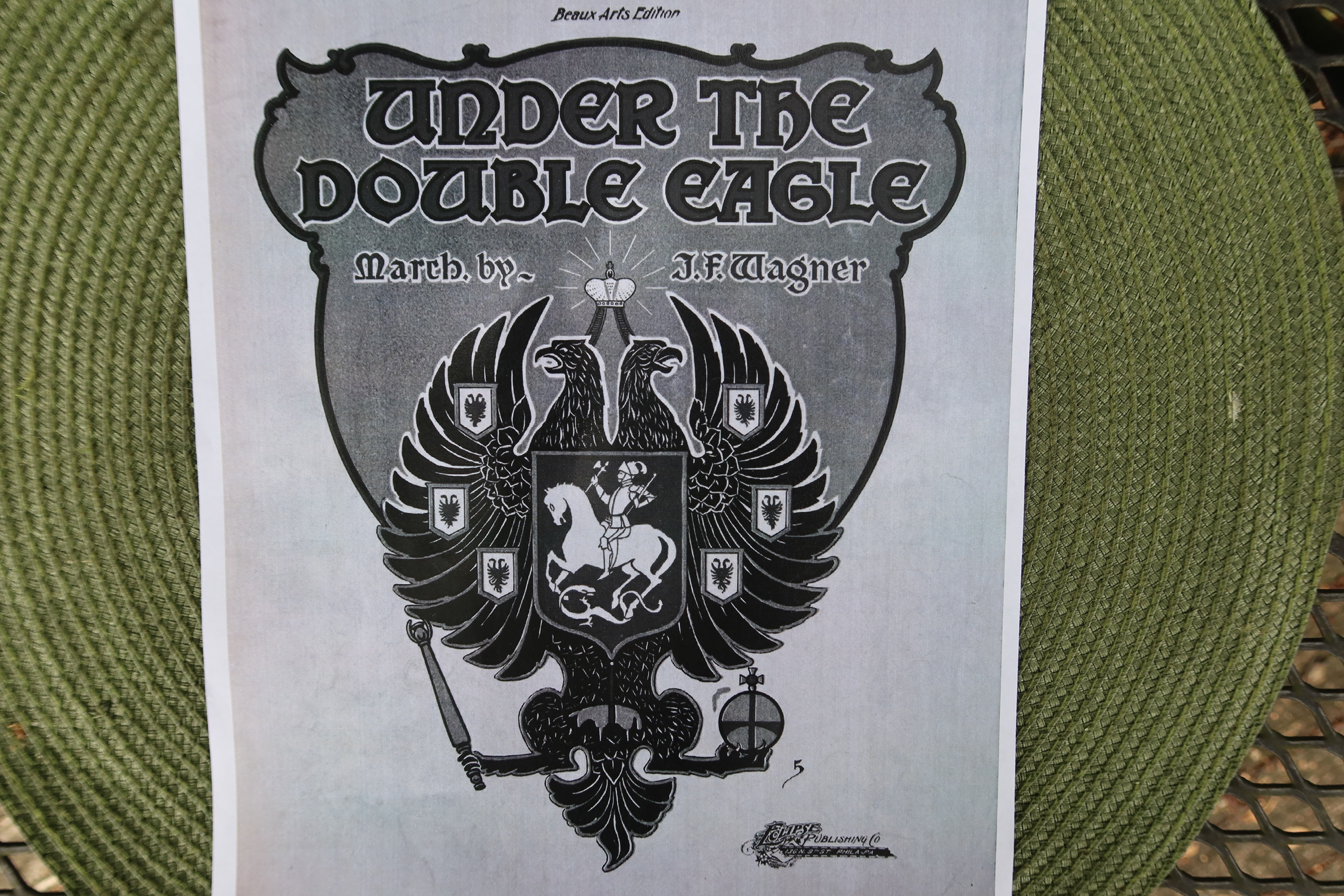
We decided to infuse our dulcimer club’s repertoire with some new tunes for gigs and jams, and started with ones which featured animals in either the title or lyrics. After some thought, we compiled a a list of 45 animal tunes! Too many to play in our club, but there are some interesting songs on the list. One tune which I’ve always wanted to learn is “Under the Double Eagle.” When I first listened to a You Tube recording of “Under the Double Eagle” as played by Roy Clark’s bluegrass band, I mused that it sounded alot alike a march. Even with Clark’s guitar rocking along, you could hear the march tempo. And indeed, as I researched this song, I found that it was composed by Josef Franz Wagner in 1893. He was an Austrian military bandmaster and composer, sometimes referred to as “The Austrian March King.” The song’s title refers to the double eagle in the coat of arms of the combined Austria-Hungary empire. You may recognize the tune as it is often played in circus routines and as well as during the Monty Python’s Flying Circus television show. I abridged the original march to make it similar to bluegrass versions and came up with a pleasing and moderately easy version for dulcimer.
About the tune
“Under the Double Eagle” was composed by Josef Franz Wagner (20 March 1856 – 5 June 1908). Wagner wrote over 400 compositions of which 250 were published. He was the bandmaster to three successive Austrian regiments in the service of the Habsburgs. The piece was the official regimental march of Austrian Artillery Regiment Number 2 until its dissolution in 2007.
Several of Wagner’s tunes include marches played by polka bands including “Tiroler Holzacker Bub’n,” which was recorded by polka bands under the titles, “Holzacker March,” and the “Jolly Lumberjack Polka.” His other well-known piece is the “Tyrolean Woodcutter March.” Wagner’s 1893 march, “Unter dem Doppeladler” (Op. 159) or “Under the Double Eagle” became his most famous march.
“Under the Double Eagle” probably made its way to this country with European immigrants with their brass and accordion bands. Inerestingly, it has become a country music classic, evolving into Bluegrass and Western Swing band repertoires. It was especially popular in Texas in the 1930’s and 1940’s. Earlier, American composer and bandleader, John Philip Sousa, liked the tune so much that his band recorded it three times. (Sousa is an American military composer who composed “Stars and Stripes Forever.”)

Abridged Version
Since “Under the Double Eagle” was first published in the United States in 1902 by a branch of Joseph Morris Music in Philadelphia, Pennsylvania, the tune falls into realm of the public domain. With a little searchng, you can find sheet music of the tune adapted for piano and other instruments. It is interesting to have the original versions as a reference point.
The song is a multi-part march, including both A and B parts. It is usually played A-B-A. Plus, the march includes an introduction. The song was written in the key of E flat major and modulates to A flat major for the “Trio.” Over the years, bluegrass and swing guitar players have abridged and modified the tune. Some of the bluegrass versions omit the introduction. Often the subtle key change is omitted.
Dulcimer Version
For the dulcimer, I made the arrangement in the Key of D using DAD tuning. I found that it was difficult to incorporate a key change into the tablature and still maintain the march tempo and strum on the dulcimer. So, I followed bluegrass versions and omitted the key change for the “trio.” In musical terms, what is a trio? It is a part written for three instruments. However, we’ll just play one instrument — the dulcimer. I liked the pickup notes in the A Part which I found in bluegrass versions (but not in the original sheet music) and kept these notes.
Since this is a march, it needs to have a steady beat and rhythm. When playing the dulcimer, I found that strumming across the strings to maintain the tempo was the best technique for me. Although you can pick some of the notes to fill to in places, this is not a gentle fingerpicked tune. I just don’t have the right wrist and thumb dexterity to flatpick, but it works for some folks and is more similar to the techniques used by guitar players in bluegrass bands.
I am enjoying my “abridged” version of “Under the Double Eagle.” It is peppy and not too dificult to play on the dulcimer. We can all pretend that we’re at the circus when playing the tune. Plus, we have many more animal tunes to share at some point in the future. Enjoy this energetic march!

Here’s a pdf file to download.
References:
https://en.wikipedia.org/wiki/John_Philip_Sousa
 Dulcimer Jambalaya
Greetings,
As the Web manager for Tucson Dulcimer Ensemble I am writing to see if I have your permission to post your free tab of the month on our website’s secured “Members Only Area“. Only our active members have access to this area. TDE is a small group of around 25 members during the winter season and 8 – 10 members during the summer. Our group consists of mostly retired players and if and when we do play for others it is either a nursing home or a small church group. We do not charge for our time since we believe we are helping those groups out and it is a way of promoting our music and instruments. We play for the fun of it.
A couple of our members believe that since the TAB is put on your site as a free tab our group has the right to add it on our website In our secured TAB area. Since this is a gray area I told everyone, before any tab is added to the web page I must have the artist’s permission to place it there.
We have some members that do not do well with technology and have issues trying to get music from the internet. I usually will print the music for those members and let the other members download from the website.
Due to the copyright issues that seem to pop up on occasion I want to be sure I am not stepping on toes that may get our group into a situation where we could be fined for illegal use of Tablature.
If I do get permission from you then I will post those tabs for our group to use. I will print off your response to cover us and add your tabs to our site. If I do not have permission, then those tabs will not be added to the website and if our members wish to use them, they will need to either get permission or bring copies for the group and pick the TABS up after the practices.
So, If I have your permission to post your free TABs on our website please respond to this email with permission or respond with a denial of right to publish. This way I have the proof incase of any issues in the future or members asking for content to be added without the artists permission.
Thank you for your consideration.
LikeLike
Hello, thanks for your interest in my tablature. I’m not trying to make money off of my tablature;, and post the tablature to share and for others to learn. I am pleased that you might enjoy my tab. You are welcome to print off copies for your club members to use and put it on your secure WEB site. The only things I ask are that you not publish my tablature in a book or newsletter withoout my permission. Or upload on a public WEB page. Occasionally I have put copyrighted songs on my blog (but no longer). Plus, I would like the credit. Also, from time to time, I post someone else’s tablature for a blog post. Although I get permission from that person, I wouldn’t want to see that person’s tablature shared all over the country. Use in your own club is fine, but I’d rather you not distribute further than that. One is coming up in July. In those cases, these musicians have books which can be purchased which contain similar tablature. Support these musicians. Enjoy my tablature. Also, my response pertains only to my own blog and tablature — not to other musicians — it would be wise to check with other musicians about their preferences for making copies as others make a living at this kind of thing. And. thanks for asking for clarification.
LikeLike
Thank you, all songs placed on our web page is listed with the song title – tab creator. An example would be:
Amazing Grace – MH Samuels
Amazing Grace – T Glazener. And so on. We use these songs to learn and enjoy playing new material. We don’t put anything in books etc except for our own folders or on our tablets for playing.
LikeLiked by 1 person
Hello, Your secure WEB page, personal tablets and copies for club membersthat sounds find. And that is an interesting concept to use a secure WEB page to place your club’s music. Our group uses a flash drive — but that has problems of adding new music. With folks becoming more aware of copyright issues — and sharing music — it is wise to always ask the source, if possible. I think it is becoming more complicated, especially with these on-line festivals as instructors, rightly so, don’t want their workshop music shared as that is the source of their income. Anyway, enjoy my tablature and glad to see your group is interested in learning new tunes and music. Hope to hear you all play sometime!
LikeLike