

I love this catchy reel which is said to have originated in Scotland in the 1700s. The tune is also played extensively in Ireland as a fiddle tune and in America as a folk tune. You may have heard it listed by many other names, for example, “Did You Ever See the Devil Uncle Joe” and “Hop High Ladies.” The versions are similar. The tune is tricky for dulcimer players because of all the “runs” which are typical of this style of British Isles music. I wanted a tune which novice players could achieve. So, I simplified and simplified. Aaron Copland used the tune in his ballet, Rodeo. Hey, if Copland can adapt the tune — for an orchestra, perhaps I can adapt it for novice dulcimer players. It’s my “creative license.” I like my version, I hope you do, too. And here’s a little lady who is hopping high.

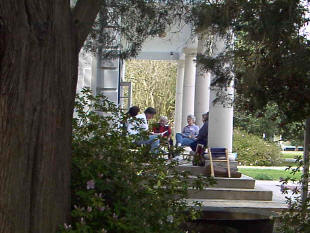
“Did You Ever Go to Meetin’, Uncle Joe?” and “Hop Light Ladies, The Cake’s All Dough” are two other interesting names for this basic tune, “Miss McLeod’s Reel.” The listing of tune titles for this song is enormous. Apparently, the reference to “cake’s all dough” in the above title may refer to a dance where the cake was the prize. Not bad! And, yes, there still are real meeting houses as the one above is of an old-order Mennonite community in the Shenandoah Valley.
Here’s what the internet site, the Bluegrass Messengers, (see reference), says about the origins of the tune:
A universal favorite in the British Isles and North America. Apparently the tune was first printed in Gow’s Strathspey Reels of 1809 (pg. 36), with the note “An original Isle of Skye Reel. Communicated by Mr. McLeod.” It was popular as long ago as 1779 in Ireland as its playing is mentioned in an account by a foreign visitor named Berringer or Beranger of a “cake” dance (i.e. where the prize was a cake) he participated in while visiting in Connacht. O’Neill (1913) relates Beranger’s observations somewhat differently and gives that it was one of six tunes played by Galway pipers in 1779 for the entertainment of the traveller.
And continuing from the Bluegrass Messenters (Jump Jim Crow and Hop High Ladies are similar tunes with different lyrics):
Thomas D. Rice introduced “Jump Jim Crow” in 1828 and it became a popular minstrel song. Lomax included it in his collection, Our Singing Country. That set is from the playing and singing of Fields and Wade Ward of Galax, Virginia, and Aaron Copland took the tune from the Lomax book (as Ruth Crawford Seeger had transcribed it) to use as the second instrumental tune in the “Hoedown” of Aaron Copland’s music for Rodeo.
John A Lomax and Alan Lomax
Folklorists, John A. Lomax and his son, Alan, traveled across the country in the 1930s and 1940s making field recordings of songs of the people they encountered along the way. Interestingly, their travels included stops at the Louisiana state penitentiary, Angola, where they met and recorded Huddie William Ledbetter known as “Lead Belly.” Over 10,000 field recordings were make for the Library of Congress archives of American folk songs. The Lomax father and son team compiled these songs into a series of anthologies. One is, American Ballads and Folk Songs, published in 1934. Our Singing Country, published in 1941, followed. This tune, “Hop Up, My Ladies” is included in the second anthology.
Aaron Copeland’s “Hoedown” in Rodeo Ballet
Just a bit of trivia, Aaron Copeland was commisioned to compose the score and music for the ballet, Rodeo, first performed in by the “Ballet Ruse de Monte-Carlo” which moved to New York to escape World War II. The ballet was choreographed by Agnes de Mille who played the lead in the original ballet. The premiere was at the Metropolitan Opera House in 1942 and it received 22 curtain calls. The ballet is said to be a “celebration of the American West.”
The Southern title to the tune, “”Hop Up, My Ladies,” is included in Lomax’s collection, Our Singing Country. Aaron Copland included elements of this song, as found in Our Singing Country, in his section, “Hoedown” in the Rodeo. Since this book was published in 1941 and the ballet premiered in 1942, Copland must have been aware in the lastest trends in American folk music. In my opinion, Copland is just a genius. I just love anything which he composes.
Here’s a You Tube recording of “Hoedown” from Rodeo conducted by Aaron Copland himself. If you listen carefully, you can hear some of “Hop Up, My Ladies.” It is in the second part of the instrumental.
Miss McLeod’s Reel for Dulcimer
Originally, the tune, “Miss McLeod’s Reel,” was a reel which is a tune played for dancers. The tempo of a reel may vary but is typically between 100 – 130 bpm. That’s quick tempo, so get ready to rock and roll. Of course, play slowly until you learn the tune. Try to use several fingers to play the notes, keep one finger down on the lowest note of the run as a place holder.
The tune is almost always set in the Key of G. However, for the mountain dulcimer, I changed it to the Key of D in DAD tuning. The arrangement includes very few chords or harmony notes. Just strum across all the strings and keep going.
For a novice arrangement, I omited alot of the notes. It still contains the basic tune. I love the part in measures #9 and #11 which emulates the “hop” of the dancers. Use a hammer-on with a syncopated rhythm — hold the 7 fret for one-and-a-half beats. I transposed several meaures in the “B” part to an octave lower to make them easier to play. You can’t tell.
Parts “A” and parts “B” have the same chord structure. They can be played together as a duet!
As I said, this is a snappy little tune. Fun to play. And I love the idea of composing along with Aaron Copland. Enjoy!

References:
http://bluegrassmessengers.com/did-you-ever-see-the-devil-uncle-joe–powers.aspx
https://en.wikipedia.org/wiki/Rodeo_(ballet)

 Dulcimer Jambalaya