
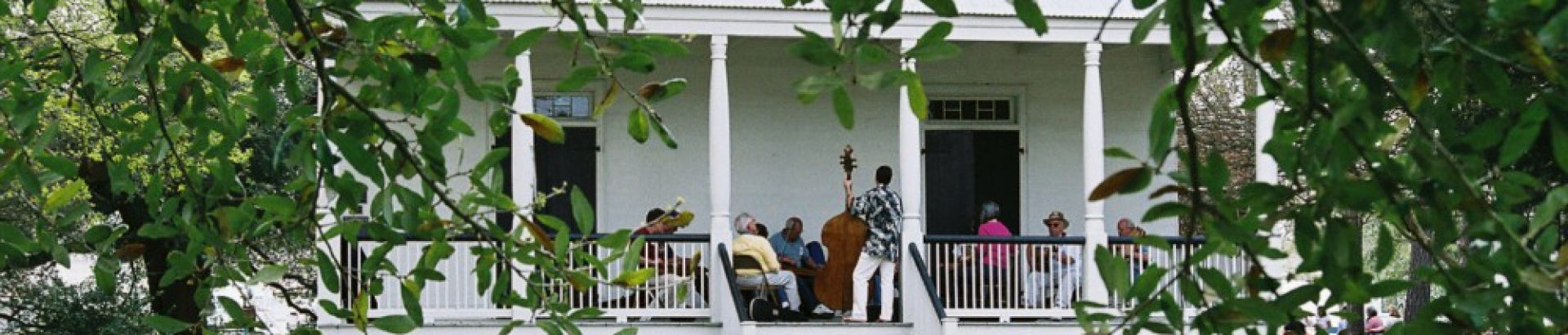

Fingerpicking on the dulcimer to accompany someone who is singing is a beautiful way to play the mountain duclimer. This style of playing is quieter and more expressive. It brings out the beauty of the dulcimer. For this method, put down the pick in your right hand. Assign a right-hand finger to each string and pluck the strings individually to provide accompaniment. For my style of fingerpicking, rather than play the melody, I pick chords with my right hand in a rhythmic pattern. It can make a striking harmony. For a lefty like myself, this is a welcome change as I am challenged to hold a pick with my right hand. I like the idea of introducing fingerpicking to novice dulcimer players before strumming becomes the only way to play. So, here’s my “take” on fingerpicking. “Froggy Went A-Courtin'” is a rhythmic, melodic tune. Everyone is familiar with the song. It makes a good one to illustrate my technique and is a good one to practice with since it has many verses.
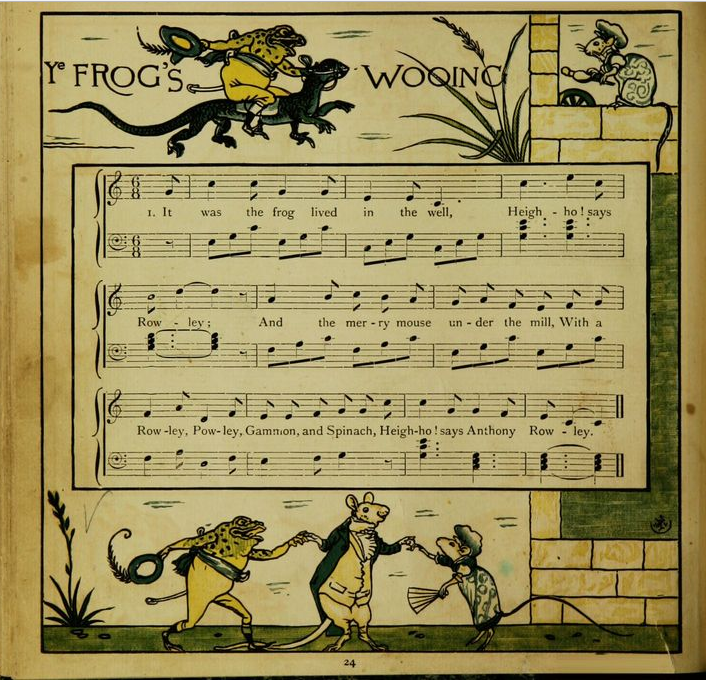
Here’s an illustration of the song from an early book featuring this tune, “The Frog’s Wooing”, in “The Baby’s Opera: A book of old Rhymes and The Music” by the Earliest Masters. I always thought that this children’s song was an English one but it may have Scottish origins. The first known text was published in 1549 in Scotland. The first musical version was published in England in 1611. It has multiple verses about a frog who asks Miss Mouse to marry him. But not without Uncle Rat’s consent, she says. Undoubtedly there is hidden meaning to the verses, possibly a parody of English courts at that time.
The song may have originated as a satire of Queen Eizabeth’s habit of giving animal nicknames to her ministers. A version was created to express popular displeasure over her proposed marriage to a foreigner. Sir Walter Raleigh was known as her fish, Leicester her lap dog, and at the time of her proposed marriage to the Duke of Alencon and Anjou, Simier, the French ambassador was her ape; the Duke himself her frog. The song actually became something sung in nurseries and passed down that way over the generations. (https://secondhandsongs.com/work/119833/all)
As a child, I took the song at face value. I can remember it being sung from my early childhood.
Fingerpicking Book Resources
I am the type of learner who appreciates written material. I have two favorite references regarding fingerpicking which are as pertinent today as they were years ago. During one of my early participations in the “Appalachian State Dulcimer Workshop” in Boone, North Carolina, I took a fingerpicking class taught by Sue Carpenter. She wrote the book, “Patterns and Patchwork,” and describes it as “mountain dulcimer fingerpicking made easy.” This book details fingerpicking from basic patterns to more advanced songs and gives lots of examples. I highly recommend it. It is available on her internet site (https://suecarpenter.net/).
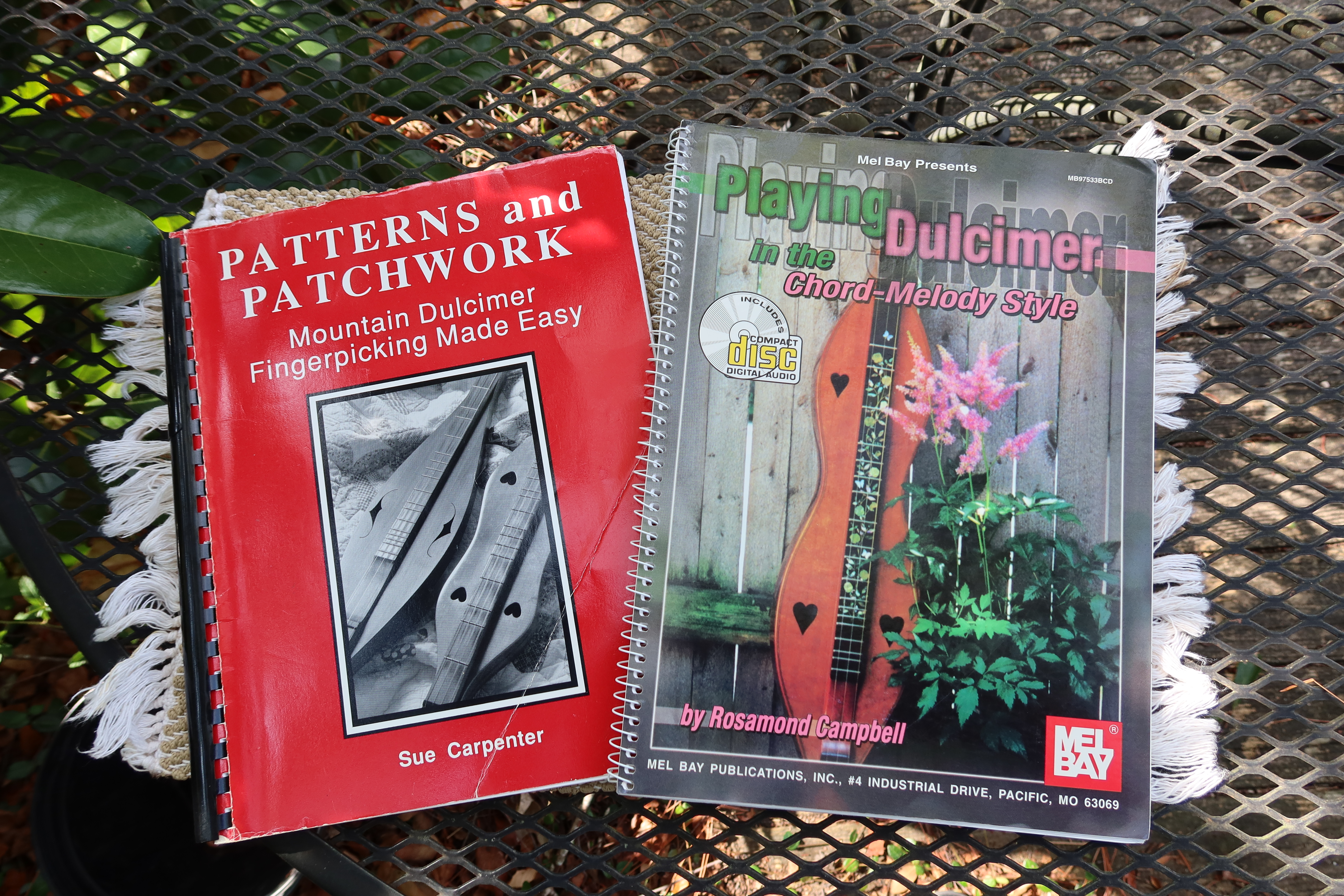
Rosamond Campbell describes a totally different way of fingerpicking in her book, “Playing Dulcimer in the Chord-Melody Style.” If you enjoy fingerpicking, this reference is an interesting “read” for intermediate players and up. The music in this book can be challenging. Rosamond showcases her style which involves fingerpicking the melody of the song along with harmony notes. It begins with easy tunes and goes to very advanced ones. It goes into great detail regarding how to play each song. Also included are many suggestions for ways to play the dulcimer in an expressive manner. This book was published by Mel Bay Publications.
Let’s Fingerpick
To fingerpick, we are going to multi-task — sing, play chords with the left hand and fingerpick with the right hand at the same time. This is “muscle memory.” It requires practice!
My style of fingerpicking is to play the same right-handed pattern over and over throughout the song. The dulcimer is a rhythm instrument when it is strummed. It continues to be a rhythm instrument when it is fingerpicked. You pick the strings on each beat (or half-beat). How easy is that!
For this fingerpicking style, you must be able to play the song’s chords with your left hand with ease. (This is so you can focus on your right hand and also sing.) So practice and practice playing the chords to the song, “Froggie Went A-Courtin'”, while you strum. And I included just three easy chords : “D” is an open strum. The “G” and “A” chords are easy ones. (The chords are shown above the standard notes in “Froggy Went A-Courtin.”)
Right Hand Fingerpicking Placement and Technique
Fingerpicking is a true example of “muscle memory.” For this style of fingerpicking, your right hand wrist moves very little. It is important to establish “ground rules” for your right hand fingers. Assign a finger to each string — and this doesn’t change. Always (or almost) play the string with this finger. Then you can focus on memorizing the fingerpicking patterns. The thumb goes with the melody string, the index finger is assigned to the middle string and the middle finger goes with the bass string.
To fingerpick, your hand hovers above the stirngs. To “pick” the string, pull the fat pad — behind your nail — into and up off the string to create the sound. Pull your finger up and off the string — sort of like a marionette.
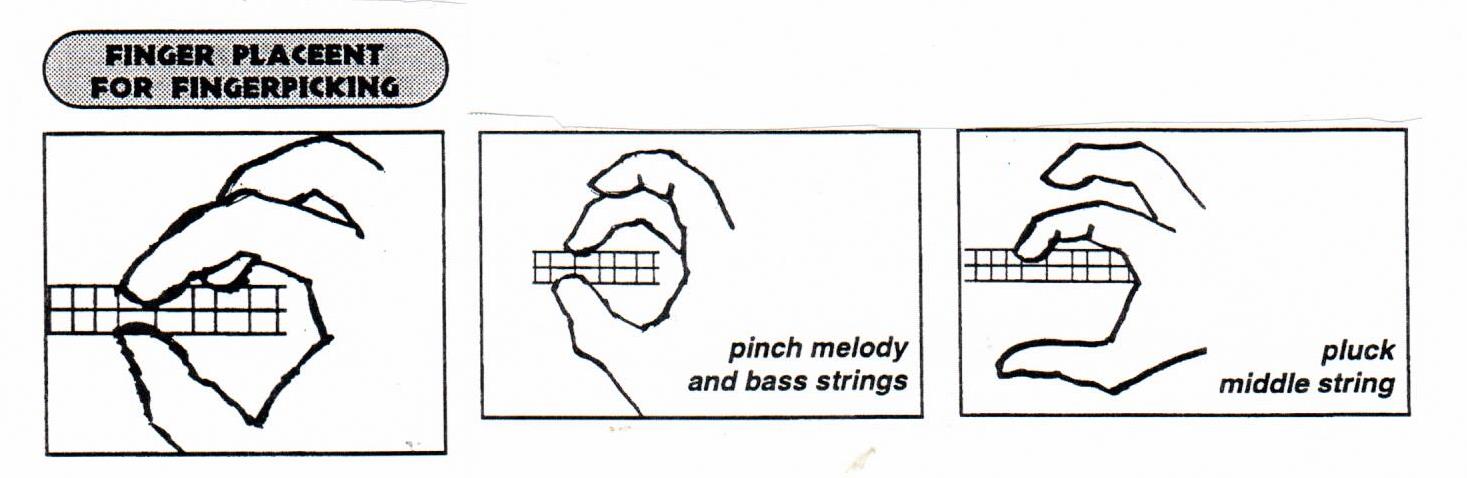
Picking with your fingers is quiet compared to using a pick. A room full of pickers can drown out a fingerpicker. To achieve a louder tone, you can place fingerpicks on these three fingers.
Fingerpicking Patterns
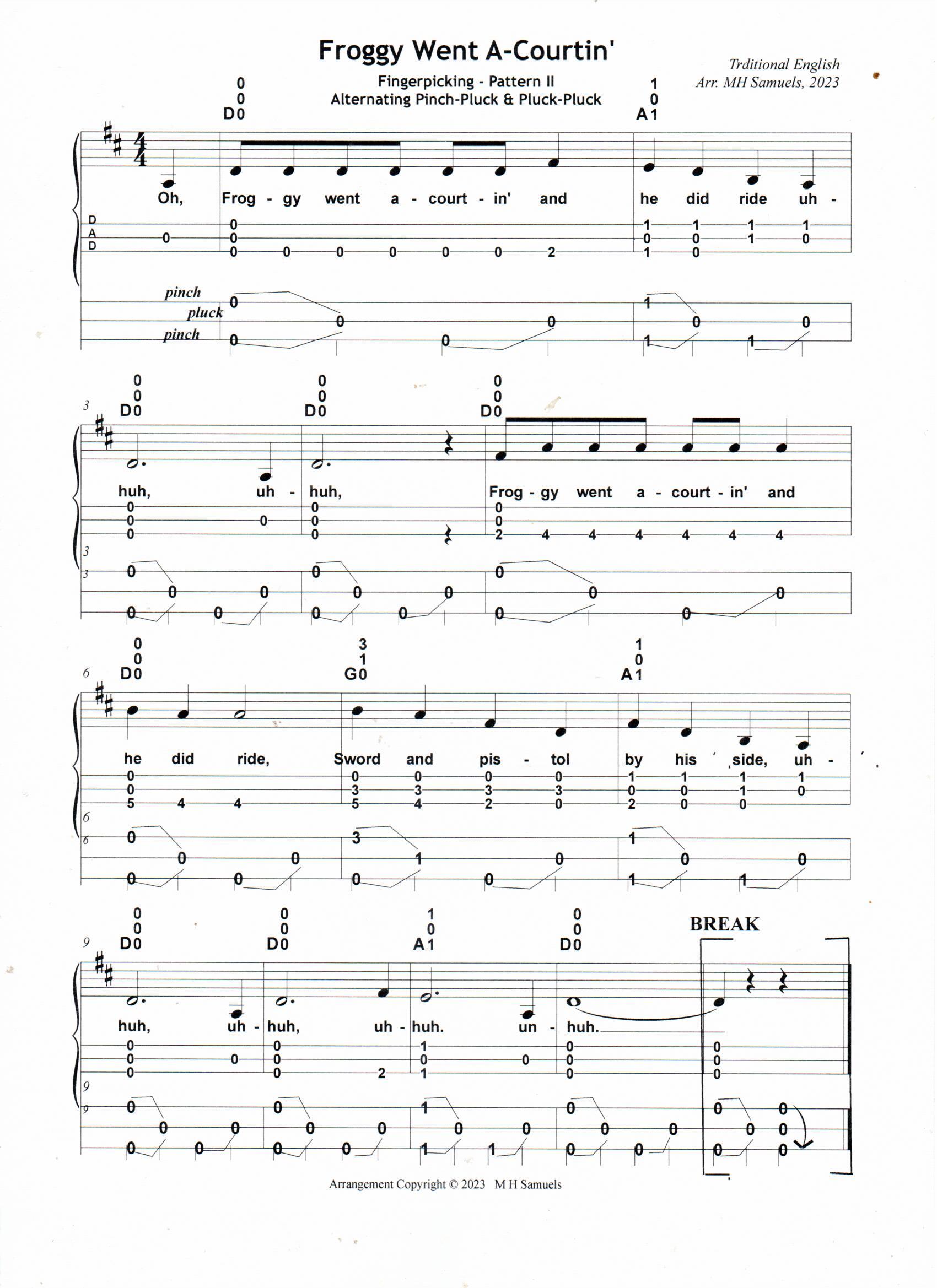
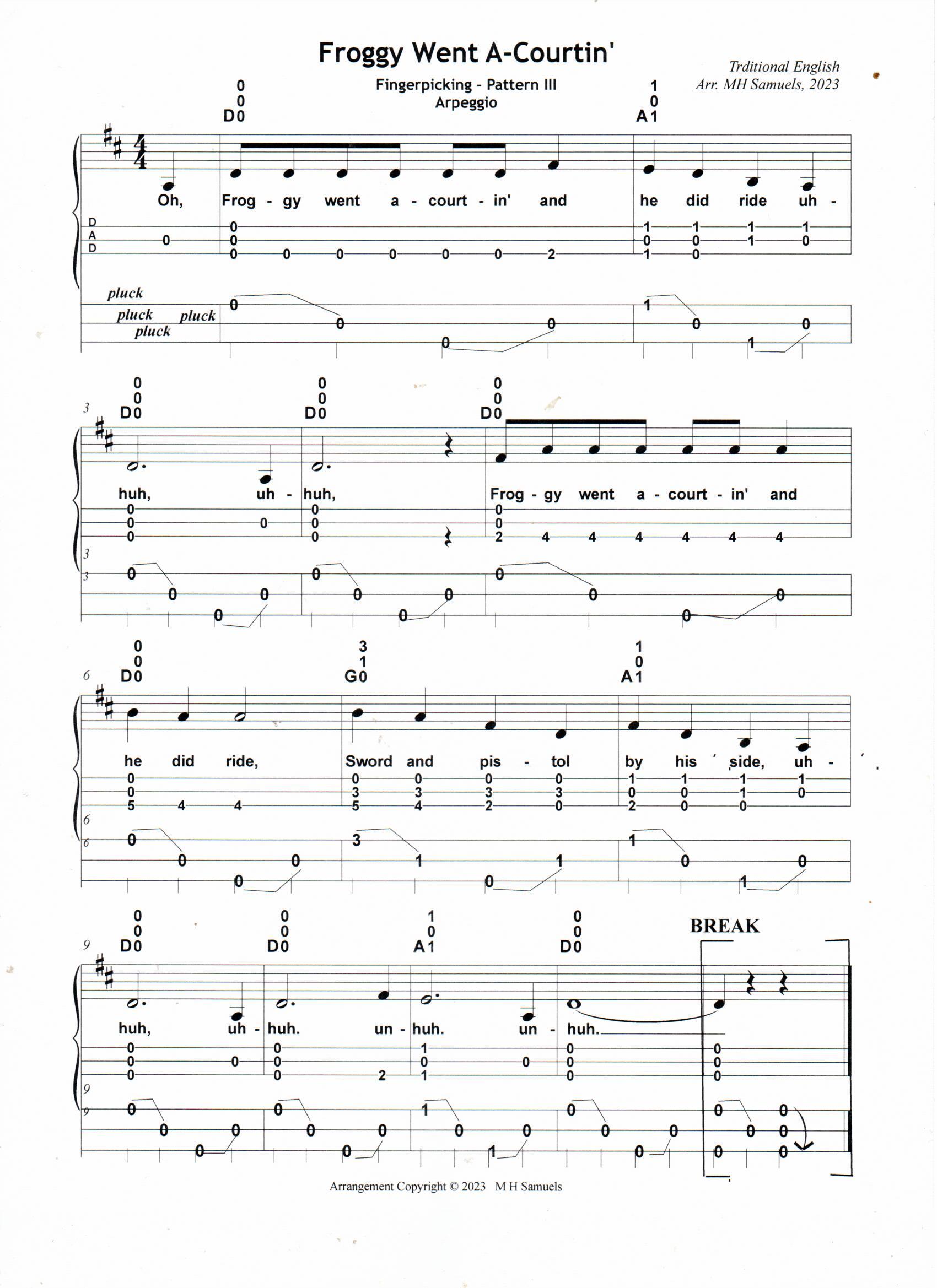
There are many, many fingerpicking patterns and styles of fingerpicking. Here are three simple ones. Pattern I is the basic one, Pattern II and Pattern III are derived from the first one. These patterns are for songs in 4/4 time signature. I have given diagrams of each pattern on the tablature for “Froggy Whent A-Courtin'”.
- “Pinch-Pluck” (Pattern I): On the first beat of the measure, “pinch” or fingerpick the melody and bass strings at the same time using your thumb and middle fingers. Then on the second beat, “pluck” the middle string with your index finger. Repeat this pattern for the entire song, changing chords with your left hand when appropriate. The right hand fingers keep to the same strings — that part doesn’t change.
- “Pinch-Pluck & Pluck-Pluck” (Pattern II): On the first two beats of the measure, follow the pattern above. “Pinch” the melody and bass strings with your thumb and middle finger, respectively, on the first beat. On the second beat, “pluck” the middle string with your index finger. On the third beat, “pluck” only the melody string with your thumb. On the fourth beat, “pluck” the middle string with your index finger. Repeat this pattern for the rest of the song.
- “Arpeggio” (Pattern III): Arpeggio means to play each note of a chord individually rather than all together at one time. For this pattern, you simply fingerpick each string individually. Play the bass string on the first beat of the measure (with your middle finger). On the second beat, play the middle string (with your index finger). On the third beat, play the melody string (with your thumb). On the last beat play the middle string again (with your index finger.) Repeat this pattern for the song. This “arpeggio” pattern is almost like Pattern II.
“Brush”
End the song with an inward brush. With your index finger, brush across all three strings — bass to melody — with your index finger. It gives a final “hurrah” to the song.
Vary the Patterns
Once these patterns are memorized comfortably, the patterns can be combined throughout the song. Add an inward “brush” here and there. Or, invert the patterns. Or increase the tempo of the fingerpicking patterns by picking a string on each eighth note rather than quarter note. Add a little variety — but really not too much! Then sing the verses as you play along which is the goal of this style of fingerpicking.
You Tube Video
Here is a beautiful version of “Froggy Went A Courtin'”. The musicians are playing harmony with their instruments — no dulcimer in this arrangement — but it gives an idea of what can be accomplished with fingerpicking. It is by “Elizabeth Mitchell & You Are My Flower,” from Mitchell’s fourth Smithsonian Folkways album ‘Blue Clouds.’ And I see Jay Unger in the video — so these are top notch musicians. No problem — we can do it too!
Here is my version of “Froggy Went A Courtin'” for dulcimer with the melody tabbed out as well as fingerpicking patterns and lyrics. These JPEGS are not intended for download — there’s an extra measure in these versions. I are included PDF files (which are correc) to download. Enjoy!


References:
https://en.wikipedia.org/wiki/Frog_Went_a-Courting
https://secondhandsongs.com/work/119833/all
Home

