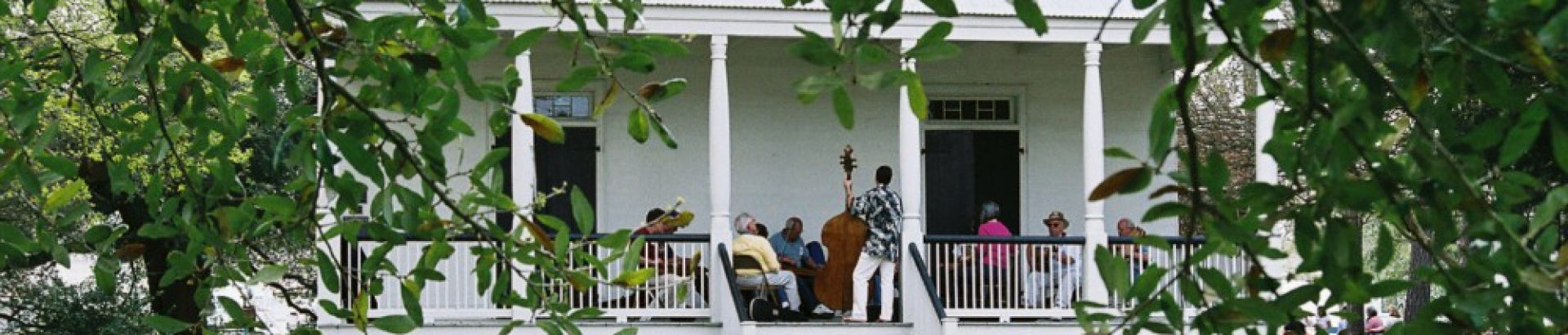

This year, our Lagniappe Dulcimer Society group was asked to participate in the Creole Christmas Celebration at the Magnolia Mound Antebellum plantation in Baton Rouge. The original cottage of this French Creole house was built circa 1791 and is one of the oldest buildings in Baton Rouge. The goal of the Creole Christmas Celebration is to re-enact a garden party as it might have existed at an antebellum plantation of the early 1800’s. I researched Christmas music which might have been performed at this time in Louisiana; and found that Christmas was celebrated very differently during the 1700’s and early 1800’s in colonial American. It was a primarily family celebration, although it seems that there was plenty of dancing. singing and food. I wrote a dulcimer arrangement of “Rise Up, Shepherd, and Follow” for this event.

The area south of Baton Rouge was settled by French, Spanish and even some Germans, Irish and Italians. The parishes north of Baton Rouge included English, Irish and Scottish settlers. For our performance, I included songs from these native countries, as I couldn’t find ones specific to Louisiana.
Early Magnolia Mound Plantation
In fact, the first two owners of Magnolia Mound were Irish including Irish immingrant John Joyce. In 1798, John Joyce, who was a merchant and builder, drown during a business venture on the Gulf coast. His Irish widow married Armand Duplantier in 1802. Duplantier was a native Frenchman who served under Marquis de Lafayette during the American Revolution. He expanded the original plantation home, adding and updated the main rooms in the fashionable Federal style. Elaborate European furniture was purchased in the port of New Orleans and the home was finely decorated. The Duplantier family owned the plantation from 1802 to 1830. They raised cotton and later sugar cane on the 900-acre plantation. It was a fine Louisiana plantation.

Christmas Carol Performance List
For our performance, I selected traditional carols which originated in the countries of France, England and Germany, some dating back to medieval times. The carols are not as common as the ones which we are used to hearing, but they are quite beautiful. We included French tunes such as “Bring a Torch, Jeanette, Isabella,” “The Friendly Beasts,” “Il est Né le Divin Enfant,” “Noël Nouvelet” and “Patapan.” I love the Gloucestershire Wassail and it made the list even though this area of Louisiana definately wasn’t English. It was hard to narrow the music choices.
I wanted to include African-American spirituals related to Christmas and discovered that there probably were none as the slaves on these Louisiana plantations did not celebrate Christmas at all in these very, very early colonial years. I did, however, find a beautiful African-American spiritual related to Christmas which dates to the late 1800’s, “Rise Up, Shepherd, and Follow.” I have included a dulcimer arrangement for that tune in this blog post.
Christmas in Early Louisiana
In colonial America, Christmas was celebrated quite differently than today. Due to the influence of early Purtian settlers and other Protestant reformers, Christmas celebrations were frowned upon, especially due to the English secular drinking and rowdiness. The southern states (Louisiana, Alabama, Arkansas) were the first to delcare Christmas Day as a state holiday in the early 1830’s. (The northern states added this day as a holiday later.) Christmas in those early times was mainly a family celebration, as well as parties, dancing and singing. In Creole Catholic Louisiana, the family attended Midnight Mass on Christmas Eve followed by a meal of meat and seafood gumbo. Then the family probably partied the rest of the night and held an elaborate banquet meal called, “The RÉVEILLON,” which was served towards dawn.

The la crèche, originating in 12th century France, is an important part of French homes. There were also liturgical dramas, (a type of play acted within or near the church and relating stories from the Bible and of the saints.) The scenes of the manger were re-enacted, in this case, in the cathedrals and the priests used these “mystery pagents” as a way to coax parishioners to church. Many of the early French carols relating to Christmas tell the story of the nativity and the birth of Christ. (Priests were allowed to dance if they kept both feet on the ground.)
In the mid-1800s, slaves were eventually given the day off from work around the time when Christmas Day became a holiday. This date coincided to the break from the fall harvest to the new spring planting season, so the holiday was a welcome respite from the heavy work of slavery. Often the holiday was extended until New Years Day. Slaves were allowed to travel to nearby plantations to visit family and friends. They were allowed to marry. The plantation owner might prepare a more elaborate meal, including fresh meat, for the slaves with small presents of candy for the children. And there was also dancing, singing and drinking.
African-American Christmas Season Spirituals
Folk music collectors have lamented on the absence of African-American Christmas spirituals. For example, “When Thomas W. Talley was the director of the Mozart Society at Fisk University in Nashville, Tennessee, he was looking for a Christmas number that would capture the spirit of a jubilee song. He wrote, ‘As the son of an ex-slave, I knew a great many jubilee songs, but none pertained to Christmas.’ ” After searching far and wide, he realized he would have to create an original jubilee carol. “Behold That Star” was the result.” (See Reference)
I did find several other referances to African-American sprituals relating to the Christmas season. The first is “Mary had a Baby.” It was documented in the 1800’s at the Penn School in St. Helena, South Carolina. On this island, the slaves were more isolated from the white civilization than any other place in the United States and some of these traditional songs survived.
“Rise Up, Shepherd, and Follow” comes from a fictional novel written by Ruth McEnery Stuart (1852-1917). She originally lived on a Louisiana plantation. In her fictional story about a plantation called Sucrier Plantation, the slaves danced and sang the song, “Rise Up Shepherd and Follow” for their slave owner. It is presumed that Stuart heard the song while living in Lousiana and did not write the lyrics herself. The song was published in Lippincott’s Monthly Magazine, vol. 47, January 1891, in the fictional story called “Christmas Gifts.” The lyrics were set to music and published in 1902.
“Rise Up, Shepherd, and Follow” — both the lyrics and tune — have evolved over the years. The current version gained popularity in hymnals in the 1980’s. It is a beautiful tune.
Dulcimer Arrangement
I have arranged the tune for dulcimer in DAD tuning. It uses the C natural rather than C sharp note, giving it a mixolydian minor sound. It should be played in an expressive manner. Katie LaRaye Waldren wrote a version of this song which includes some jazz-type chords — I don’t know if this book is still available. Waldren is one of the most creative mountain dulcimer arrangers that I know. If you can find her self-published book, you are in luck. She also plays the hammered dulcimer, has written several tablature books, is a dulcimer instructor, and has a number of recordings.
I love playing and singing Christmas carols and music. It’s a musical time of the year. Although contemporary Christmas songs are nice, some of these older, traditional carols make make a beautiful and special performance. I enjoyed my exercise of finding out what song was written at what time. So many of the hymns and carols which we sing were written in the late 1800’s and even the 1900’s. But, there are plenty of tunes which were written much earlier.
Enjoy my version of “Rise Up, Shepherd, and Follow”!

1 There’s a star in the East on Christmas morn;
Rise up, shepherd and follow,
It will lead to the place where the Christ was born;
Rise up, shepherd, and follow.
Refrain:
Follow, follow,
Rise up, shepherd and follow.
Follow the Star of Bethlehem;
Rise up, shepherd, and follow.
2 Leave your sheep and leave your lambs;
Rise up, shepherd and follow;
Leave your ewes and leave and rams;
Rise up, shepherd, and follow. [Refrain]
3 If you take good heed to the angel’s words;
Rise up, shepherd and follow;
You’ll forget your flocks, you’ll forget your herds;
Rise up, shepherd and follow. [Refrain]
References:
https://www.hymnsandcarolsofchristmas.com/Hymns_and_Carols/behold_that_star.htm
https://www.umcdiscipleship.org/articles/history-of-hymns-mary-had-a-baby
https://www.stnicholascenter.org/who-is-st-nicholas/origin-of-santa

 Dulcimer Jambalaya
I love your articles and have saved many of your tabs. Have you put together a Christmas book of tab?
LikeLiked by 1 person
Hello, that’s for your warm regarding my tab. I am so glad that you are downloading the tabs and, hopefully, playing them. I love the feedback, especially what you would like to hear more of. Yes, I have thought about making a book of my own Christmas tab. It would have to be some of the more unusuall Christmas tunes, as there are plenty of other great books of Christmas tab out there of the more familiar tunes. Perhaps that is a project for next year! I certainly have enough music to fill a book. Thanks again for visiting my blog and merry holidays!
LikeLike