
The holiday season is a great time to enrich our lives with music; especially tunes played on the mountain dulcimer. I enjoy learning and playing Christmas carols which originate around the world and are not so known so well in this country. “Sussex Carol” fits this description; it is the quintessential English carol. Written in 6/8 time signature, it is simple, melodic and uplifting. This carol is sometimes included in the Christmas Eve Mass service as sung by the King’s College Boys Choir in Cambridge, England. I found a wonderful but complex version sung by the choir on YouTube composed by their organist and choir director, David Willcock. Willcock included an organist playing an eclectic countermelody while the choir added several descants. After some consideration, I decided to make a much simpler version for the dulcimer. My carol can be played as a solo. If desired, you can add the countermelody which I based on Willcock’s composition. A third person can add the chords. The countermelody is actually a stand-alone piece and can be played as an interlude or “break.”

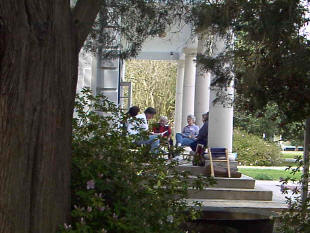
Here is the Episcopal Chapel in Lafayette, Louisiana, at their Christmas Eve Mass service last year. How we got to Lafayette on Christmas Eve to attend the mass is another story. But it was a beautiful service full of music. Was “Sussex Carol” was included? I don’t remember. However, there is a relationship of the Episcopal Church to the Church of England, and a Christmas Eve Mass in England to my story — keep reading.
About “Sussex Carol”
“Sussex Carol” is also titled, “On Christmas Night, All Christians Sing.” The song’s message, given by the angels to the shepherds, proclaims to the world peace and goodwill on that first Christmas night. It conveys the inspiration of salvation brought by the Christ child.
The British Isles has a rich history of carols — some relating to the seasons, planting crops and harvest; others to the Christmas holiday. Many are centuries old. While some of the carols were documented in song books and broadsides; others were known only to local communities and passed along by oral tradition.
The first publication of the words for “Sussex Carol” was a book written in 1684 called “A Small Garland of Pious and Godly Songs.” It was written and distributed by Bishop Luke Wadding to his parishioners. Waddings was an Irish priest, 17th century Wexford County, Ireland. It is unclear whether he wrote the words or just copied them down.

The melody to “Sussex Carol” was documated several centuries later. Around the introduction of the radio and phonographs, English folklorists scoured the countryside and local communities to document the folk music which was passed along by oral tradition — before it disappeared to mass media. These folklorists included Cecil Sharp and Ralph Vaughan Williams (1872 – 1958). Williams was a great English composer who had a strong interest in recording English folk music. In 1904, he heard Mrs. Verrall of Monk’s Gate in Sussex, sing this song and quickly wrote it down. Since Williams heard the song in Sussex County, England, that’s what he named the song.

King’s College Choir arrangement of “Sussex Carol”
I found a beautiful arrangement of the “Sussex Carol” on YouTube as sung by the King’s College Choir. This choir is located in Chambridge, England, and consists primarily of young boys along with a few adult men. The carol was sung during the Christmas Eve mass held at King’s College Chapel in Cambridge, England. This church service is called the “A Festival of Nine Lessons and Carols.” Beginning in 1928 and still continuing today, the service and music is broadcast annually on BBC throughout England and the world to millions of listeners.
The arrangement of “Sussex Carol” was written by David Willcocks, British choral conductor, organist, composer and music administrator. He was Director of Music and organist for the King’s College Choir from 1957 to 1974. He is especially known for descants and carol arrangements which he wrote for the annual service of “Nine Lessons and Carols.” His complex arrangement of “Sussex Carol” for choir and organ was published in 1961 in the Oxford Press. He also published many of his arrangements in a series of books, entitled, “Carols for Choirs.”
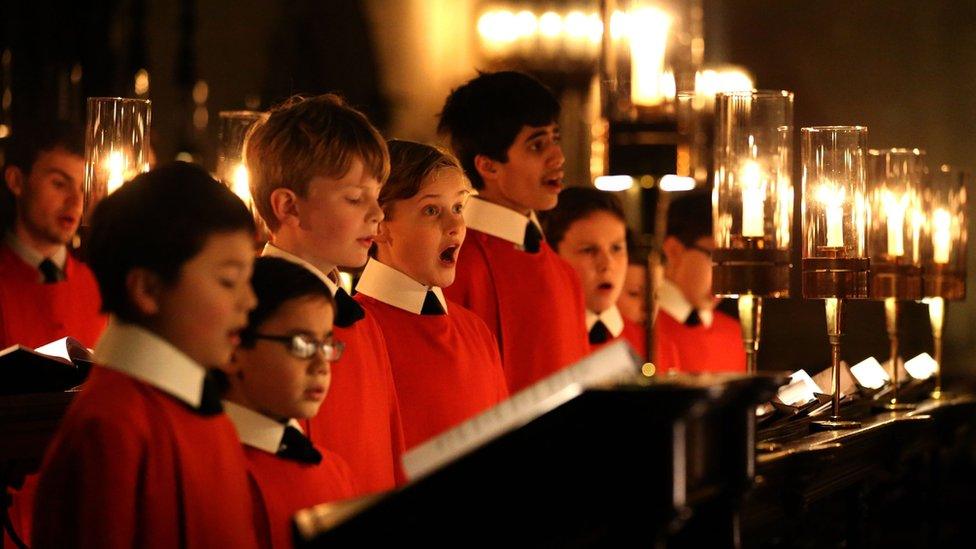
King’s College Choir of Cambridge, England
The King’s College Choir is a boy’s choir which is over 400 years old. The King’s College was founded 1441 by King Henry VI. College Statutes of 1453 stipulate that the College would consist of a Provost, seventy fellows and scholars. In addition, King Henry VI stipulated that the college would include a choir which included sixteen choristers, ten secular chaplins and six “singing men.” There were two organ scholars.
The choristers were to be “poor boys” under the age of twelve years when admitted, able to read and sing. In addition to daily singing at Matins, Mass and Vespers, the boys were to wait tables in the Hall. The boys were provided with meals and clothing, and eight pence a week for their board.
Amazingly, the choir has been in continuous service since 1441 — with reduced service during Oliver Cromwell’s rule. The choir has had better and worse times — depending largely on the strengths of the choirmaster. In the 20th century, stronger leadership prevailed. Living and school conditions improved and the choir has flourished. Services transmitted by the BBC have helped. The choir has made recordings and traveled the world.

Sussex Carol Arrangement for Dulcimer
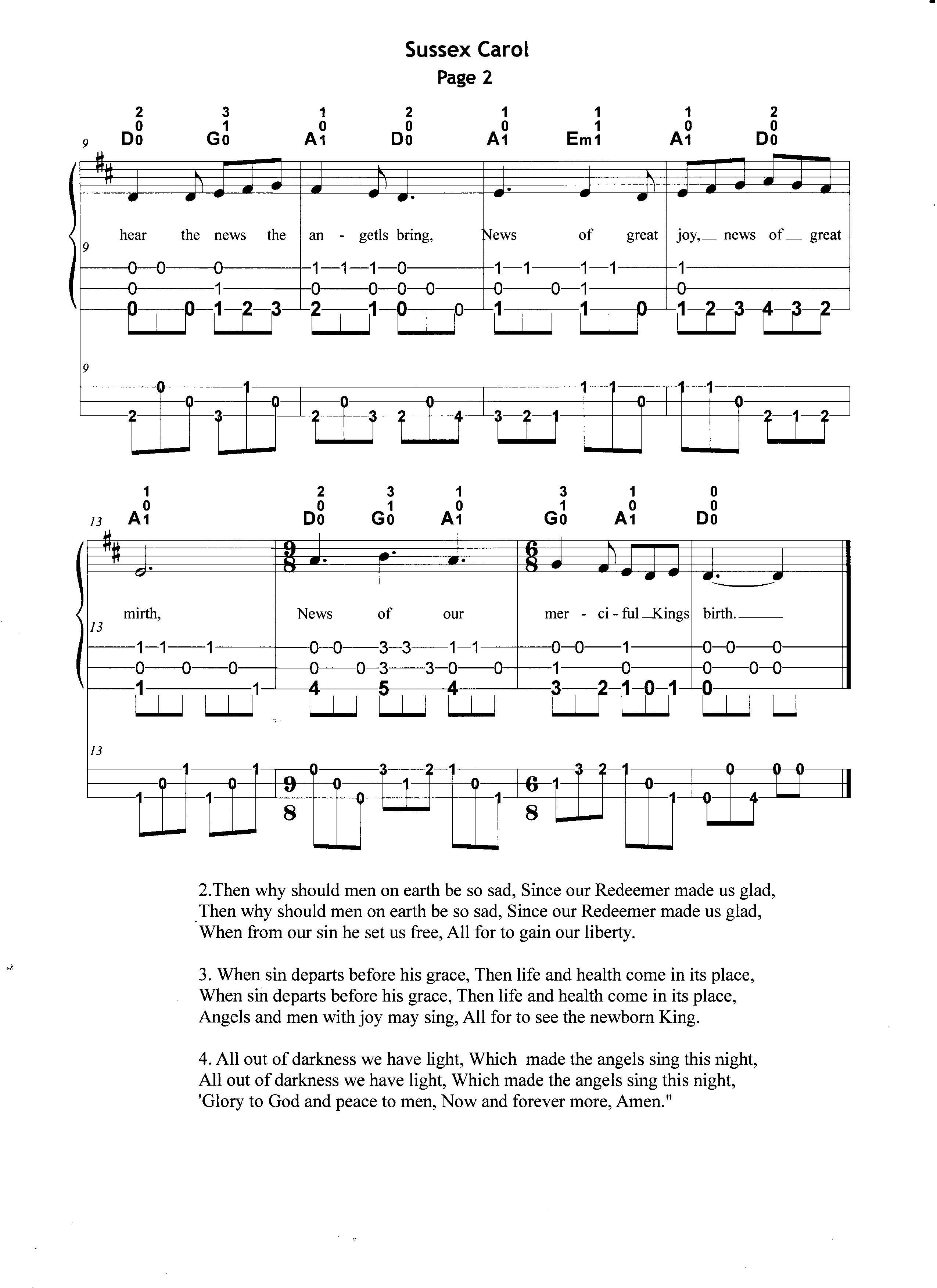
David Willcock’s arrangement done in 1961 includes a beautiful, but eclectic, countermelody played by the organ and several “ah, ah, ah” descants which interweave with the carol’s melody. Of course, this is a copyrighted work. However, I did make an arrangement for a countermelody — and it loosely follows the one played on the organ.
This song is very melodic and is written in 6/8 time signature. At one point towards the end of the song, the carol transitions to 9/8 time signature. Since the song is so melodic, I added fill-in notes to keep the rhythm going. The fill-in notes are shown in lighter tablature numbers.
There are several ways to play my arrangement.
1. The carol’s melody can be played alone as a stand-alone arrangement. Add in the filler notes (in lighter type) if desired.
2. The countermelody can be played along with the melody. It can also be played alone as an interlude or “break.”
3. Chords are included above the standard notation. They can be strummed along with the carol’s melody and/or countermelody.
Thank’s Computer Software
I can thank my trusty computer software, “Finale”, which allows playback of my tablature. This was the only way I could “proof-read” my countermelody to make sure it sounds okay with the carol. Alas, all good things come to an end and Finale is going out of business. What happens in the future remains to be seen.
Enjoy the arrangement
I love history and discovered alot of interesting information while researching the background of the carol and the King’s College Boys Choir. And my memories of attending the Christmas Eve Mass in Lafayette, Louisiana, at the Episcopal Church last year makes this story special to me.
I hope you will enjoy my arrangement of “Sussex Carol.” It is a beautiful carol and is very uplifting during the holiday season. The countermelody adds an unexpected, and hopefully, pleasant addition to the work. Merry Christmas.
A PDF file is included after these images. Please, download, share and enjoy the tune.

References:
https://www.kings.cam.ac.uk/choir/the-choir-today
https://www.pbs.org/wgbh/christmas-tabernacle-choir/the-concert2022/sussex-carol/
https://open.spotify.com/embed/track/0kbQuv2C0AxYS6Kp3CDtGP?utm_source=generator
 Dulcimer Jambalaya
Hello! If you can’t use Finale, you could try Tabledit. (tabledit.com). I use it all the time to write guitar tab and dulcimer tab. It’s Tull Glazner’s go to program for writing tab. It’s about $60 for a copy with free lifetime upgrades. If you decide to get it, I highly recommend purchasing Melanie Johnston’s – TablEdit Manual which you can buy/download from dulcimerdownloads.com The manual that comes with Tabledit is horrible! wordy, confusing, massive! Melanie’s booklet is straightforward, clearly written with examples. You can just work your way through the exercises she presents to build a tune following her instructions, or just use her manual as a guide. It’s great!
LikeLike
Hello, Thanks for the tips for using Tabledit for dulcimer tab and the instruction book. Sounds like a great option, and something I’ll consider. Thanks for visiting my blog.
LikeLike
Just to add to the TablEdit comment that was previously listed.
LikeLike