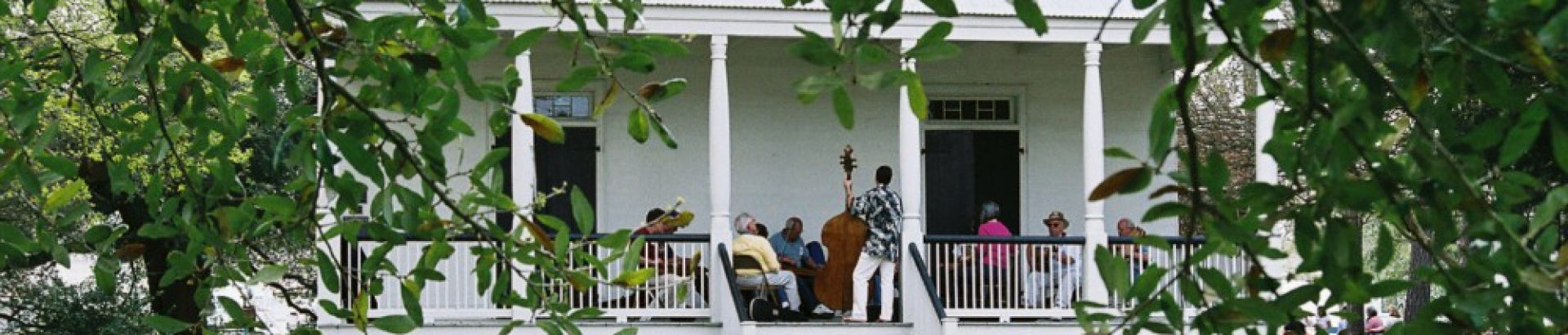

I love all the music of the Christmas holiday season. This especially includes learning and playing some of the lesser known Christmas carols. “Masters in This Hall” fits this category. The carol is based on a French dance tune dating to the 1700s. However, it has never been very popular. I had not heard of it until I stumbled upon a compact disk recording of the tune played by a hammered dulcimer ensemble. The featured instrument was a bowed psaltery and the setting was an old cathedral. The psaltery resonated throughout the church in a slow, ethereal quality. I loved the arrangement! I’ve had this carol in the back of my mind for many years in hopes that someday I could write a mountain dulcimer arrangement. This year, I revisited the song and tried several tunings on my mountain dulcimer. I discovered that it fits nicely in the DAC tuning. I added parts for an accompaniment and chords to give variation and richness. I can definately picture this Christmas carol being played and sung in an old hall, as shown below.

Song’s Origins
The melody of “Masters in This Hall” was composed in 1706 by the French composer, Marin Marais, as a dance for his opera Alcyone. Later, in 1710 an English translation was published in a work called, For the Further Improvement of Dancing. William Morris (1834 – 1896) was an English poet, writer, socialist activist and textile designer. He wrote the lyrics as a poem when he was 26 years old. His poem was paired with the French tune and published in Edmund Sedding’s collection of Nine Antient and Goodly Carols for the Merry Tide of Christmas (1860).
The basic premise of the lyrics is that a humble shepherd can have as much importance as his master and those who are rich in the eyes of the newborn Jesus. It tells the story of a poor man announcing the birth of Christ to the weathly masters of a hall. The refrain celebrates how God’s birth has “cast a-down the proud.” It sounds like a song which a social activist might pen.
The original carol had 12 verses. (It would make a great processional). As with many carols, the lyrics have changed over the years and have been adapted to the times. I found that only four or five verses were included in the sources which I researched. The song is included in The Oxford Book of Carols, published by the Oxford University Press in 1964. (The first edition of this music resource was published in 1928.) I often use this book of carols as a reference for carols of all seasons.

Remember Record and Compact Disk Stores?
Do you remember records, tapes and compact disks? We’re now in a new world of streaming and downloading. However, “back in the day,” a compact disk store was located close to where I lived. I enjoyed going there to browse. At one visit, I discovered as series of recordings, including Christmas carols, produced by Maggie Sansome. Maggie is a hammered dulcimer player from Maryland and her playing and musical arrangements were stellar. She included other musicians in her ensemble playing — and managed several of them on her music label. I was excited to discover that Maggie had transcribed the songs on her compact disks for the hammered dulcimer. Each compact disk makes up one book. These books are published by Mel Bay, Inc. who publishes countless music books for all instruments. Never mind that the hammered dulcimer and mountain dulcimer are two different instruments, I purchased the books anyway as resources.
“Masters in This Hall” is included in Maggie Sansome’s book and corresponding compact disk entitled “Sounds of the Season.” I was able to locate the book on its spot on my bookshelf (but, unfortunately, not the compact disk). I used “Sounds of the Season” as one of the resources for my own version.

Playing the Tune on the Mountain Dulcimer in a Minor Key
“Masters in This Hall” is written in a minor key. It definitely has the sound of a haunting, mysterous song. It is not one of those melodic or joyous Christmas carols with a “ring-a-ling” charm which you hear while walking down the street. No, this Christmas carol needs a special place and time for playing.
It is not difficult to make this carol sound like a dirge when played on the mountain dulcimer. However, when played with expression and lilt, this tune is mesmerizing and beautiful. After all, it is a dance tune. Written in 6/8 time signature, it has the characteristics of a jig, it needs to have rhythm, lilt and beat when played. Although it was written well after the Renaissance time period had ended, the melody has that ancient “feel.”The building shown in all the photos on this post is the City Hall in Hamburg, Germany. The hall has a beautiful interior. I can envision this song being played in the hall. Enjoy!


Often there is more than one way to play a tune on the mountain dulcimer. This song is written in a minor key. For example, place a capo at the first fret in DAD tuning to play a song in the key of E minor. In this tuning, the first fret as “home base.” However, for this song, I found that the DAC tuning works nicely. The first fret is still “home base,” but the Key is D minor.
Tuning a Mountain Dulcimer from DAD to DAC.
It is easy to change from DAD to DAC tuning on the mountan dulcimer. You only have to change the melody string one note lower — the middle and bass strings remain unchanged. Here are the DAD and DAC tunings compared to the notes on a piano.

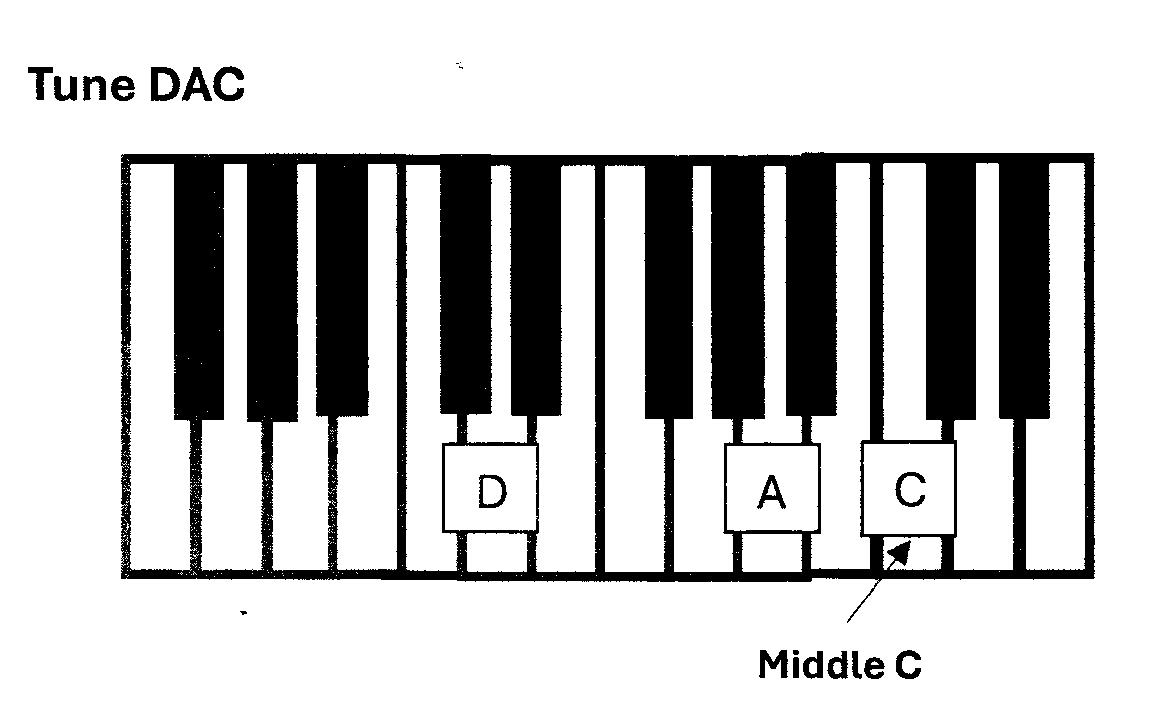
On the dulcimer, the minor scale for this DAC tuning now begins on the first fret. (It is still the “D” note, since we have retuned the dulcimer.)
Here is the DAD Fretboard:
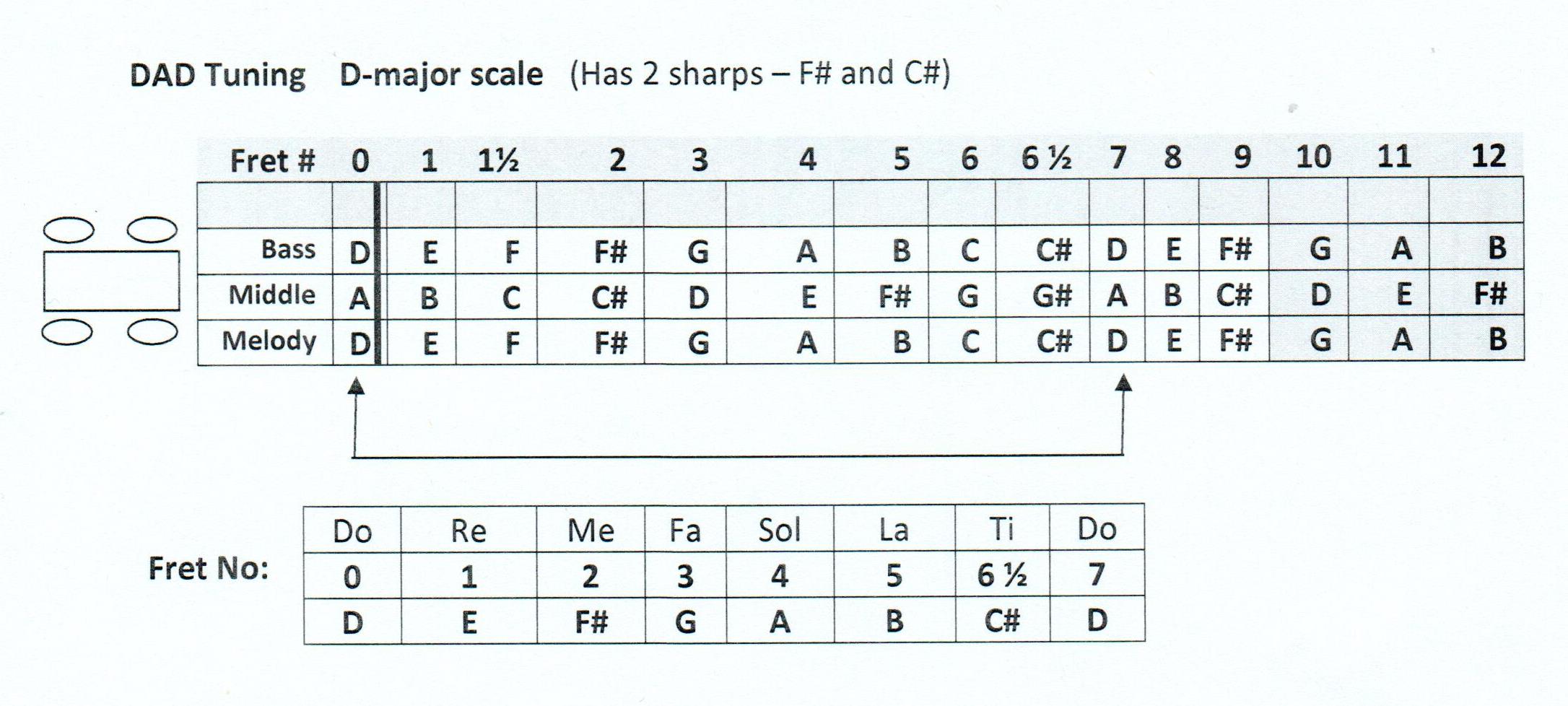
Here’s the DAC fretboard and D minor key. We are still using the 7-step scale (“do”, “re”, me”….scale).
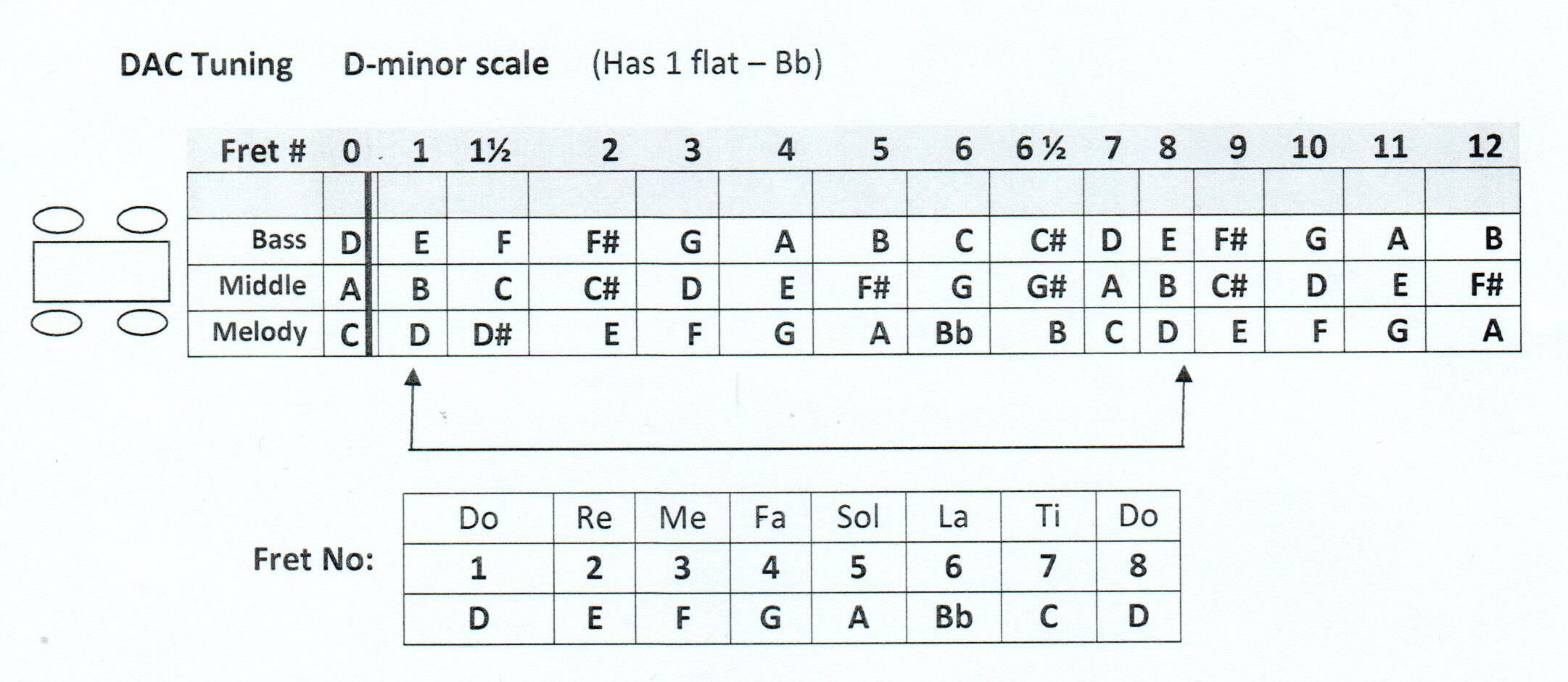
Notice that now there is a Bb note at the 6th fret on the melody string, This minor scale uses the 6th fret and not the 6-1/2 fret. It begins at the first fret and goes to the 8th fret on the melody string. You can’t play an “open” strum across the strings; it will sound very disjointed. You must keep the first fret depressed and strum.
(In this arrangement, a C# does show up in the fourth measure — and that note is not technically on this minor scale. It may sound “out of place.” Play it anyway. The note is found on the 2nd fret, middle string. Likewise, the D7 chord in measure #16 may sound “off”, it is a transition chord. Omit if if you prefer.)
Re-Tuning Reminders
Here are several reminders when retuning a mountain dulcimer from DAD to DAC:
1. Check to make sure you are turning the proper string — it is easy to get them mixed up — and I’ve broken many strings by not paying attention and turning the wrong tuning peg.
2. Don’t turn the tuning peg too much; you only have to turn the tuning peg just a tiny bit to change a note — perhaps just only half-a-turn. Most dulcimers can easily accommodate this small change — but not much more. If the string is getting tighter — stop! You are going the wrong way.
3. As you tune the melody string down to “C” from “D” (in DAD tuning), the string is getting looser since you are going to a note lower.
4. When properly tuned to DAC, the melody string — open strum — sounds the same as the bass string when it is depressed at the 6th fret. It’s the same note.
5. Playing in a new key (D-minor) and tuning (DAC) means learning all new chord positions on the dulcimer. My favorite resource for figuring out chords in different tunings is Bryant Larkin’s wonderful book. It has chords charts for several tunings, including DAC. If you enjoy making dulcimer arrangements, this book is worth looking up. It is a self-published book and used copies may still be available.


Arrangement of “Masters in This Hall” in DAC on the Mountain Dulcimer
Tune in 6/8 time signature or jig time
This song is written in 6/8 or jig time. There are six-beats to a measure — or 2 groups of three eighth note counts. Most of these are paired as a quarter note and eighth note — make sure you hold the quarter note for two counts. Give emphasis to the first eighth note of each three-beat group. Play with lilt.
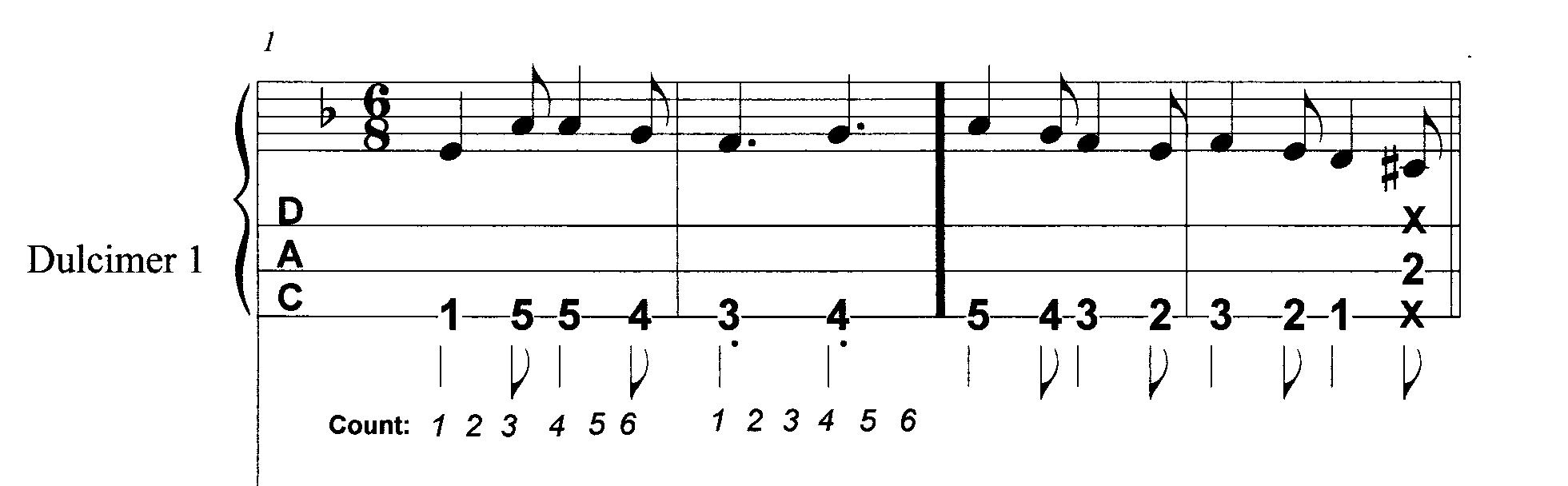
I made an arrangement for two dulcimer parts — plus a third dulcimer can play chords. However, Part 1 is the melody and it can be played alone, too — with either the melody notes only or adding harmony notes.
Dulcimer 1 Part:
Dulcimer 1 plays the melody of the tune. The darker type shows the melody notes. In several places, the notes cross to the middle string. This is either for convenience (easier to play) or because the only place the melody note is on the middle string of the dulcimer.
You can play Dulcimer 1 in two ways. First, play only the melody notes and strum across all the three strings on the first and fourth beats with the middle and bass strings sounding as drones. In several measures, however, play only the notes shown to avoid discordant sounds.
Alternatively, you can add the harmonizing notes which on the middle and bass strings. There are lots of ways to add the harmonizing notes; I changed up the notes throughout the song tp give several options.
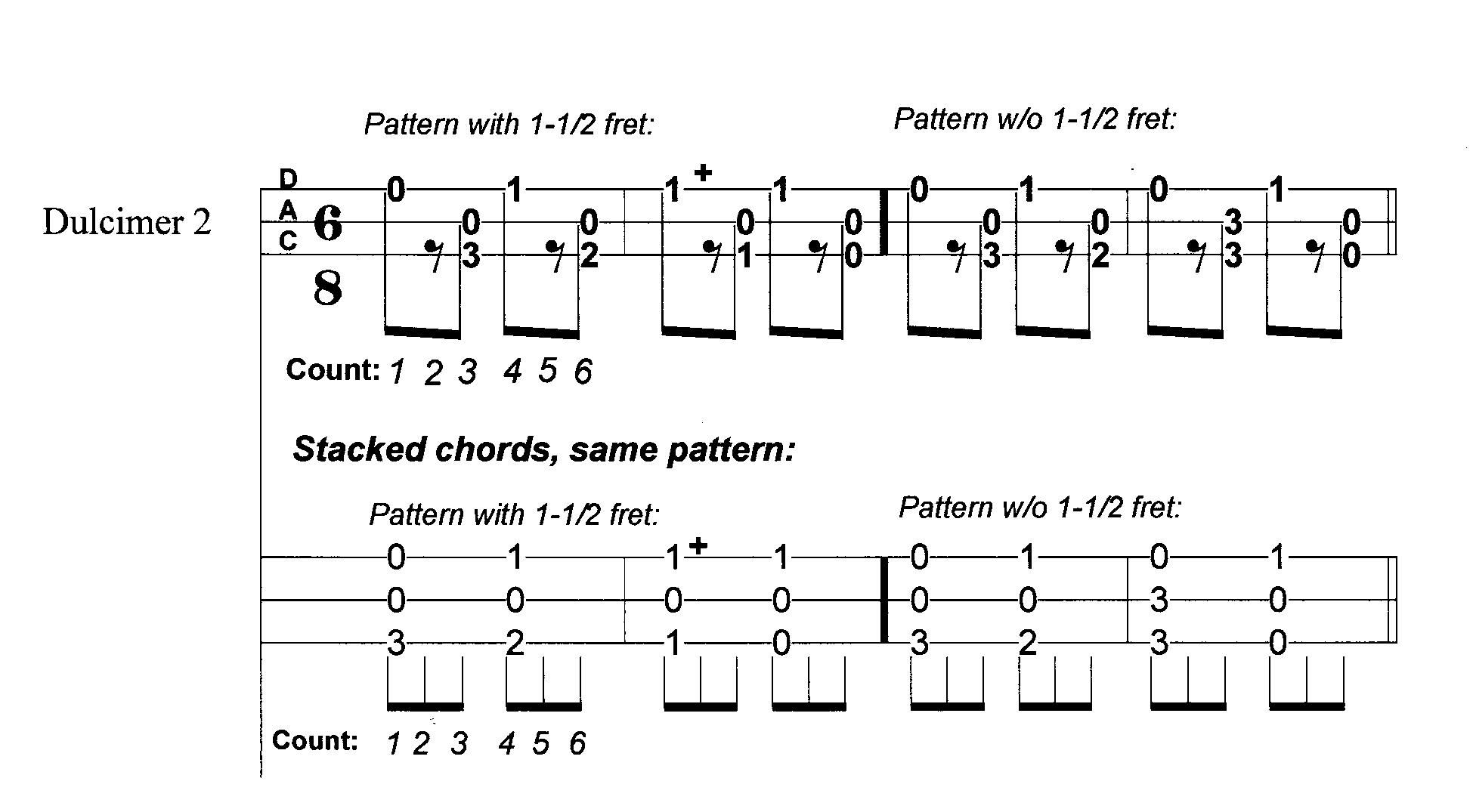
Dulcimer 2 Part:
This part is 2-measure sequence of repeating chords. It is played throughout the entire song until the ending measure. Form the chords on the dulcimer strings at the beginning of the measure; pluck the bass string and strum the middle and melody strings. Although the tablature shows a rest, let the bass string ring out (don’t mute the string. Also, don’t strum).
Chords:
Chords are shown above the standard music line. They are encircled. The top number is the bass string fret number and the bottom number is the melody string fret. Remember, that in DAC tuning, there is no “open” strum; a D-chord is played 0-0-1 (bass to melody string.) There are many ways to form these chords — or in some cases — partial chords. Again, I changed up the chords throughout the arrangement to show the possibilities — select and substitute other chords, if desired.
Play the chords along with Dulcimer 1 and Dulcimer 2. For a break between some of the chords, play only the chords and Dulcimer 2.
Enjoy This Arrangement!
One of my goals is to arrange some of these “lesser known” carols for the mountain dulcimer. After fiddling around for many years, I think I’ve come up with a great arrangement for “Masters in This Hall.” So, retune your dulcimer to DAC (that’s not hard to do) and give the tune a try this holiday season. I have provided several ways to play the carol — as a solo, duet and ensemble.
Please print out and share this arrangement. And play it! I just ask that you don’t publish it or upload it to a public internet site. And, Merry Christmas!
Here are Jpeg files to view; following is a PDF files of the three pages to print out.


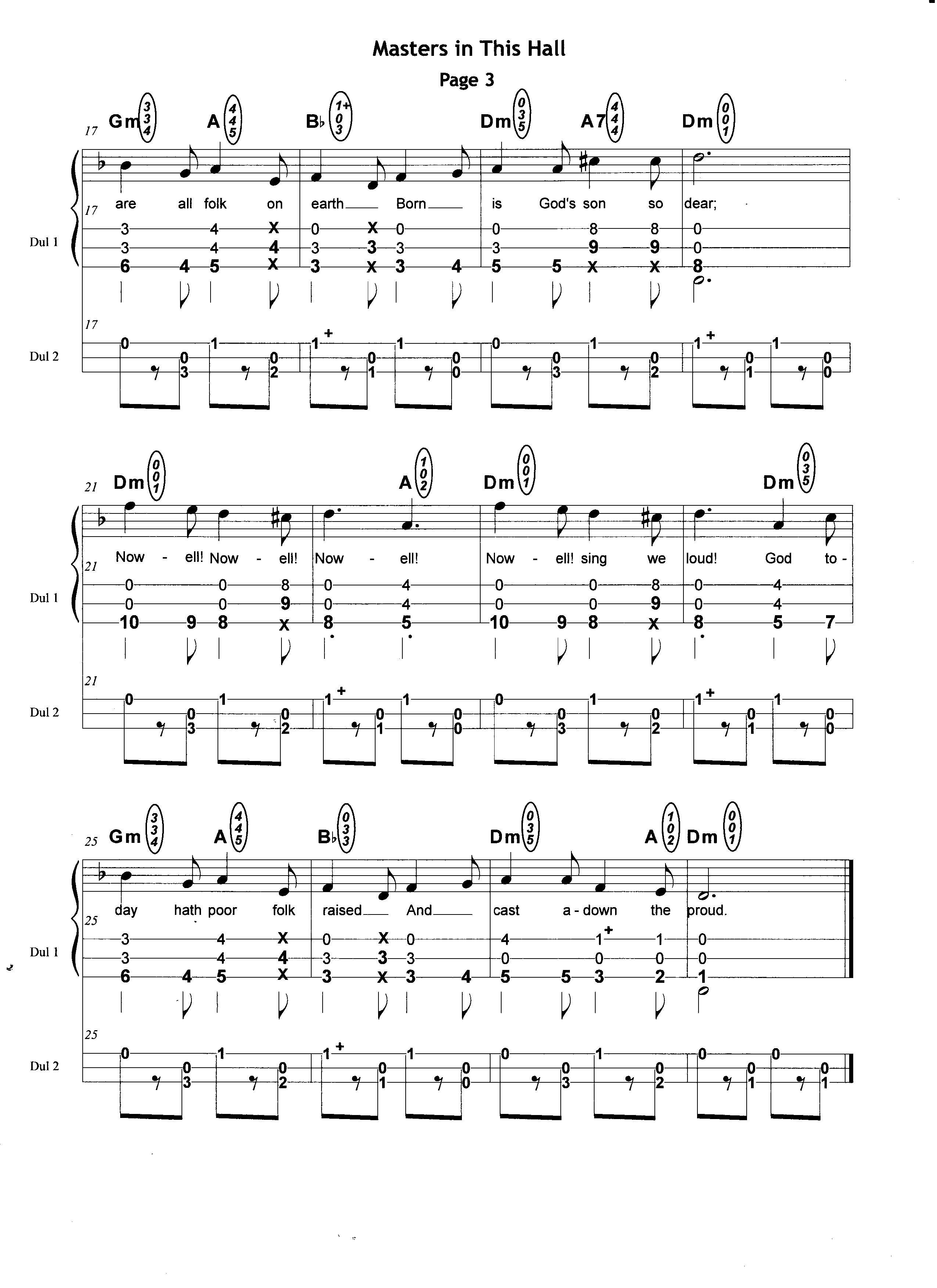
Here is a PDF file to print out:
 Dulcimer Jambalaya
I love Masters in this Hall, which is heard a lot around here in Revels celebrations. Thanks for the article on the history of the song.
-Julie
LikeLike
Hello, Thanks for visitng my blog. It is a great Christmas Carol! I hope you enjoy this arrangement — and you can play the chords on a uke, too, as well as dulcimer!
LikeLike