

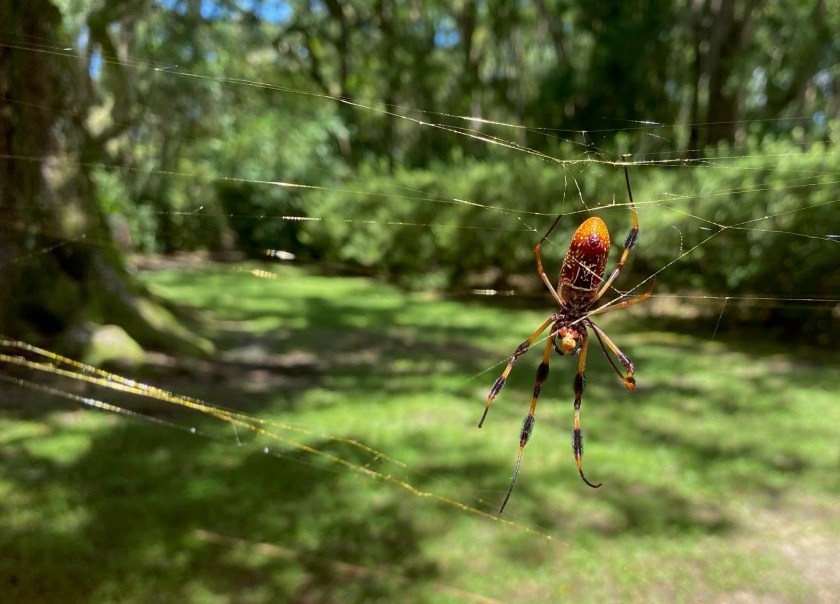
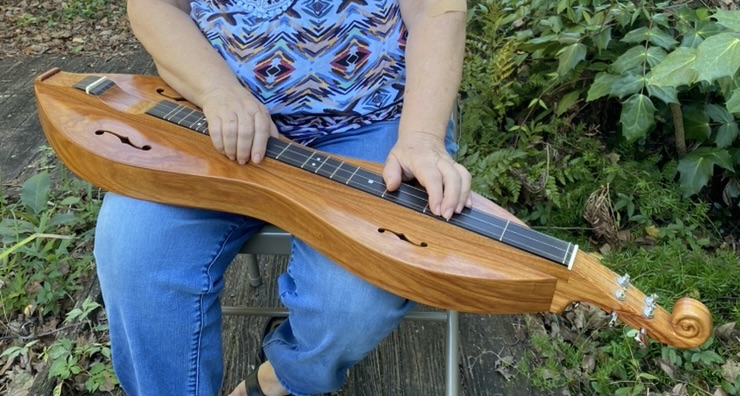
Now, here’s a children’s song reimagined in a unique fashion. While scrolling through my Facebook feed late one night, a particular reel caught my attention. It featured a musician playing a ukulele while belting out the song, “Itsy, Bitsy Spider.”A four chord riff started out the arrangement and continued throughout the song. The singer’s rock band providing a driving, rhythmic beat to accompany the song. And – most importantly — the melody of the song seemed just a little “odd,” to say the least. I got out my dulcimer (tuned to DAD) to try to figure out the chords to the ukulele player’s arrangement. Much to my surprise and excitement, I discovered that the song was being played in the Key of D. Hey, I could play my dulcimer along with the reel on Facebook as it rolled along. Sort of like having a karaoke bar in my own living room late at night. Loads of fun — so relaxing — I must have played the reel for several hours. I kept fiddling around and transcribed the entire tune. The repetitive pattern of the chord riff is great for beginners as a way to learn dulcimer chords. Play this either as a duet with one dulcimer playing chords/bass line and the second melody – or as a solo by singing along with chording. I contacted the performer via Facebook messages; he graciously gave me permission to post my arrangement.
Musician — Sunny Promyotin and “Sunny and the Black Pack”
Ah, to be talented and creative. Sunny Promyotin is a multi-instrumental musician, producer and band leader who hails from the San Francisco bay area. Musically, he is a classically trained pianist. He also excels at playing the ukulele — what an interesting combination. And his stellar vocals are really the key ingredient to all of his arrangements. In 2015 he formed the band, “Sunny and the Black Pack,” which seeks to re-imagine contemporary music. Rather than playing traditional covers of pop, rock, jazz songs — Sunny’s approach is to re-invent the music by starting with a blank canvas and adding the music. In addition to serving as the house band for Howie Mandel (of America’s Got Talent) in Los Angeles, Sunny has quite a social media presence and following. Numerous children’s songs and contemporary songs uploaded to Facebook and YouTube show the creativity and versatility of Sunny’s band. The band has certainly found a social media nich.
“A Riff on Itsy, Bitsy Spider”
I stumbled upon Sunny’s ukulele arrangement of “Itsy, Bitsy Spider” quite by accident on Facebook late one night. But, it turned out to be an interesting adventure — playing the song on the dulcimer along with Sunny’s band. I loved it. With my dulcimer tuned to DAD, I could play along with the Facebook reel. However, digging deeper — I discovered that things were more complicated than it first seemed.
There is alot going on in this song. First, the song includes a dominant base line with a four-chord pattern played on the ukulele (and accompanying guitars) which repeats throughout the entire song. Second, Sunny sings the melody to “Itsy, Bitsy Spider” as the base line chords continue. And, the two components don’t always go together. Let’s look at each part separately. While the intent is to play them as a duet, the parts can actually be played as two individual songs.
Four-Chord Pattern
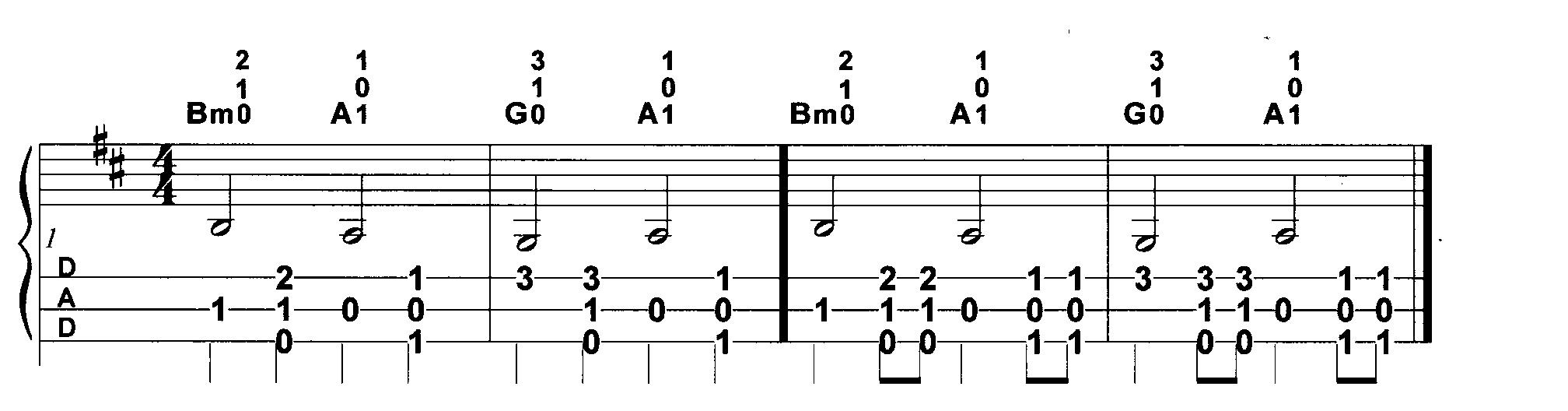
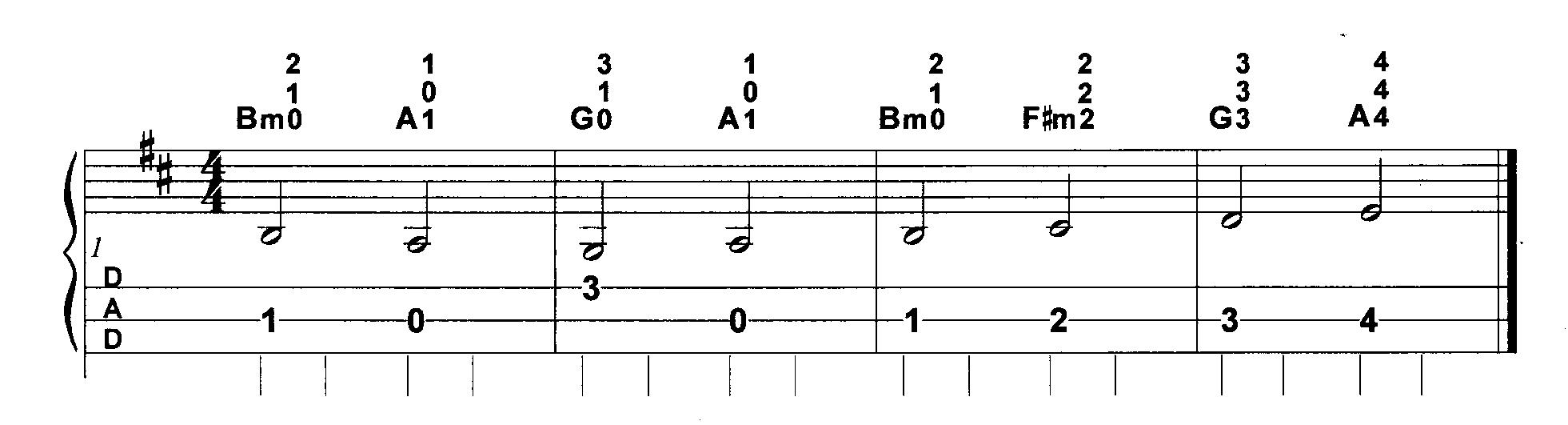
To make sure that I was interpreting the Facebook reel correctly, I consulted two professional upright bass musicians and friends — an LSU Jazz professor and a Boston-based orchestral musician. They independently came up with the same chord pattern — which is reassuring. The chord pattern is — Bm, A, G, A. This pattern repeats throughout the entire song. The “A” and “G” chords are dominant ones in the Key of D. The “Bm” chord shares notes with the “D” chord. Hence, it seems like this song fits into the Key of D.
There are many places on the dulcimer to finger the chords which make up the bass line. Sunny just repeats the same chords over and over. For beginners, I would keep to the same configuration. However, you can also play the chords higher on the fretboard. At one point you can substitute a F#m chord in the mix. Don’t worry. It works.
By using a “pick-strum” approach — picking on the beat and strumming on the backbeat — you can achieve something that sounds similar to the ukulele and guitars on the Facebook reel. Or use a “pick-diddy” pattern on the dulcimer.
Bass Line
There is also a dominant bass line which goes along with the chords and sort of parallels the melody. These notes are found on the middle and bass strings and make up part of the chords.
“Itsy, Bitsy Spider”‘ Melody – D-Aeolian Mode
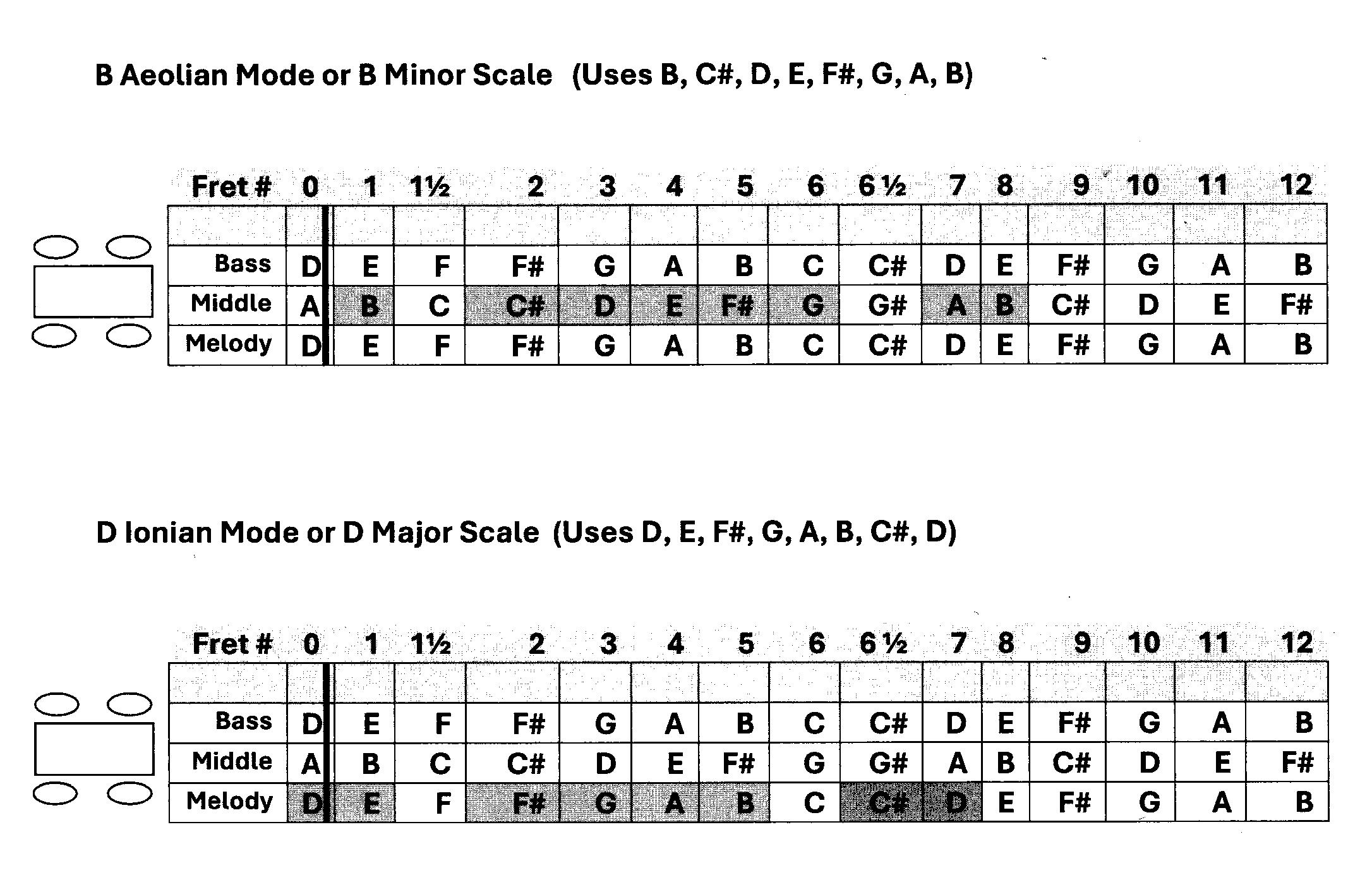
Sunny’s melody to “Itsy, Bitsy Spider” is where things get complicated. The tune, as Sunny sings it, does not sound like the song which we are used to hearing. This is because Sunny has shifted things to a minor key — the B Aeolian mode or the B minor key. It gives “Itsy, Bitsy Spider” a haunting, mountain minor sound.
The B Aeolian mode (or B-minor scale) and D Ionian mode (or D-major scale) share the same notes. Hence, both can be played in DAD tuning.
B Aeolian mode is played on the middle string starting at the first fret on the dulcimer. D scale is played on the melody string starting with an open strum and “zero” fret.
So, for Sunny’s version, the melody to “Itsy, Bitsy Spider” is played on the middle string of the dulcimer starting at the first fret.
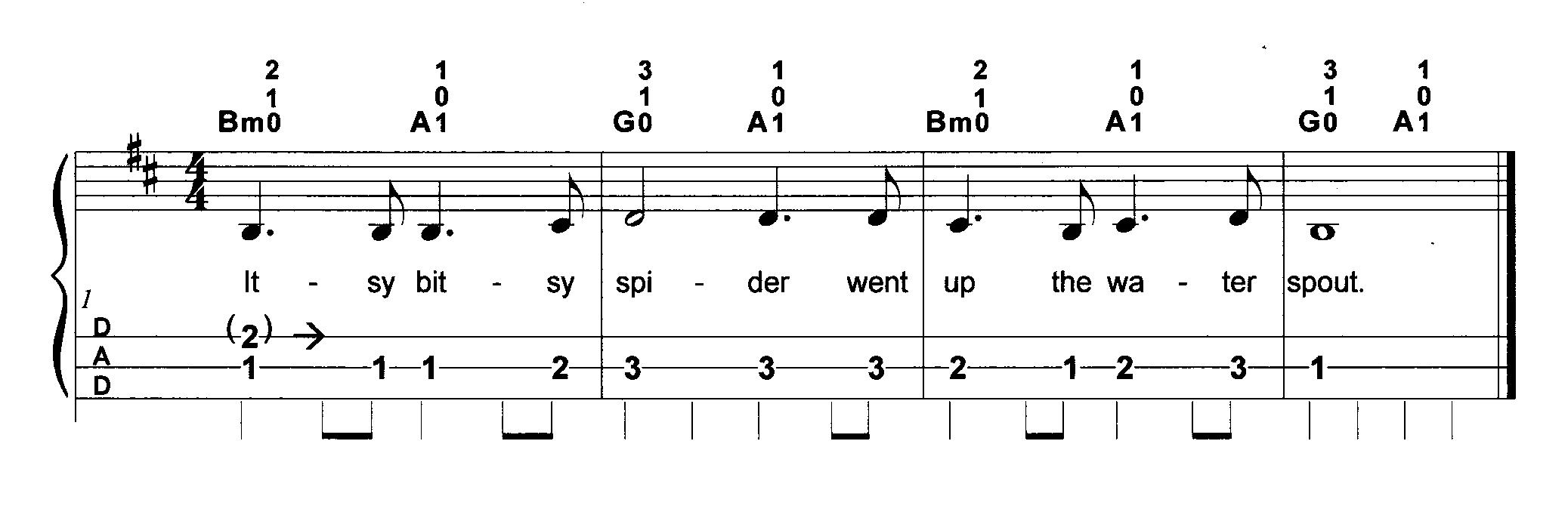
Don’t strum across all the strings when playing any tune which starts on the first fret on the middle string if you are in a DAD tuning without a capo. It will sound horrible.
Add harmony notes on the bass string to achieve a pleasing sound. These frets are shown in parenthesis on the bass string, followed by an arrow which means to hold that fret down the entire time. Try not to play the melody string.
Google Search for Sunny Promyotin and “Sunny and the Black Pack”
So, pull up Google and search for Sunny Promyotin and his band, “Sunny and the Black Pack.” In addition to “Itsy, Bitsy Spider,” the band has many other children’s tunes and contemporary songs posted on Facebook reels and YouTube videos.
Get out your dulcimer and rock along with Sunny! And if you are technologically minded and are using a YouTube video, you can slow down the speed of the reel while maintaining the pitch — thus playing at a slower tempo. Go to the “settings” icon. Although not all Sunny’s music is in the Key of D, at least “Itsy, Bitsy Spider” is dulcimer-friendly.
Here is a YouTube link: https://www.youtube.com/shorts/U7WEvd4-nB8
For Beginner Dulcimer Players – Memory Exercise
For a beginning dulcimer player, learning and playing chords is simply “muscle memory.” Playing the chords over and over ingrains the patterns into your mind. I think that this is called “practice.” I find that playing along to a Facebook reel or YouTube video makes this process an enjoyable exercise. It’s like having a karaoke bar in your living room. Sunny’s “Itsy, Bitsy Spider” has four repeating chords — Bm – A – G – A. Thece chords are commonly used in dulcimer tabature. Learn these chords — as well as the D Chord — and you can play hundreds of tunes.
A Riff on “Itsy, Bitsy Spider”
Sunny’s arrangement is an eclectic rendition of “Itsy, Bitsy Spider.” Moving a song from a major key to a minor mode gives interesting results. And, I love both the ukelele and Sunny’s brassy voice. In this version, both the chords/bass line and the melody are being played/sung at the same time. — They don’t quite match in a couple of places; but who cares.
Playing music late at night is my way of unwinding. I had a great time deciphering Sunny’s version and am pleased with the results. I think my arrangement is true to the Facebook reel.
I hope you will enjoy this mountain minor version of “Itsy, Bitsy Spider,” too! If you have two dulcimers, I intend that both dulcimers play the intro. Then one person plays melody and the second plays the chords. Or, just sing along with your playing.
Here is a jpeg of the tune followed by a PDF file. Download and share the tune with friends. I just ask that you don’t upload/post the song to a public internet site, publish it or distribute the printed version around the country.
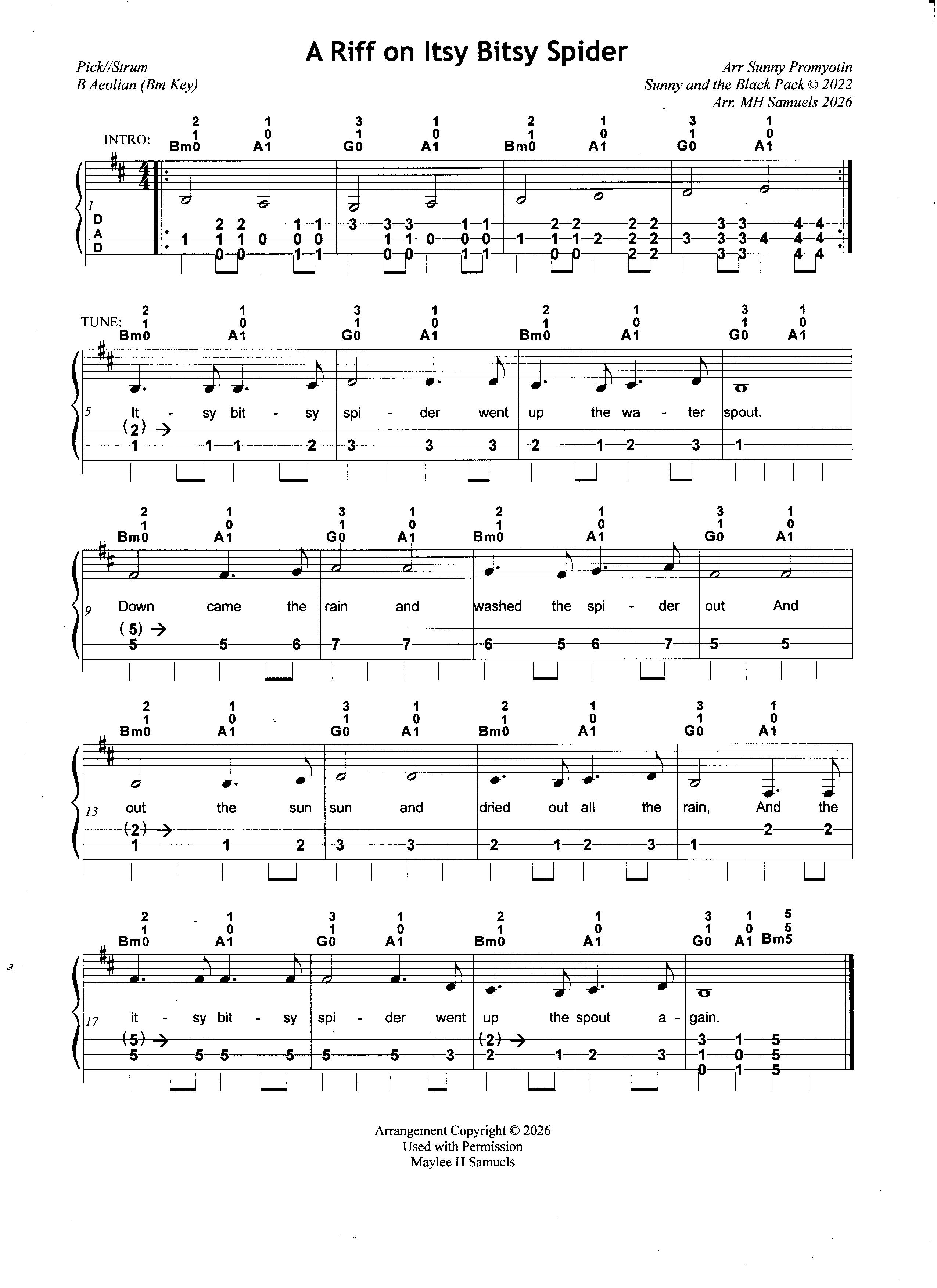
And, here is the PDF file for downloading.
 Dulcimer Jambalaya
i was looking forward to listening to this but I don’t think there is a link.
LikeLike
Since performers sometimes remove and take content down; I try not to post links in my blog that may become broken later on. However, here are a couple of links for Sunny’s song. Enjoy:
YouTube: https://www.youtube.com/shorts/U7WEvd4-nB8
and one on Facebook: https://www.facebook.com/watch/?v=615496056116085
LikeLike