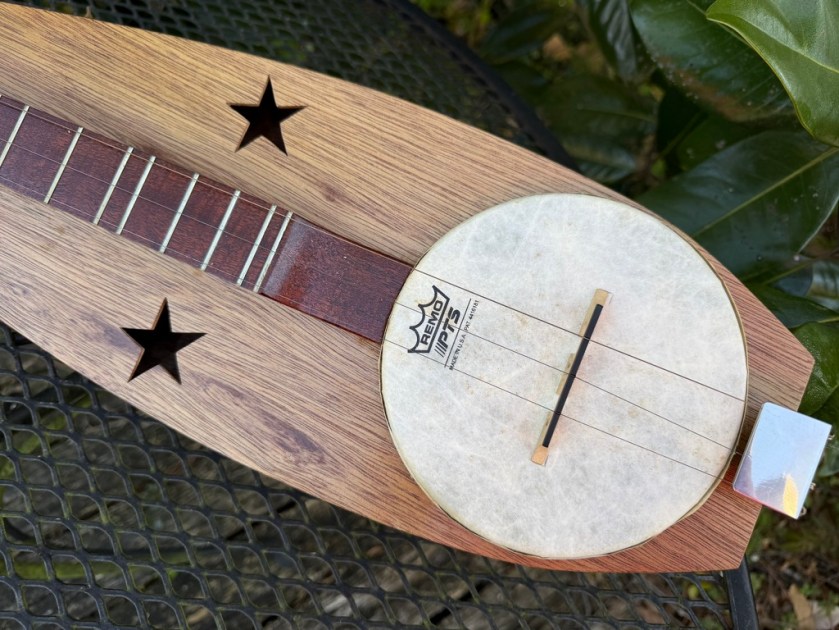
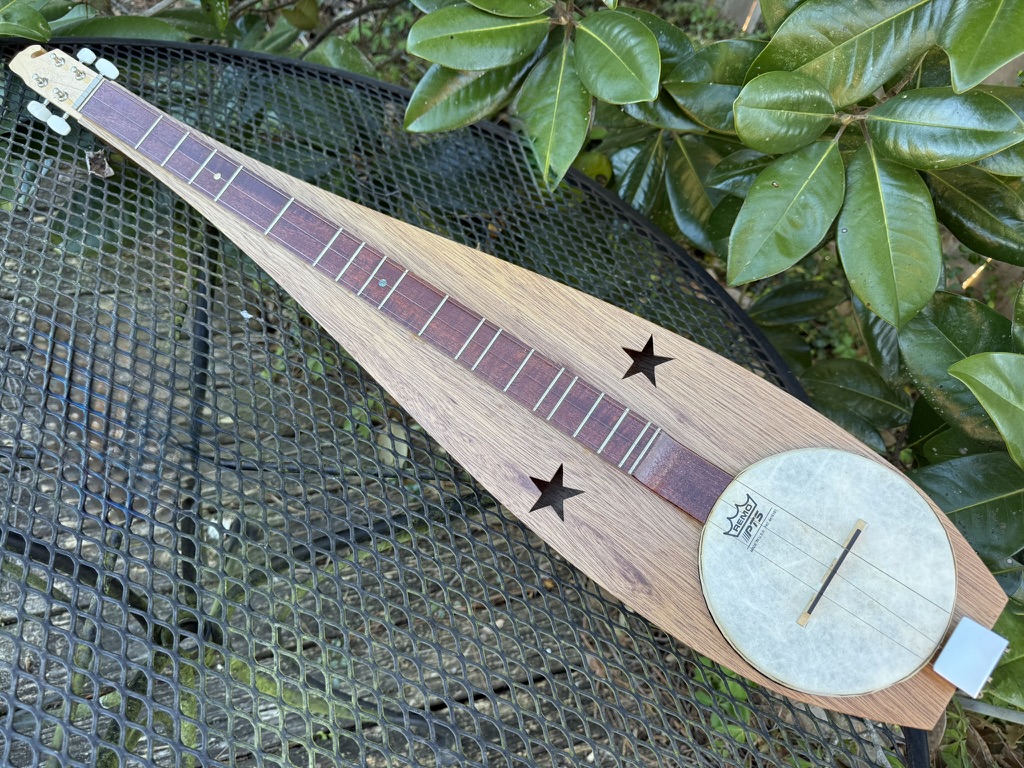
I am enjoying my newest favorite dulcimer — a hybrid banjo-dulcimer — which I purchased last summer. This musical instrument has the round head of a banjo and the fretboard of a dulcimer. It sounds like a banjo but is played like a dulcimer. I quickly discovered that this particular banjomer requires adaption in technique to achieve a pleasing tone. The strings are taunt — they don’t vibrate like a traditional dulcimer — and strumming across the strings can sound very staccato and harsh (like a banjo). So, I did a deep dive into to learning how to play my banjomer including purchasing instructional books written by accomplished dulcimer players. Then, I wrote my own tablature for a tune, “Worried Man Blues.”
Resources for Playing Banjo-Dulcimers
I quickly learned that there are as many ways to play a hybrid banjo-dulcimer as there are dulcimer players. And, the same can be said for traditional banjo players. Some techniques can be modified from traditional banjos to banjo-dulcimers. Other playing styles seem to be unique to dulcimer players. Banjo players fall into two different styles of playing — those who strum (clawhammer banjo) and those who fingerpick. Each style of playing uses totally different techniques. And, each style can be played on banjo-dulcimers.
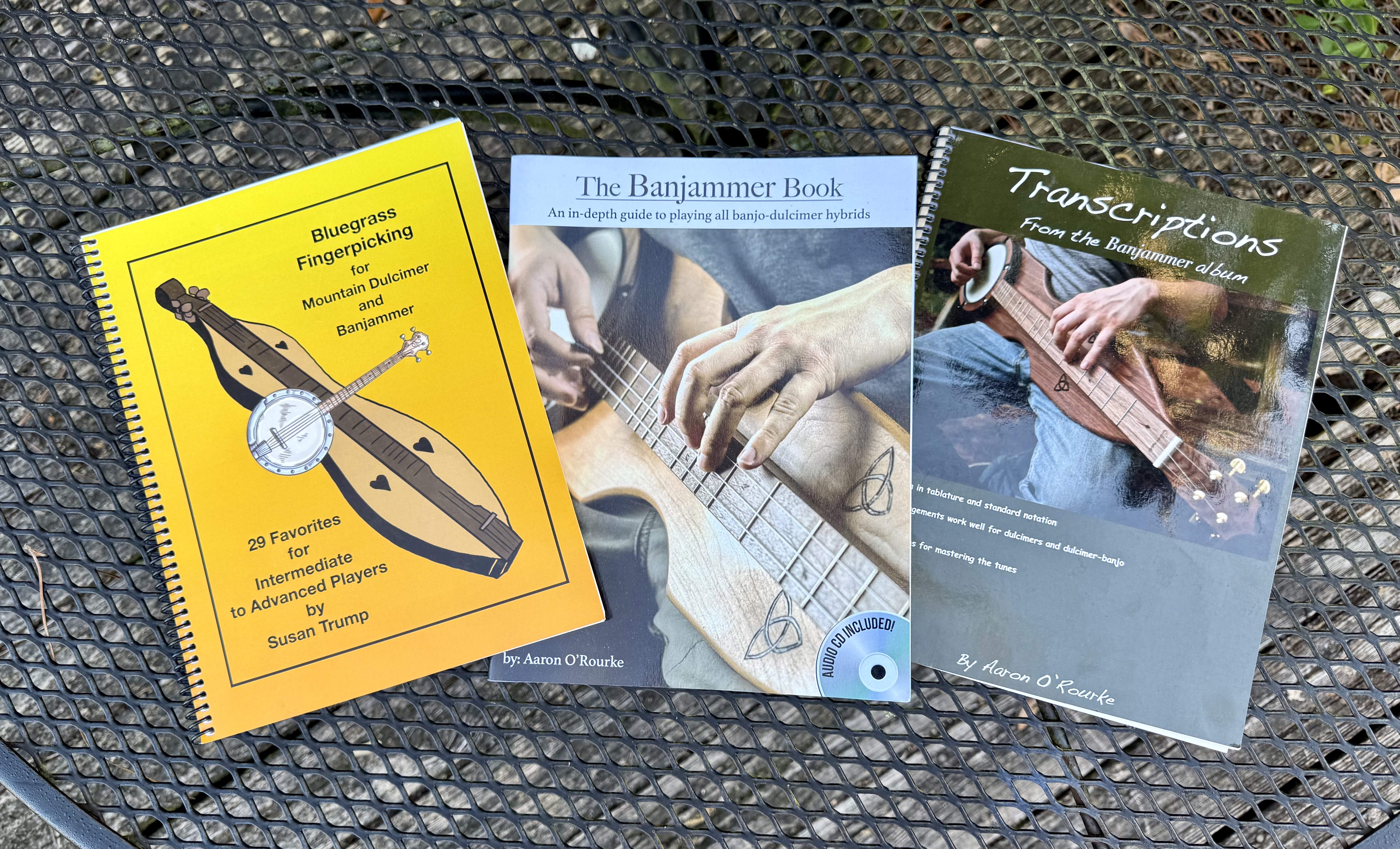
To find inspiration for playing my new banjo-dulcimer, I headed to books written by dulcimer players in addition to watching videos of both traditional banjo players and dulcimer players. Both Susan Trump and Aaron O’Rourke have written instructional books on playing hybrid banjo-dulcimers. These books are excellent and demonstrate the wide range of techniques which can be achieved on the banjo-dulcimer. Both books include plenty of tunes for practice. Aaron O’Rourke discusses how strumming, including clawhammer banjo style, can be adapted for banjo-dulcimers. He also explains several fingerpicking adaptations for this dulcimer. Susan Trump’s book starts out with strumming on the banjo-dulcimer. Then Susan’s techniques evolve into a unique fingerpicking style which is adapted from five-string banjos for three-string banjo-dulcimers. Interestingly, both Aaron and Susan use the “bum did-dy strum” pattern as the rhythmic basis for banjo-dulcimer strumming.
In Susan Trump’s fingerpicked style of playing, the tune’s melody is often noted on the middle string. This allows the melody and bass strings to ring out as drones which emulate the sounds of a traditional banjo. The fingerpicking pattern maintains the same rhythm as the strummed version.
Since Trump’s fingerpicking style is such a rhythmic style of playing, songs which work the best are those with a rhythmic persona. Plus, tunes with lots of held notes add for places for filling in notes with the fingerpicking drones. And, it is important to note, that not all songs fit well with a dulcimer-banjo mentality. Picking appropriate songs is part of the skill of playing this instrument.
Susan Trump’s book gives plenty of songs for getting started. She usually includes a strummed version along with basic and fancy fingerpicked versions of the song. I love it, and it is enough material to keep me going for awhile. I recommend purchasing both Aaron’s and Trump’s books to learn the details of all their techniques. Check Susan Trump’s web page to purchase her book. I located Aaron’s book on a third-party dulcimer accessories vendor. Aaron O’Rourke also wrote an accompanying tablature book to match a banjo-dulcimer compast disk (which I don’t have). However, the tablature book can be used without the recording.
Worried Man Blues
“Worried Man Blues” is an old blues/folk tune which dates back to African American singers; most likely after the Civil War. There are many variations to lyrics for this song as well as many melodies. Basically, the song laments the experience a person who wakes up to find that he has been shackled and is now sentenced to work on a chain gang. Apparently, in the late 1800s, this practice existed to arrest and detain freed African Americans for unspecified reasons. The song has similarities to “Do Lord, Do Remember Me.”
The song was recorded by the Carter family in the 1930s. Later it became a favorite of folk singers such as the New Lost City Ramblers, Pete Seeger, Woody Guthrie and the Kingston Trio as well as bluegrass artists including Ramblin’ Jack Elliot, Flatt and Scruggs and June and Johnny Cash. Van Morrison, Northern Irish musician, recorded the tune.
Dulcimer Tablature for Standard Dulcimer and Banjo-Dulcimer
I originally tabbed out the folk song, “Worried Man Blues,” for my Beginning Dulcimer Class series. After studying the tune, I decided that this one would work well when fingerpicked on a banjo-dulcimer. This song has lots of “held” notes. Plus, it easily fits on the middle string since many of the notes of the tune’s melody go below the keynote of the song and must be played on the middle string.
As a reminder, song in DAD tuning can be played on the middle string as well as the melody string. On the middle string, the song is shifted up to begin on the 3rd fret. (In the key of D, the scale goes from the 3rd fret to 10th fret.) Remember, that the scale on the middle string uses the 6th fret and not 6-1/2 fret.
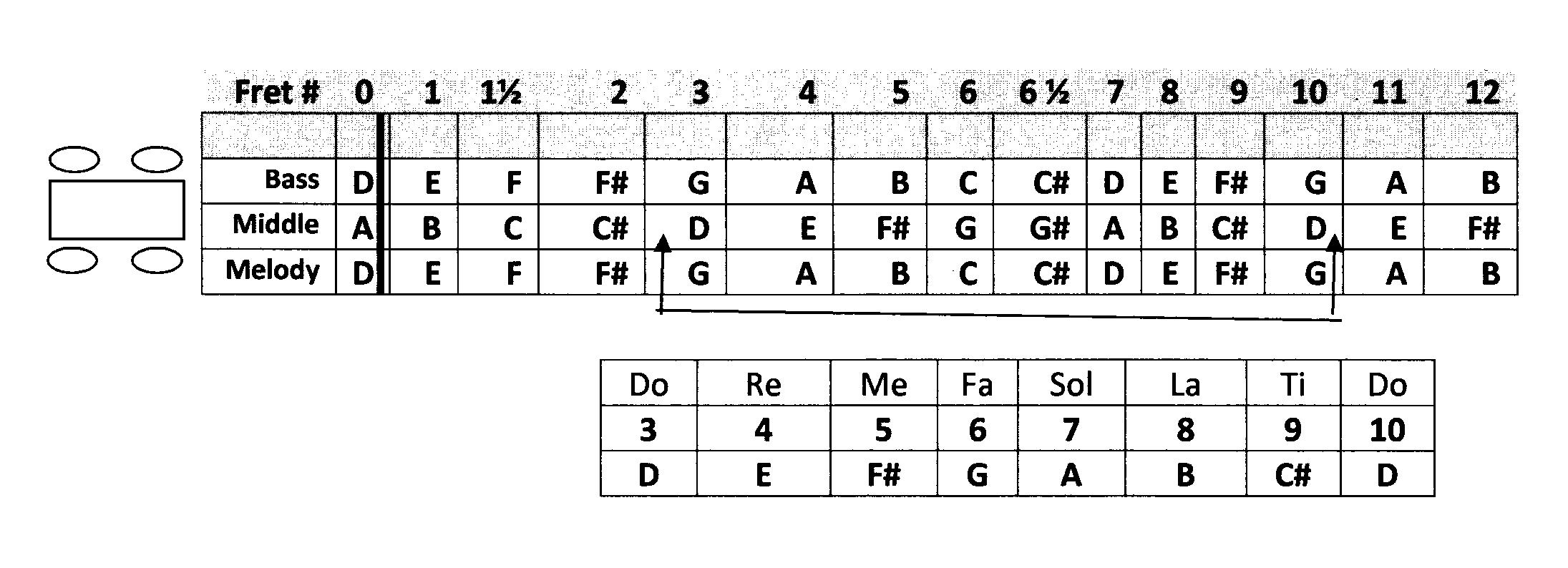
The fingerpicking pattern for this song is to play the melody notes on the middle string. Fill in held notes with eighth notes with the picking alternating between the melody and bass strings. These eighth notes occur on the 2nd and 4th beats. This pattern emulates the “bum did-dy” strum of a banjo.
For fingerpicking on a banjo-dulcimer, put down the pick. Play with your fingers. The right hand is assigned a finger — thumb, index and middle finger — to each string. Try to keep these fingers constantly on (or hovering above) the assigned strings the entire time. This improves efficiency of motion. Anchor the right hand by placing the pinky and ring finger on the banjo head or side of the fretboard. Pluck the string crisply with conviction. Otherwise, the string will sound harsh.
For the left hand, finger the frets for strumming or fingerpicking in the same manner as a standard dulcimer. Try to keep the frets depressed as long as possible. There isn’t any resonance with a banjo-dulcimer, so the sound will “thud” if you lift up on the strings.
And, it does take practice to make this musical instrument ring out in a pleasing manner. Otherwise, the banjo-dulcimer will sound harsh and staccato. Practice!
Dulcimer Tablature for Standard Dulcimer and Banjo-Dulcimer
I’ve included a strummed version for traditional dulcimers as well as a fingerpicked version for banjo-dulcimer hybrids. Chords with dulcimer fingerings are written above the standard music line so a second person can strum along playing the chords. Plus, I placed the two arrangements together as a duet for a standard dulcimer and banjo-dulcimer. Play them together.
Enjoy this classic folk song. It is a great one to practice both strumming and fingerpicking. And thanks to both Susan Trump and Aaron O’Rourke for the inspiration to get me going on the banjo-dulcimer.
Feel free to download the PDF versions, print them out and share with friends and fellow dulcimer players. I just request that you don’t post this tablature on a public internet site or publish the songs without permission.
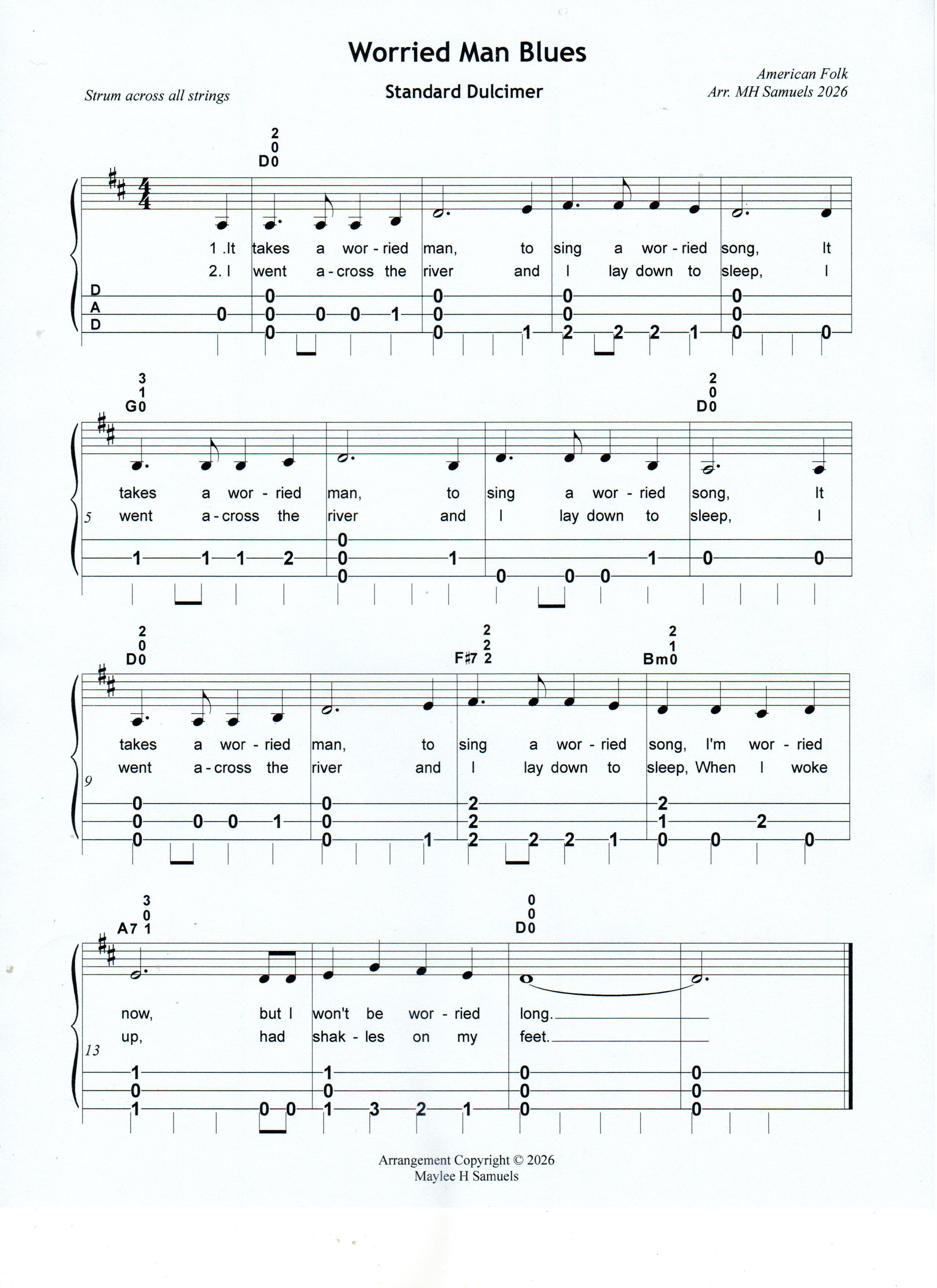
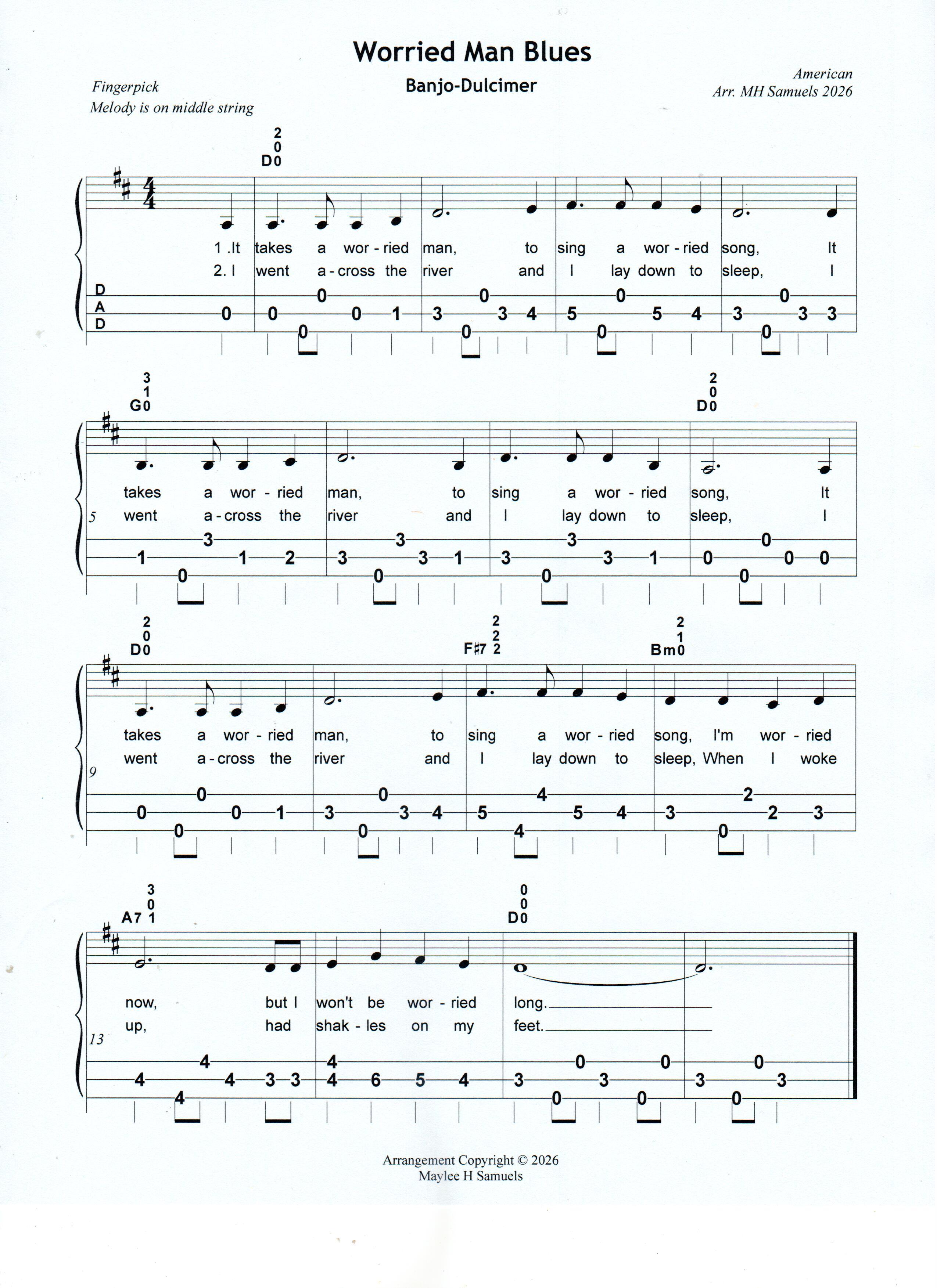
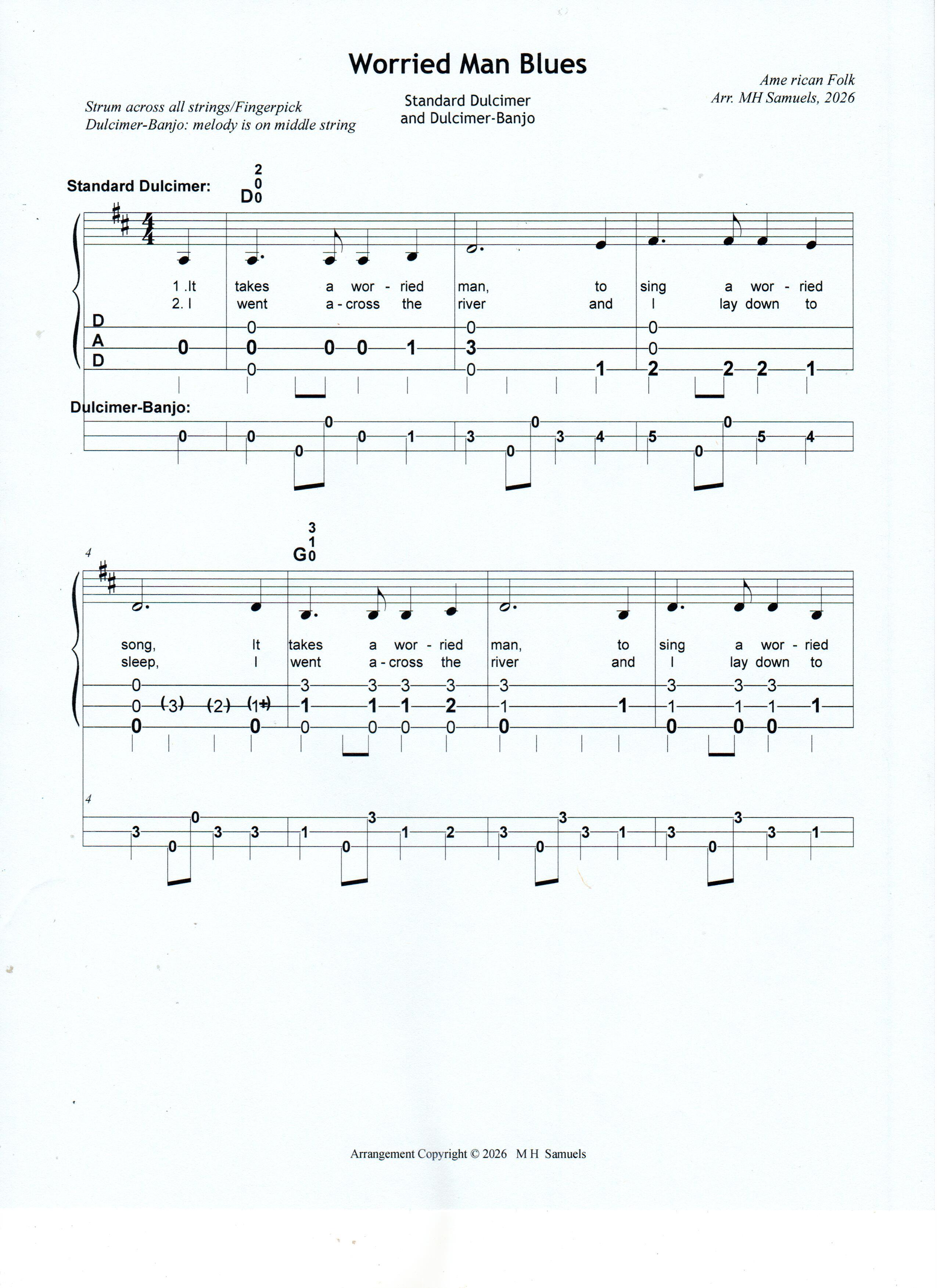
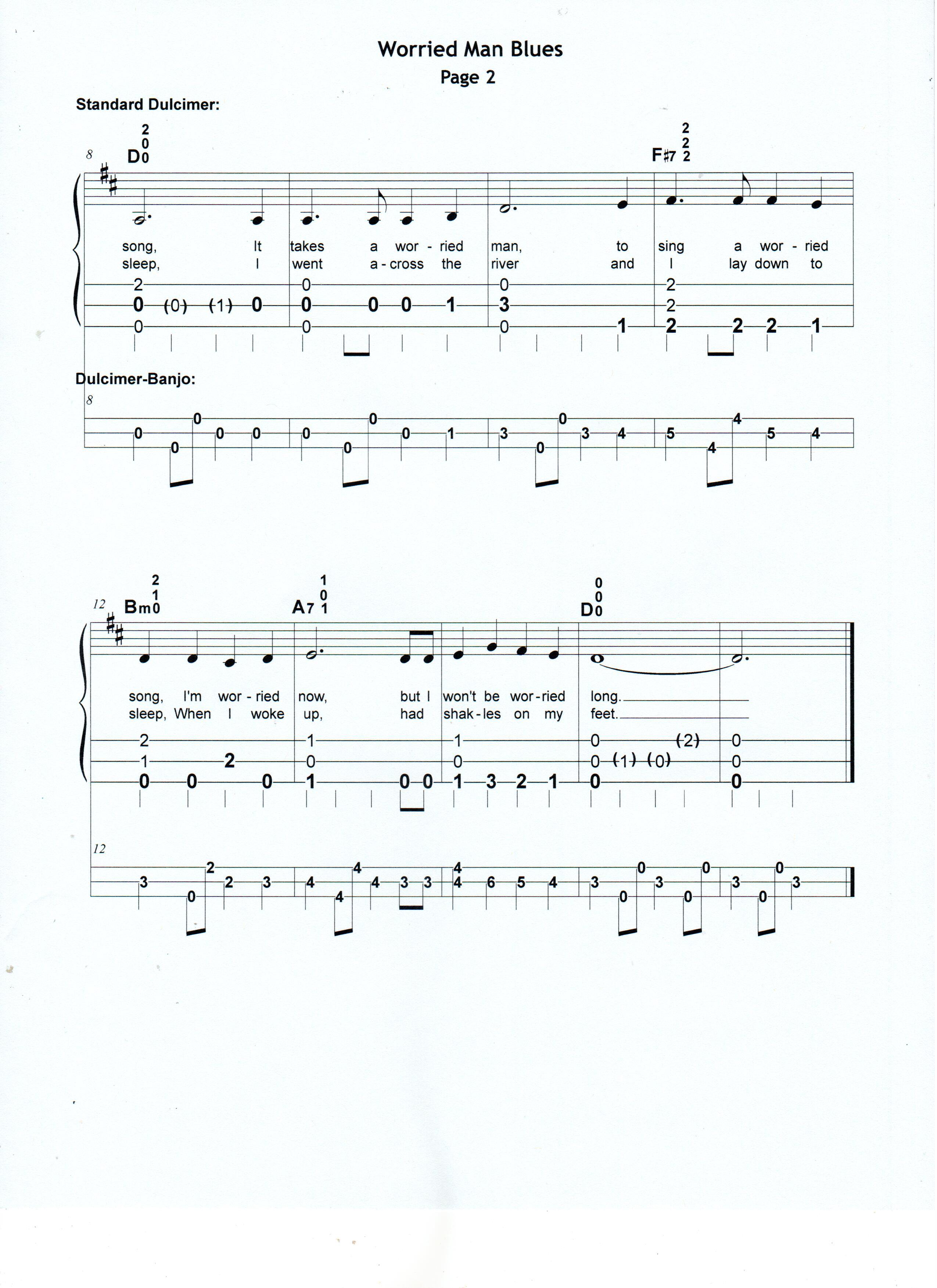
Here are a set of lyrics for this song:
Chorus:
It takes a worried man to sing a worried song
It takes a worried man to sing a worried song
I’m worried now, But I won’t be worried long
Verses:
I went across the river, I lay down to sleep
I went across the river, I lay down to sleep
When I woke up had shackles on my feet
Twenty-nine links of chain around my leg
Twenty-nine links of chain around my leg
And on each link the initials of my name
I asked the judge what might be my fine?
I asked the judge what might be my fine?
Twenty-one years on the RC Mountain Line
The train arrived, sixteen coaches long
The train arrived, sixteen coaches long
The girl I love is on that train and gone
If anyone asks you who composed this song
If anyone asks you who composed this song
Tell ‘em was I, and I sing it all day long
Reference:
 Dulcimer Jambalaya