

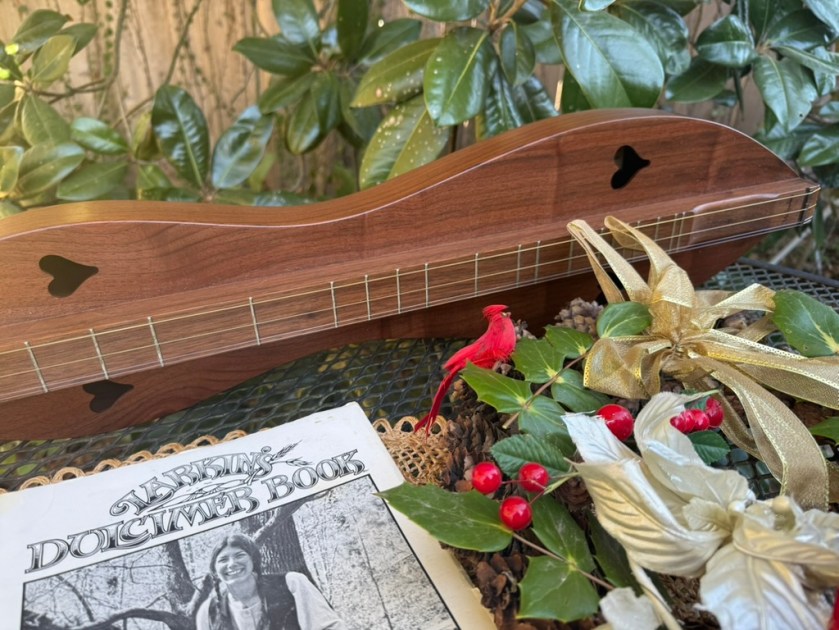
It is that time of year again for Christmas carols, hymns and secular music. I love it!. “O Come, Little Children” was one of the first Christmas carols which I learned on the dulcimer. Larkin Bryant taught it in a workshop at the Bayou Dulcimer Festival in Covington, Louisiana, years ago. I was “wowed” by anything played on the dulcimer way back then. And so, I purchased Larkin’s book and played the songs from cover to cover — totally wearing the book out. This year, I decided to revisit this charming, yet simple Christmas tune. After making an arrangement for a beginner on a standard dulcimer, I started fiddling around with my baritone dulcimer tuned to AEA. I made an interesting revelation — at least for me — of how I can play these two dulcimers together. We can do it.
About “Oh Come, Little Children”
“Oh Come, Little Children” is a German song dating from the 1700s and it is still sung in Germany today. It was originally known in German as “Ihr Kinderlein, kommet.” The lyrics seem to invite children to come and visit the baby Jesus Christ in his cradle in Bethlehem; to sing and rejoice. The song’s simplicity reminds me of a nursery rhyme or lullabye — rocking and rhythmic.
The Catholic priest, Christoph von Schmid, penned the poem/lyrics around 1798. Totally unrelated, the familiar melody was composed in 1790 by German court musician Johann Abraham Peter Schulz. As with many hymns, the poem and song were not originally played together. The two were first paired and published around 1832 in a songbook collection, Sechzig deutsche Lieder für dreißig Pfennig, (Sixty German Songs for Thirty Pennies), by Friedrich Eickhoff (1807–1886). So, this simple song has old country beginnings.
Making this tune “shine”
The key to making the song “shine” on the dulcimer is the strum pattern. Although the strum pattern is a “bum-ditty” strum, it feels totally different because the melody notes change pitches on the “ditty” part of the strum. The strum takes practice and coordination, but it is worth the effort.
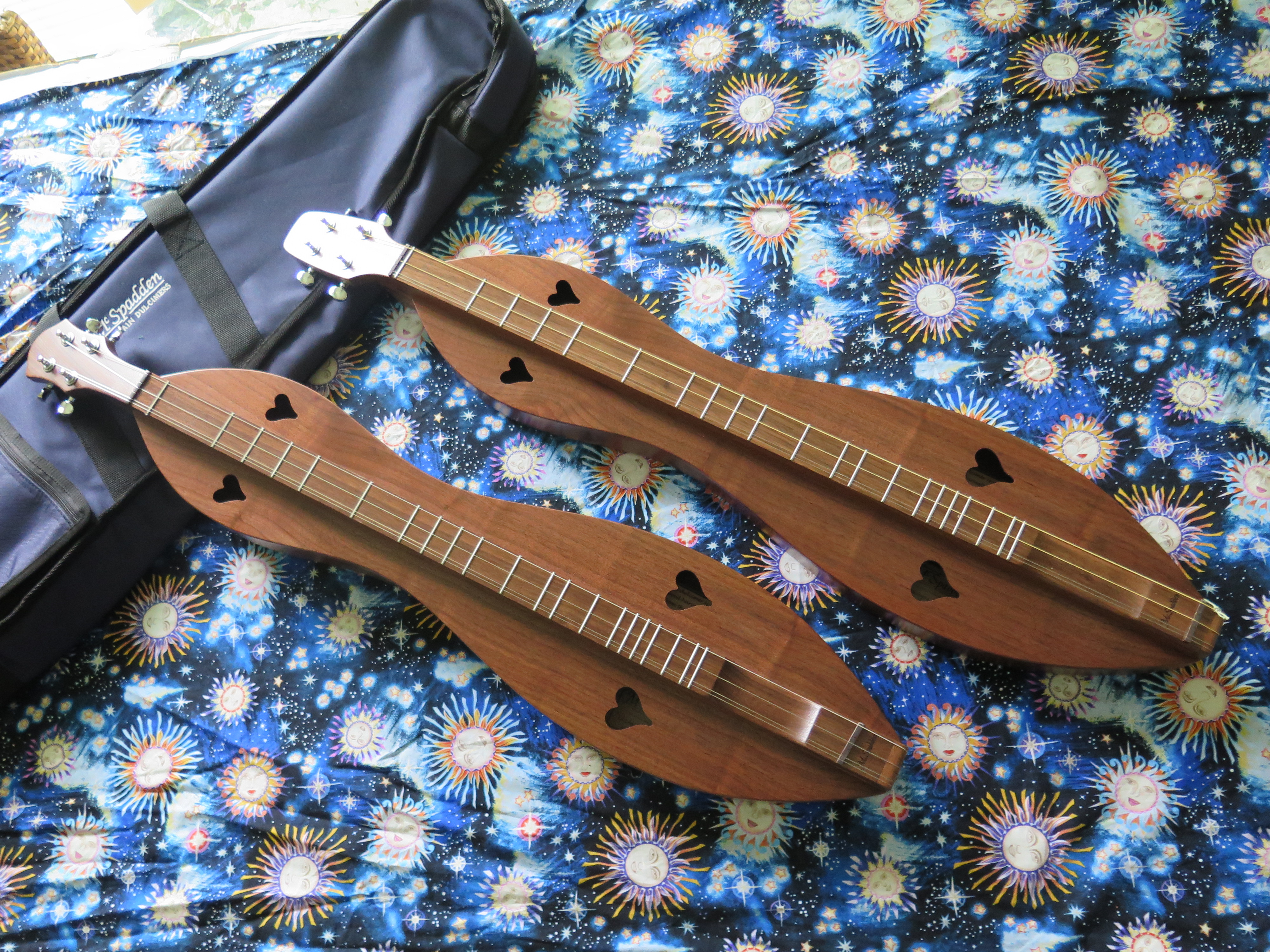
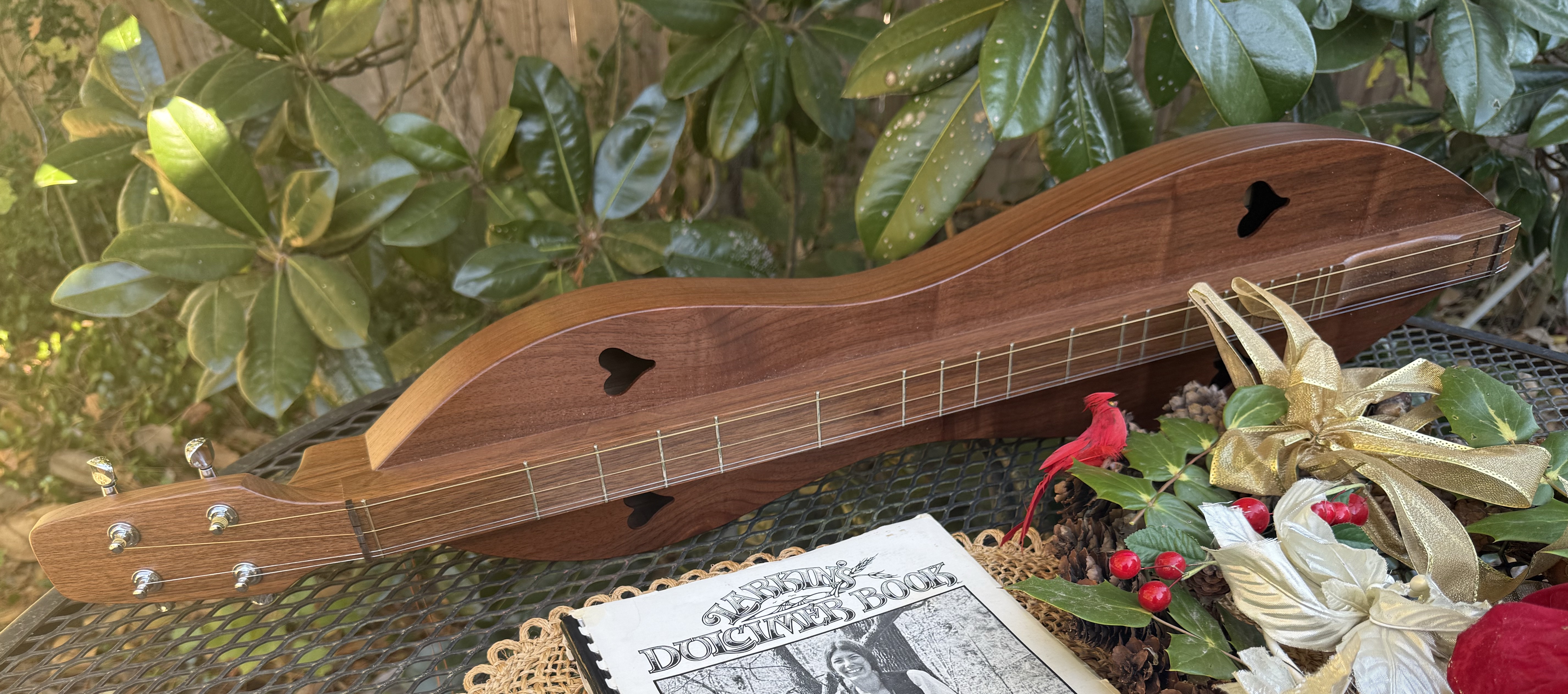
Because the tune is so soothing, I decided to get out my wonderful McSpadden walnut baritone dulcimer and write an arrangement for it, too. This dulcimer has a deep, melodic tone and accompanies the melody perfectly. Hey, we have a standard dulcimer (in DAD tuning) and baritone (in AEA tuning) duet. Play these parts together or as stand along parts. We can do it.
Baritone Dulcimers and Interesting Revelation
Most of the time, my baritone dulcimer stays tucked away in a closet. It seems a misfit. In dulcimer jams, most folks playing in the DAD tuning. The deep and quiet sound of the baritone dulcimer fades into the background. My particular baritone dulcimer has so much sustain, that stumming it fast and furiously for fiddle tunes makes it sound “muddled.” Plus, there just aren’t many arrangements written specifically for baritone dulcimers. Although singing in the Key of A is perferred for many songs and voices, there just aren’t that many baritone dulcimers around to make it viable — or for playing fiddle tunes.
However, this dulcimer beams when played in a duet or small ensemble setting — especially when fingerpicked or flatpicked. It is worth playing.
And, I made an interesting revelation. The AEA tuning for the baritone dulcimer is a 1-5-8 tuning. That refers to the relationship of pitches between the three strings — bass – mddle –melody — strings. It is the same spacing as in DAD tuning. Therefore, any tablature written for the DAD tuning can be played on a baritone dulcimer in AEA in the Key of A.
But, that’s not the entire story. All that tablature written in the Key of G in the DAD tuning now translates to the Key of D in the AEA tuning. All those so tablalature arrangements can be played on a baritone dulcimer — you are now playing in the Key of D. That opens up an entire world of music for baritone dulcimers. Isn’t that great news.
A caveat – note of caution
A note of caution here. Although playing an AEA-tuned dulcimer in the Key of D is easy and achievable, the reverse isn’t true. Playing a DAD dulcimer in the Key of A is limited — due to a number of factors beyond the scope of this blog post. It is a topic for another day.
“Special Needs” Baritone Dulcimer
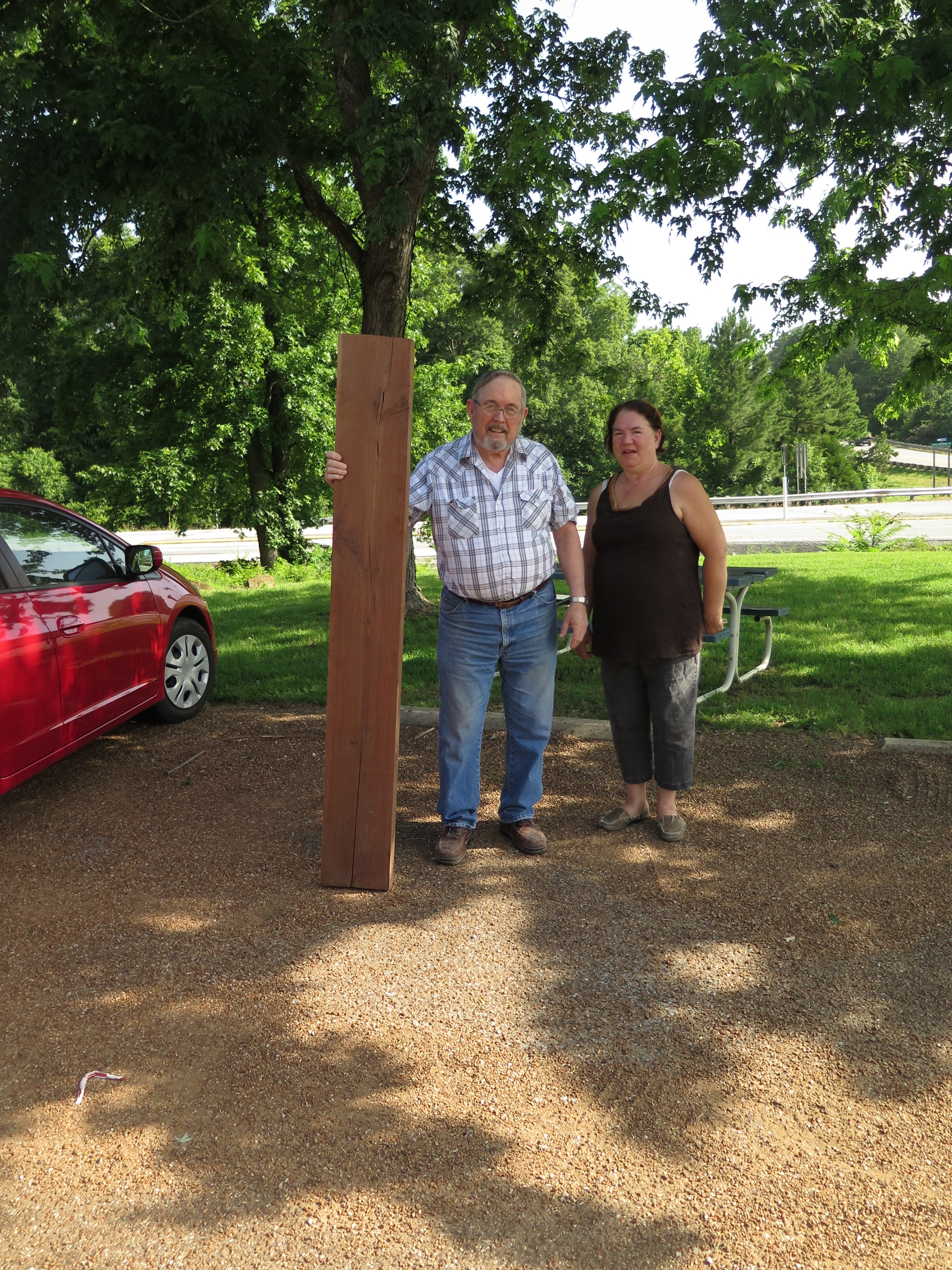
My baritone dulcimer falls into the “special needs” category. It certainly is a unique dulcimer with a one-of-a-kind story. It was custom made for me by the McSpadden Dulcimer Company. It began with a walnut plank from the Shenandoah Valley. My father had many hobbies and one was collecting and trading wood planks. This particular walnut log had been stored in his basement for years until I brought it home to Baton Rouge (not on an airplane). My project of using it for a fireplace mantel never happened. Instead, I called Jim Woods — owner of McSpadden Dulcimers — and asked if he could make several dulcimers from the plank. My friend, Joe Besse, and I drove to Arkansas from Baton Rouge with the plank barely fitting in my small red Honda. (It was a productive trip — we made several stops along the way and came home with at least 3 new dulcimers for ourselves/relatives.)
The rest is history. Jim’s luthiers took the plank and crafted it into two beautiful walnut dulcimers. Walnut wood creates a beautiful, deep tone which resonates. I wasn’t disappointed and the sound of both dulcimers is great. One is a baritone dulcimer and the other is a standard dulcimer. The two dulcimers share the same body. However, the baritone dulcimer has a longer fretboard and different tuning pegs. I think it may have additional bracing — not sure about that aspect.
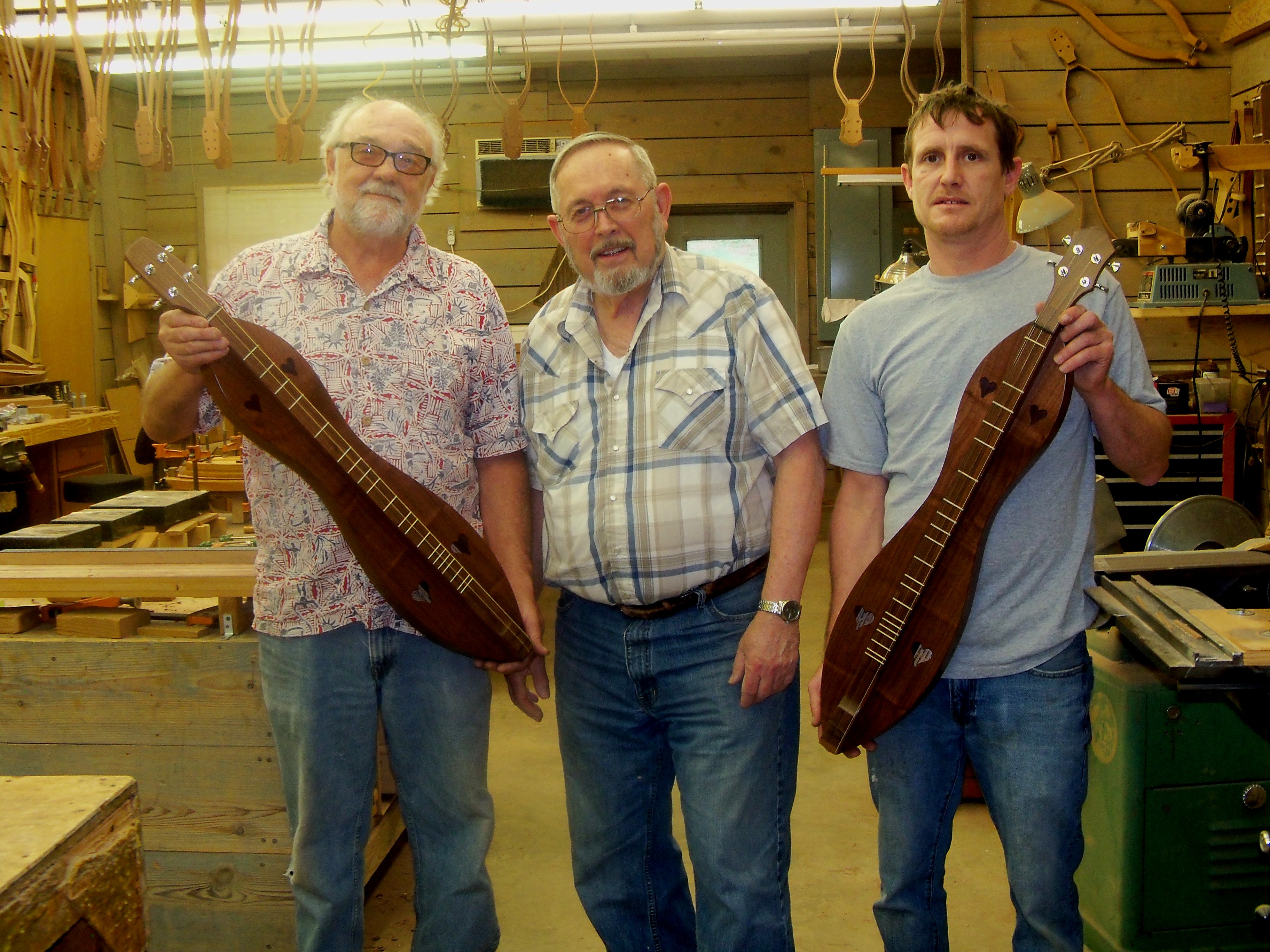
Although I love the baritone dulcimer, I don’t play it enough. I’m trying to change that by arranging with several Christmas carol for it.
Can we do it ?
Can we play a standard dulcimer tuned to DAD together along with a baritone dulcimer tuned to AEA. Stated differently, can we play songs in the Key of D on an AEA baritone dulcimer to match DAD-tuned dulcimers?
The explanation of playing these two dulcimers together can make your head spin. Yes, we can do it — play a wonderful, deep yet soft AEA-tuned baritone dulcimer along with a DAD-tuned standard dulcimer. However, the explanation can seem very comfusing and complicated. So, if desired, just skip the explanation and go straight to the tune at the end of the post. Trust me on this one.
Use a little ingenuity
Playing these two dulcimers together — one in DAD tuning played in Key of D and the other in AEA tuning — is possible, and even easy. Of course, a person must use a little ingenuity.
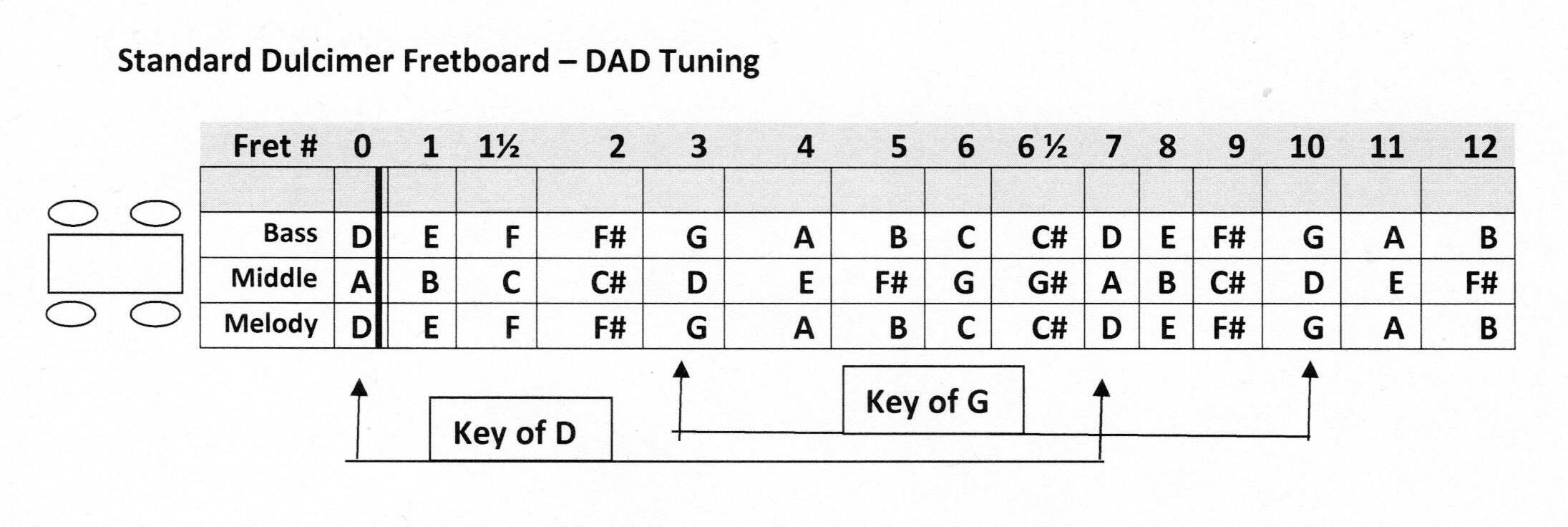
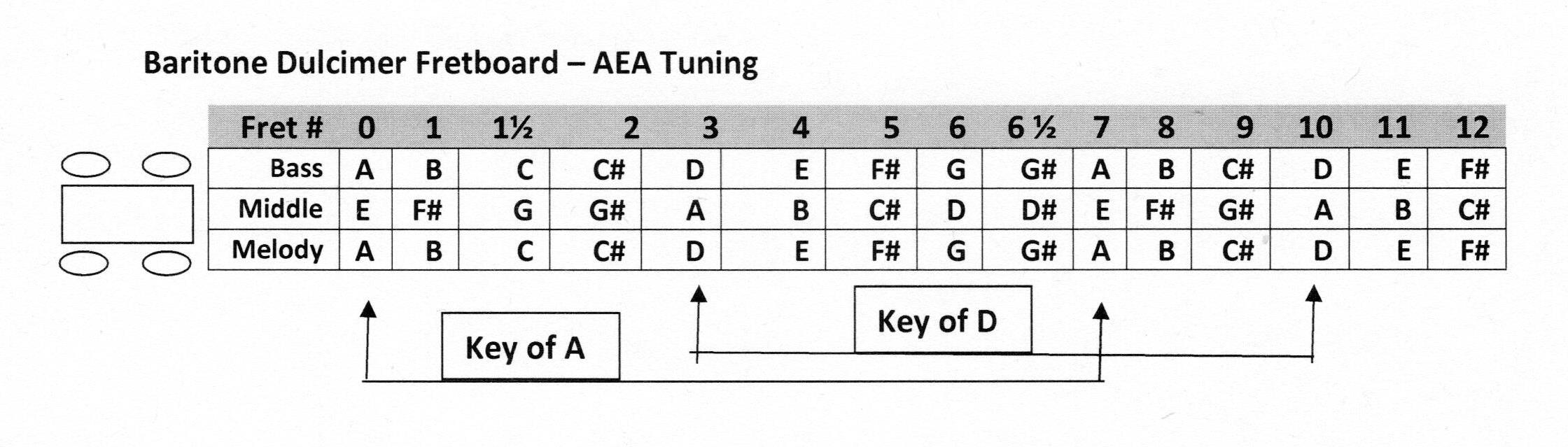
Think of the analogy of a DAD-tuned standard dulcimer. We can play both in the Keys of D and G in a DAD tuning on a standard dulcimer assuming you are willing to use chords and harmony notes. The “G” note is five scale pitches higher than the “D” note. The “G” scale goes from the 3rd to 10th fret (rather than the “0” to 7th fret as with a “D scale). The same spacial relationship exists in an AEA tuning. The “D” note is five scale pitches higher than the “A” note. In this tuning, the “D” scale goes from the 3rd to 10th fret (rather than the “0” to 7th fret as with an “A” scale in AEA tuning). You certainly can’t use “open strums” on an AEA-tuned dulcimer if you are accompanying someone playing in the Key of D. However, if you hold down chords and frets, you can strum along in the Key of D.
Here are the fretboards for a a standard DAD dulcimer and baritone AEA dulcimer.
New chord shapes for Key of D chords
It is important to understand you will have to locate new chord patterns for the Key of “D” along the AEA fretboard. They won’t have the same fret positions and numbers as a DAD dulcimer. The notes are located at different frets — but they are the same pitches. This can seem very confusing. It is like trying to ride a new kind of bicycle. Gradually, I got used to it.
I suggest trying not to overthink things — just trust me on this one. Here’s a chord chart:
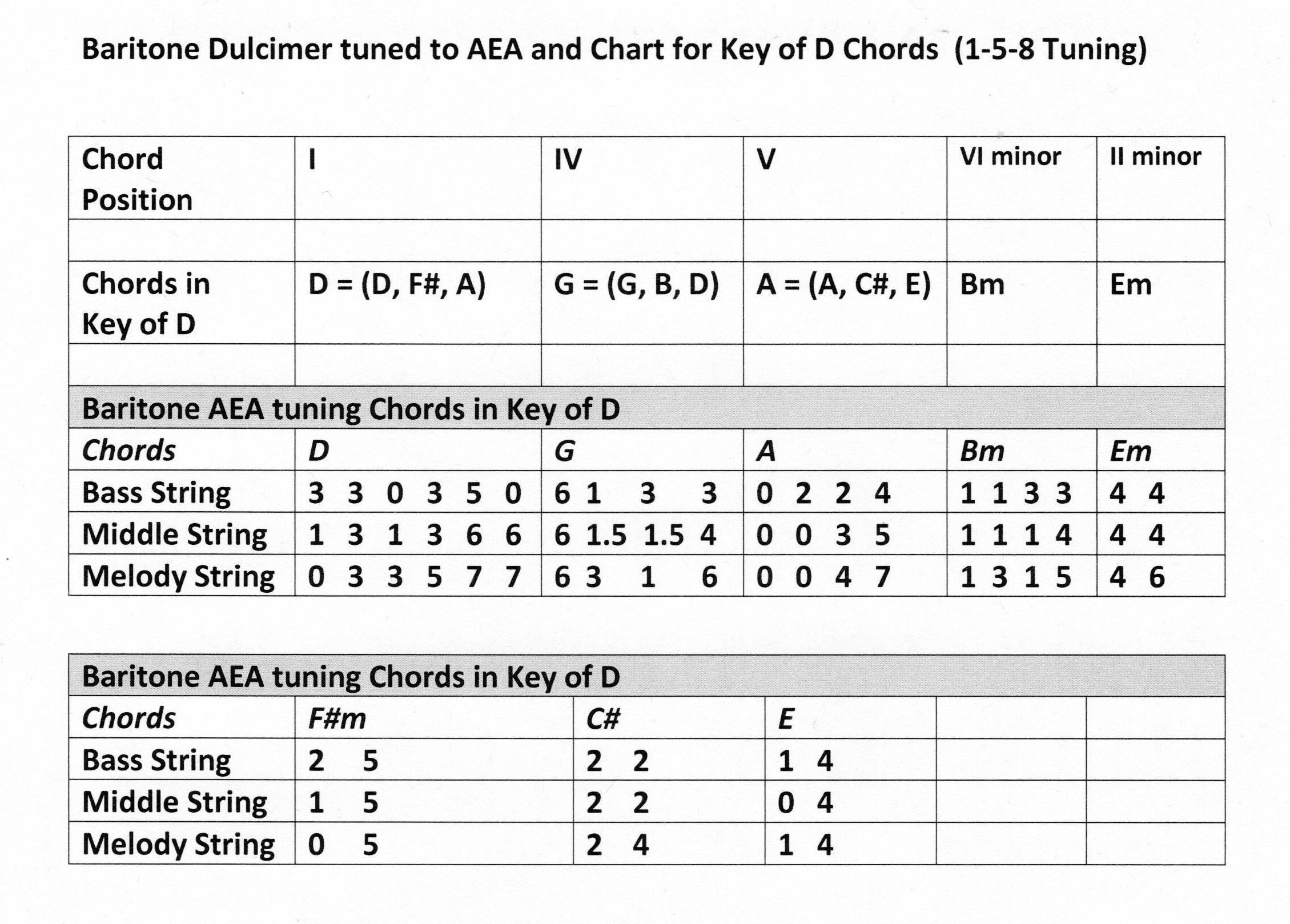
(I have included a PDF file of this chart which you can download and use as a reference at the end of this post.)
“O Come, LIttle Childern” – 2/2 Time Signature
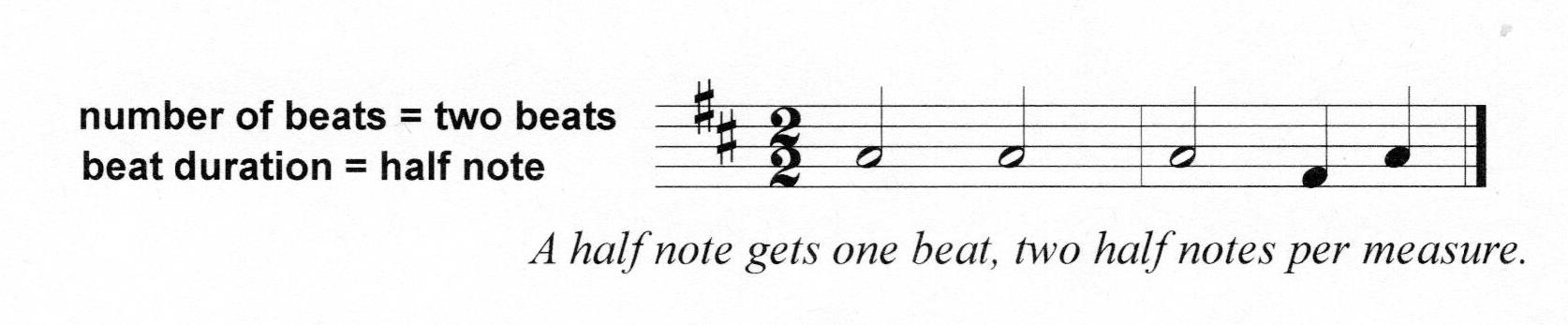
My arrangement for this Christmas tune is written in 2/2 time signature. This time signature isn’t very common and has subtle differences with a 4/4 time signature. Mainly, every other beat is emphasized in 2/2 time, rather than every fourth beat as in 4/4 time. It results in a rocking, rhythmic feeling.
In the any time signature symbol, the top number stands for the note which gets one beat. So, in 2/2 time, a half note gets one beat. The bottom number refers to the number of beats in a measure — two beats. (A quarter note gets half a beat — equivalent to an eighth note in 4/4 time.)
Rhythm of this song
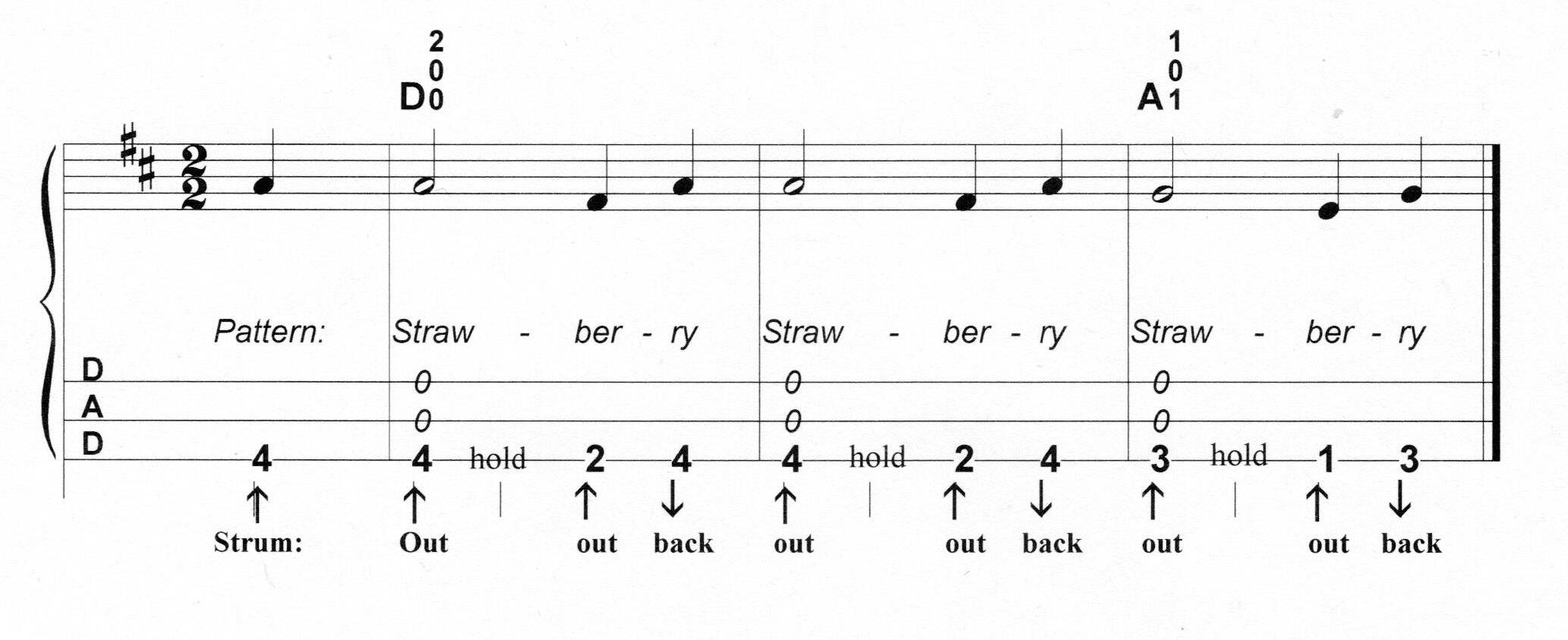
The rhythm pattern makes this song “shine” like a lullabye or rocking tune. The rhythm of this tune is “straw-ber-ry”, “straw-ber-ry” or “long – quick-quick”, “long – quick-quick.” This rhythm pattern continues throughout the entire song (except for the pick up note). Don’t add extra strums on the melody part. This may sound simple — but actually is very tricky. Practice the right hand strum without adding any frets on the left hand. Again, maintain the strum pattern of “out — out-back”, “out – out-back” and always strum in the same direction on the beat. This pattern actually tranlates to a “bum dit-ty” strum — but it feels different because the melody notes are changing on the “dit-ty” part of the strum.
Basic Solo Arrangement for Beginners
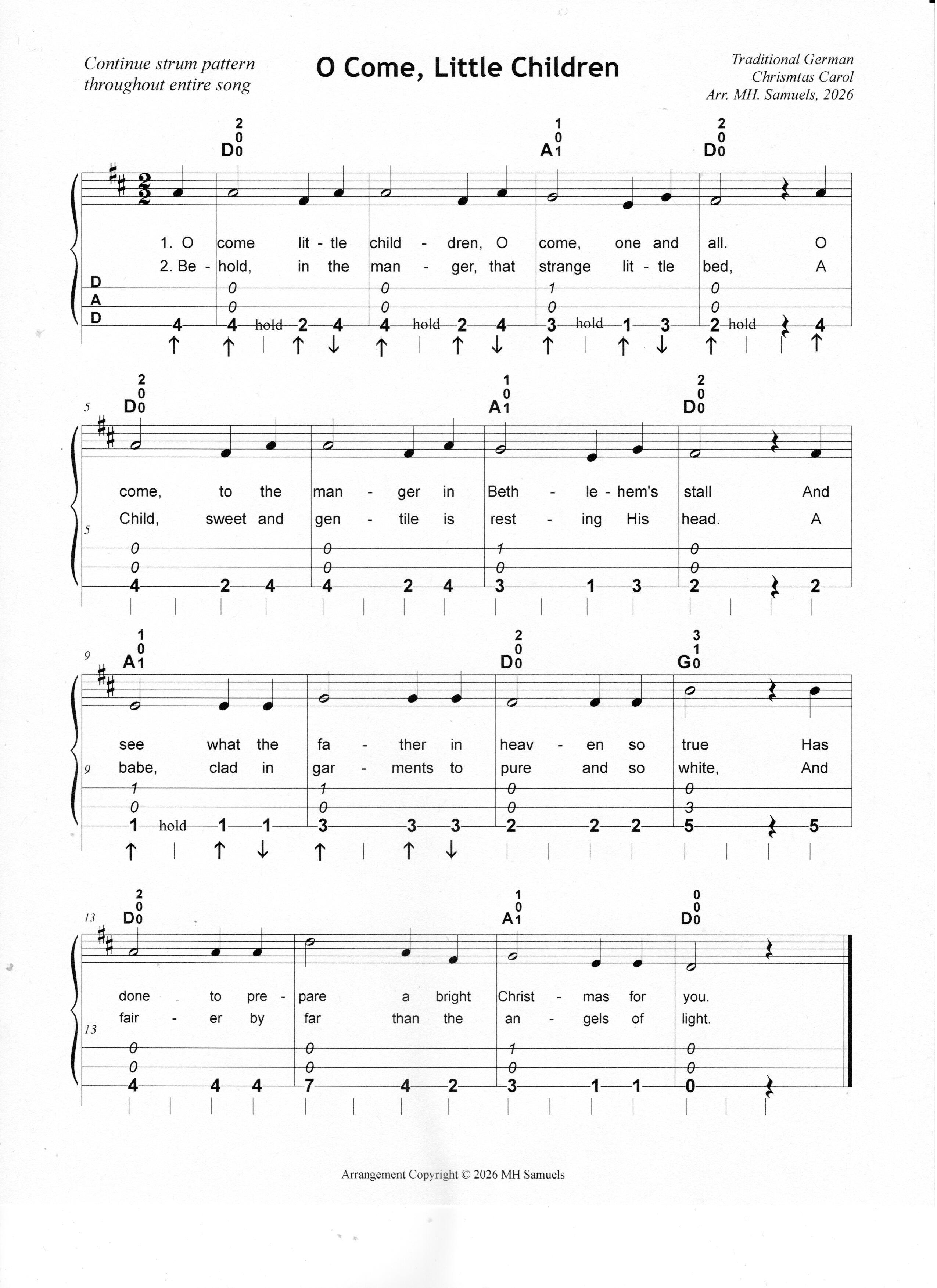
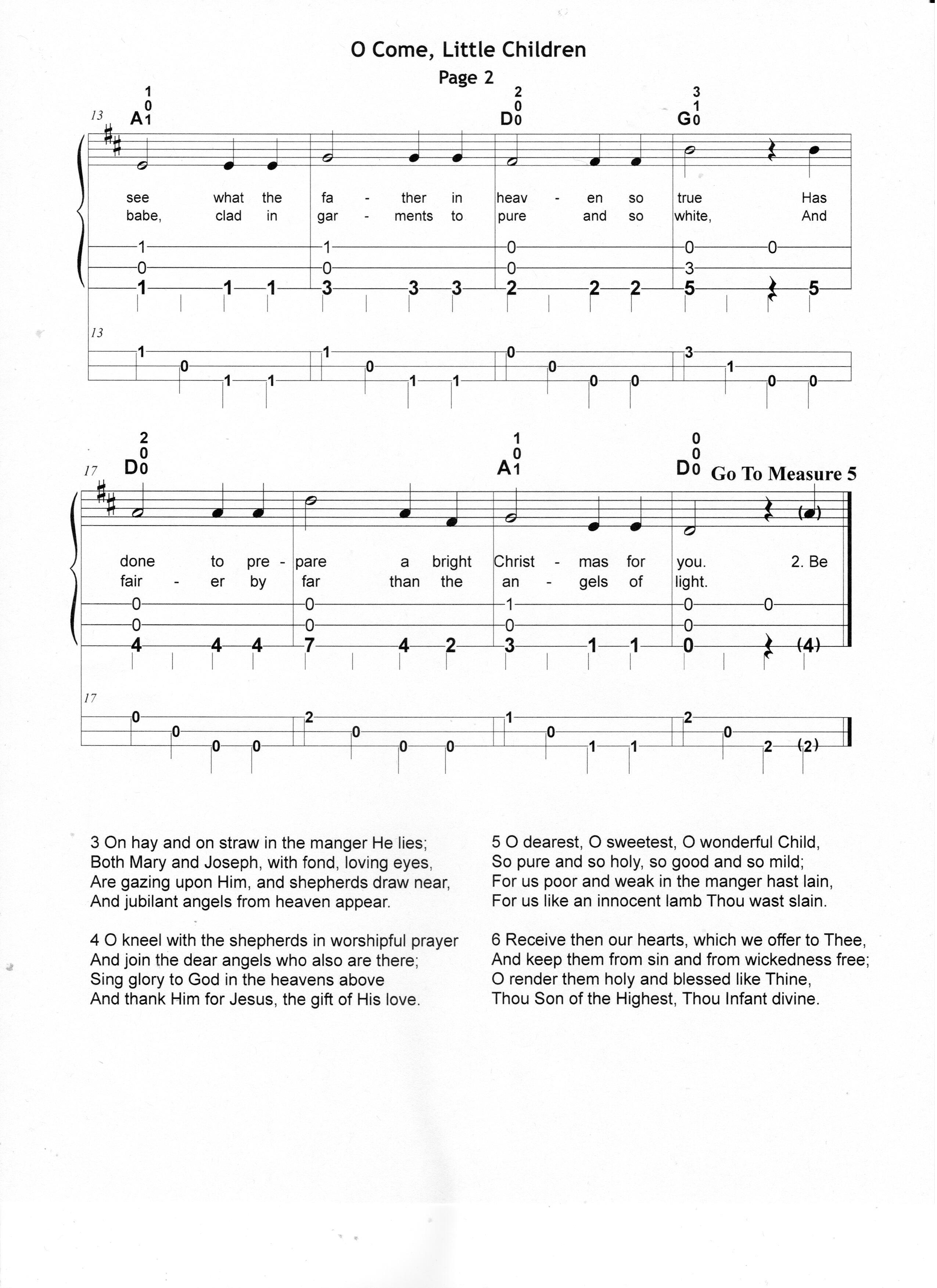
I arranged a basic solo arrangement for beginners. The song has a very simple melody. The melody is played entirely on the first (melody) string. If desired, add harmony notes on the middle and bass strings. Just try to keep up with the “straw-ber-ry” strum pattern and strumming in the same direction on the beats.
Chords are added above the standard music notes to strum and sing along.
A PDF file is included at the end of the post which can be printed out, shared and played.
Harmony Part for “O Come, Little Children” in DAD
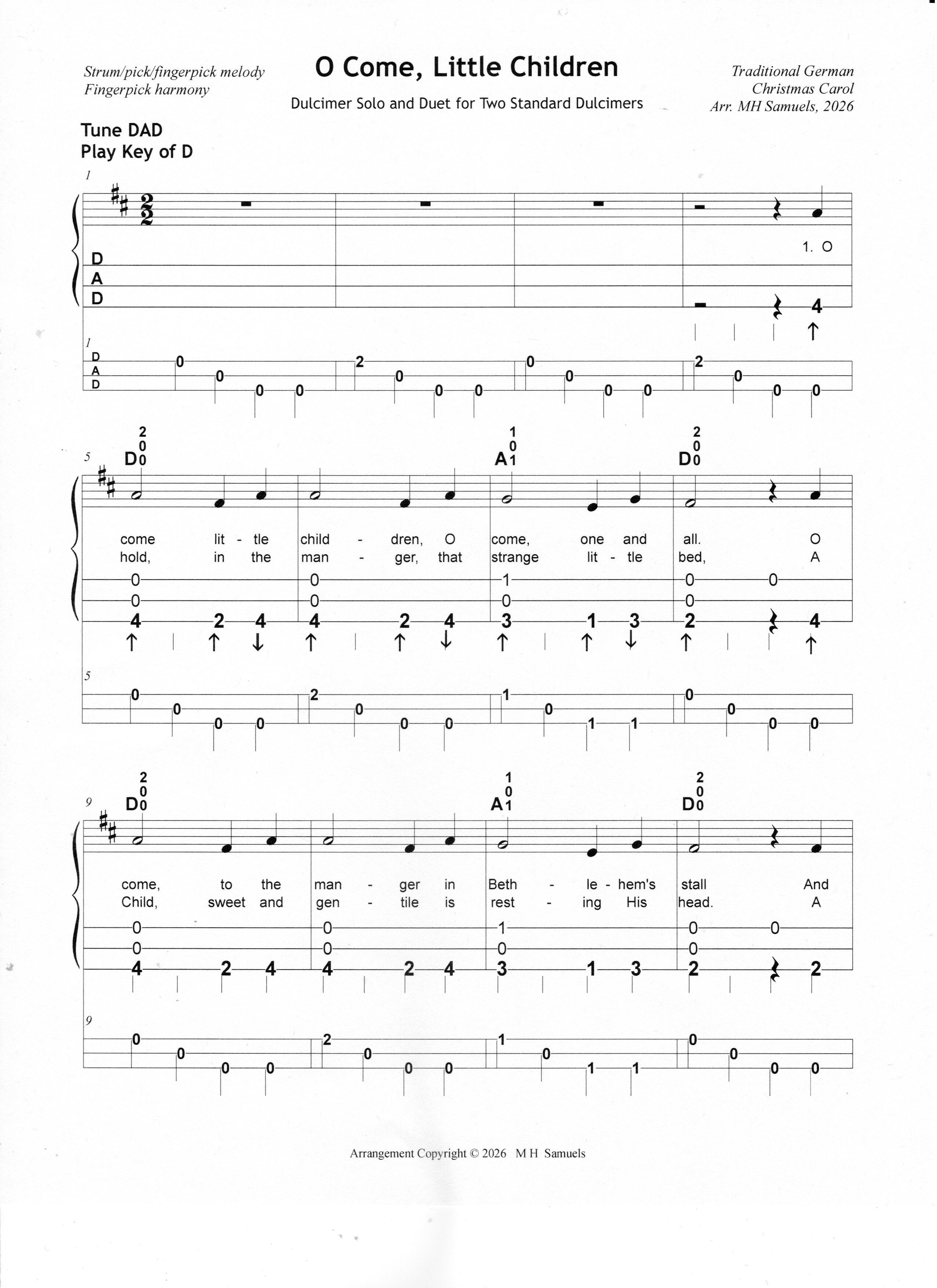
In the interest of making an ensemble arrangement, I added a harmony part in DAD tuning. This part is intended to be fingerpicked or flatpicked. The notes are basically chords which match the melody. The notes are played individually rather than strummed and fill in all the beats of the measure.
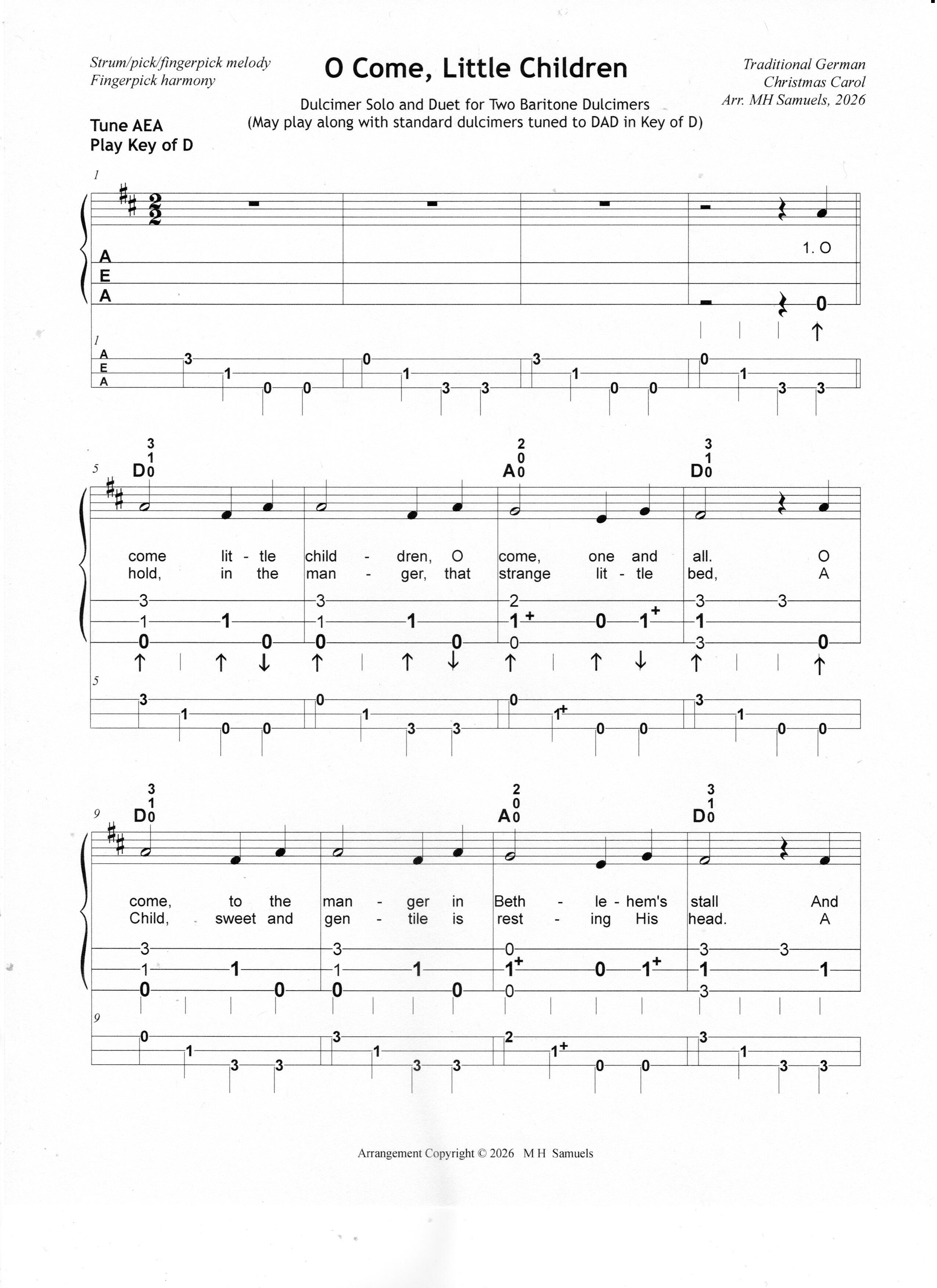
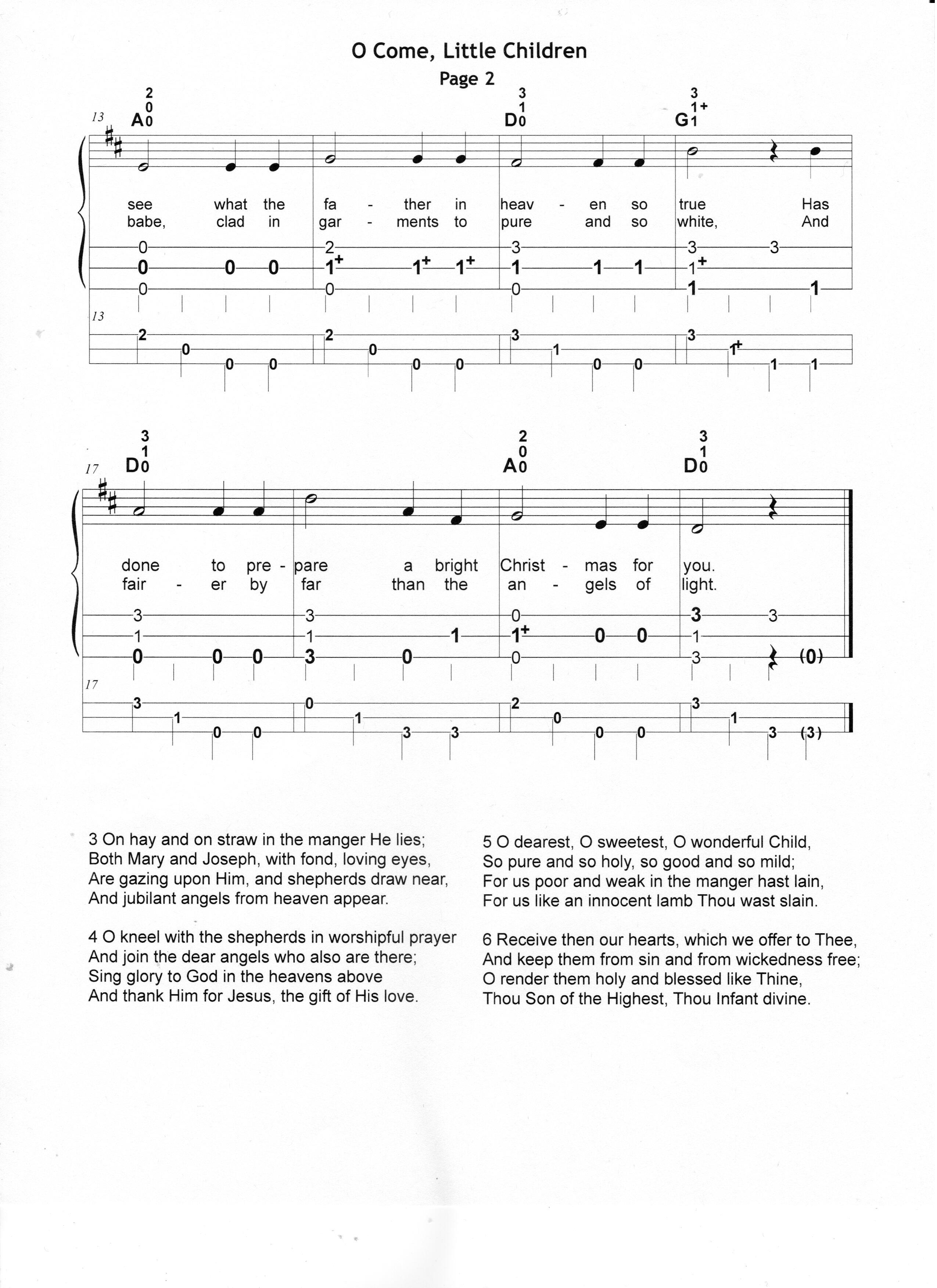
Baritone AEA tuning — Melody and Harmony Parts in the Key of D
For the baritone dulcimer tuned to AEA, I arranged both melody and harmony parts in the Key of D. These match the tune arranements in the DAD tuning. The notes are the same in either tunng (AEA or DAD) — they are just played at different positions on the fretboard.
Again, I have included:
- Basic solo arrangement for standard dulcimer in DAD tuning in Key of D for beginning players,
- Duet of same arrangement plus harmony part in DAD tuning in Key of D,
- Duet of similar arrangement (melody ad harmony parts) in AEA tuing in the Key of D.
All these parts can be played solo or together. Mix or match, including the DAD and AEA arrangements and chords written above the standard notes.
Again, don’t over-think the logic of playing these two dulcimers together. Just try it out.
This simple Christmas tune is soothing and rhythmic. It is not as common as many other Christmas carols but still is worthwhile to try out.
Let’s try to play the baritone dulcimer this holiday season and also the rest of the year. By revisiting my extensive stash of tablature and dulcimer books, I bet I can find many tunes already arranged which can be played on a baritone dulcimer along with DAD standard dulcimers.
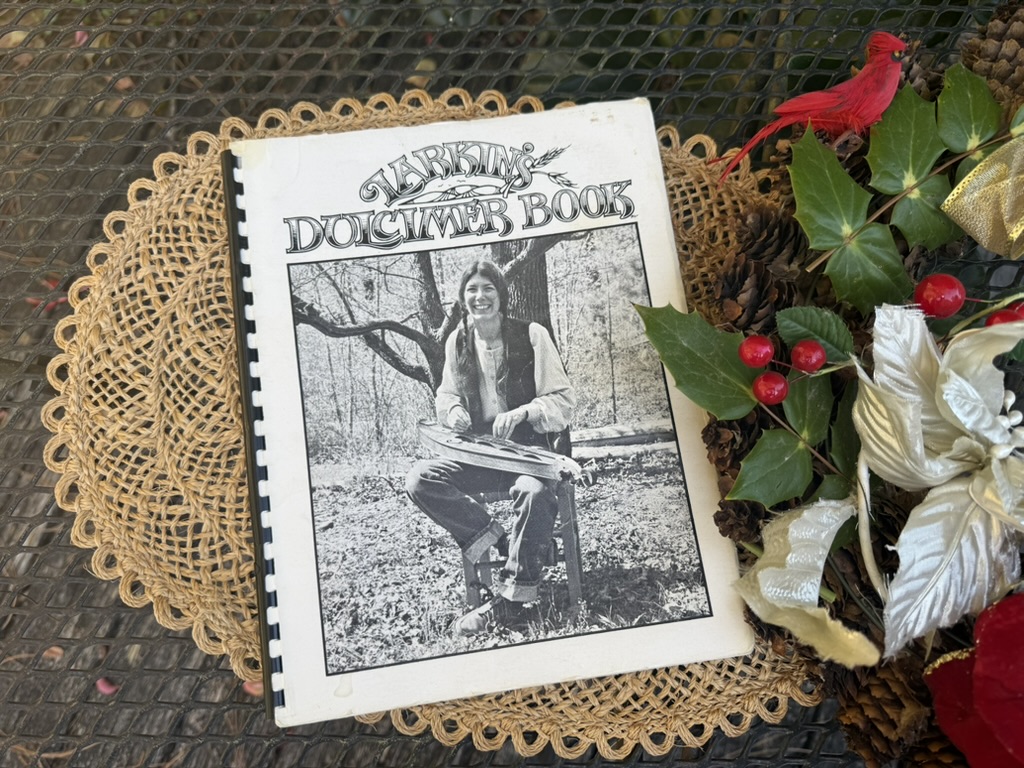
And thanks to Larkin Bryant for writing “Larkin’s Dulcimer Book.” It was my “dulcimer bible” years ago. Torn with coffee stains, I still refer to the songs, strumming/fingerpicking instructions and her chord charts.
Enjoy.
As always, please print out, share and play the PDF file arrangements of “O Come, Little Children.” I just request that you don’t upload the arrangements to a public internet site or publish the arrangements in print or digitally.

