Interested folk are often enticed to learn to play the dulcimer with the advice that, “If you can count to ten, then you can play the dulcimer.” Yes, it is true that mountain dulcimer players really need no musical experience to play this instrument. The system of numbered frets and matching tablature makes this an easy instrument to play. However, if you want to get past playing simple tunes, then developing an understanding how the fretboard is organized and how to play tunes is rather important. Over the years, I have developed my own system of teaching how to nagivate around the fretboard to play a melody. It works for me. I found that an old fife and drum march, “Old 1812,” which illustrates one common fret pattern used in many tunes which I teach to beginners. It’s a good way to become familiar with the fretboard. Plus, several You Tube reels show that it is played in the Key of D. That means we can play along with the fifers!
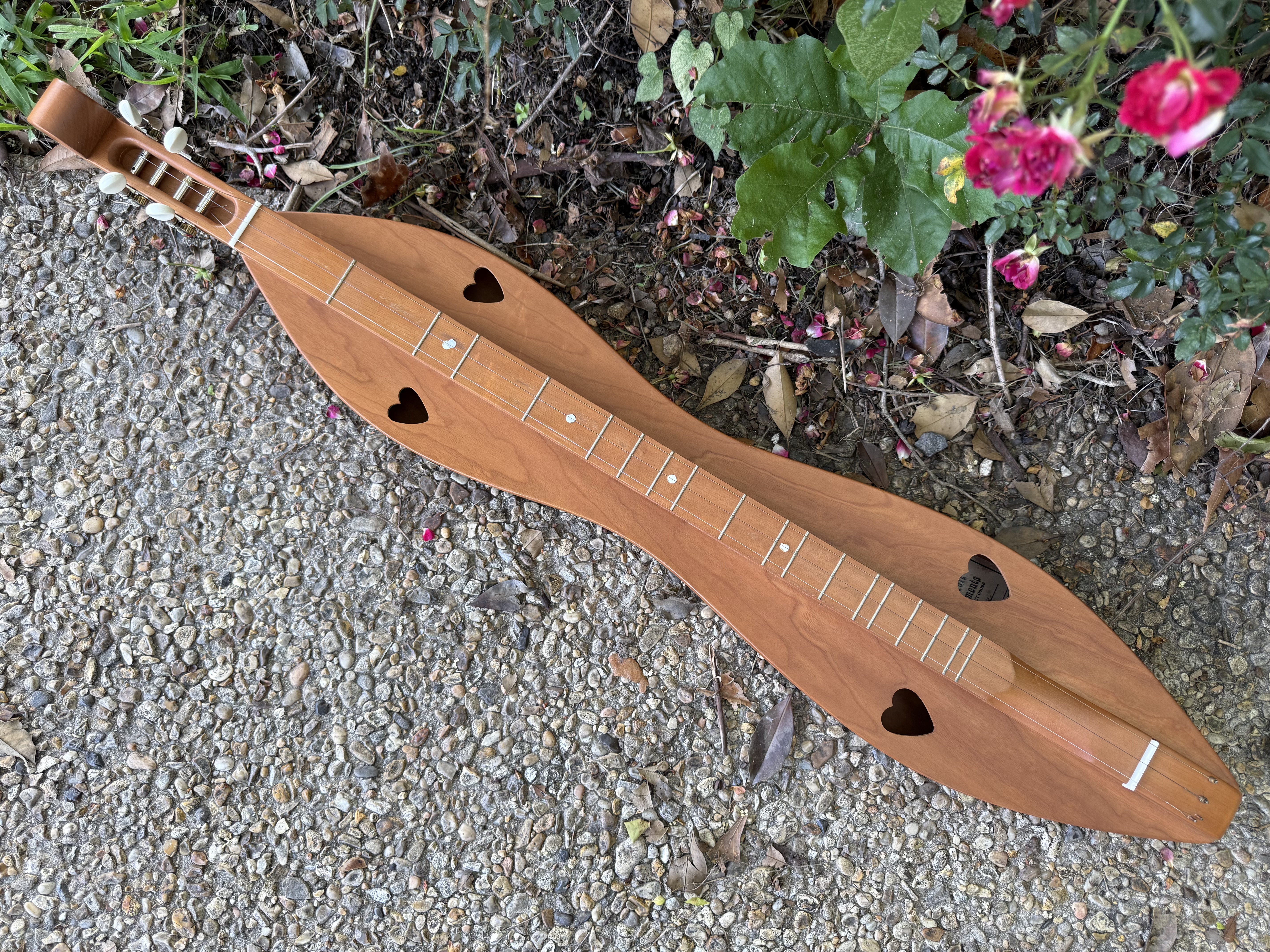
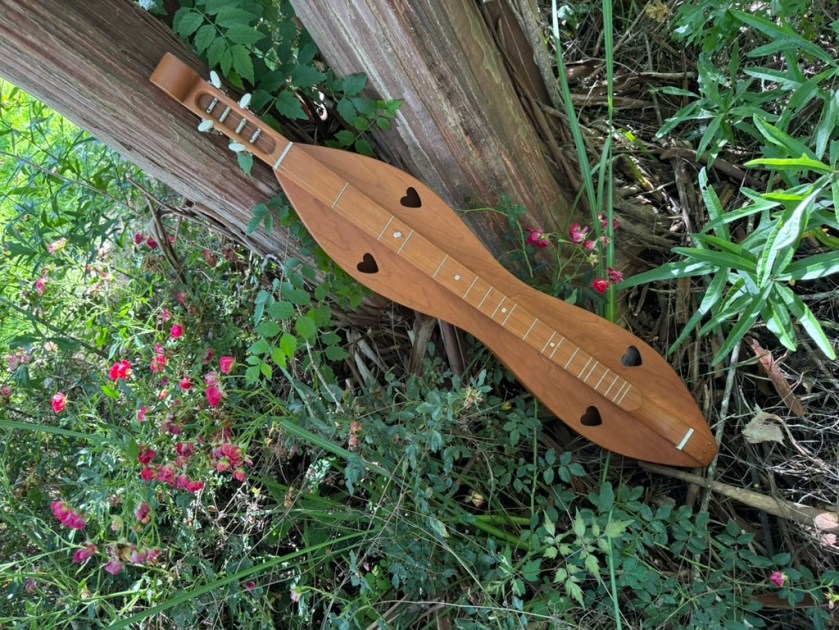
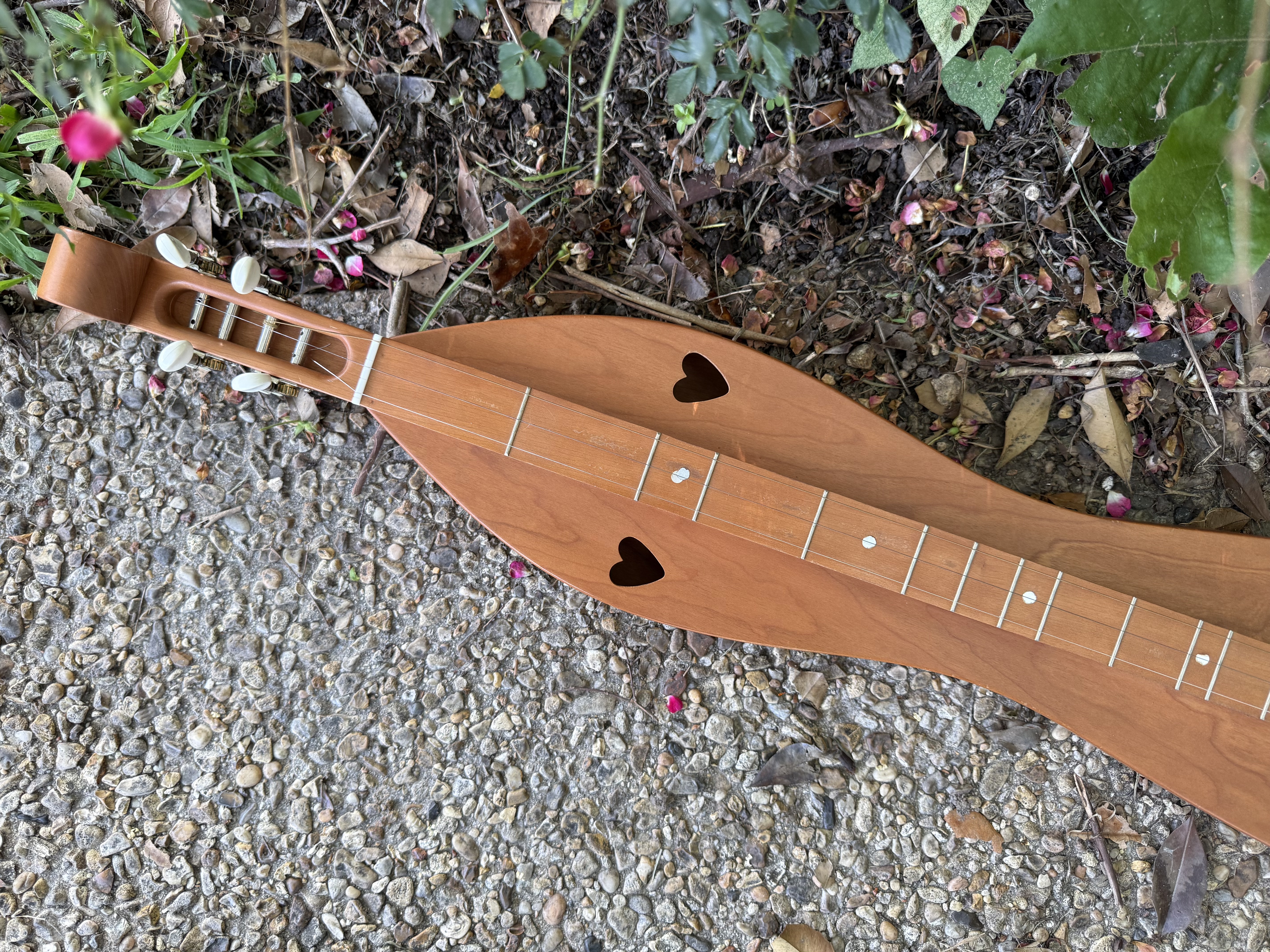
The above dulcimer is my first dulcimer — it dates the the early 1990s. It is so simple — no 1-1/2 fret — and plays as well today as the day I purchased it. My, I thought that I was really “super” when I got this Folkcraft dulcimer.
Margaret Wright’s Twelve-Tune Songbook Books
Margaret Wright — dulcimer player from Texas, musician and tablature arranger, mentor and festival organizer — is this source of this tune arrangement. Margaret has written at least 15 books in the Songbook series. These tablature arrangements are easy-to-follow for beginning dulcimer players. I highly recommend purchasing the entire collection of her books. I’m not sure if I found “Old 1812” in one of these tune books or if I got it at a workshop. Margaret somehow manages to simplify many tunes to play them on only the melody string and still stay true to the song. As I listened to “Old 1812” as played by fifers on You Tube reels — Margaret’s version is “spot on.”
(Reference https://www.jerrywrightfamily.com/products.htm)
Beginners Tips:
My teaching system revolves around learning patterns in tunes and learning the visual spacing of the fretboard rather than sticking small numbers on the frets and memorizing them. Here are several tips.
Tip 1: Learning Spacial Orientation to Frets
The dulcimer is a “diatonic” instrument which means that the scale has seven notes rather than twelve notes of western chromatic music. Visually, the “black keys” of a piano are missing. This translates into the uneven spacing of frets on the dulcimer fretboard. (Compare to a guitar where all the frets are spaced evenl.) Plus, the dulcimer is a melodic instrument — much of the melody to a tune is played on the first string, especially in DAA and DAD tunings.
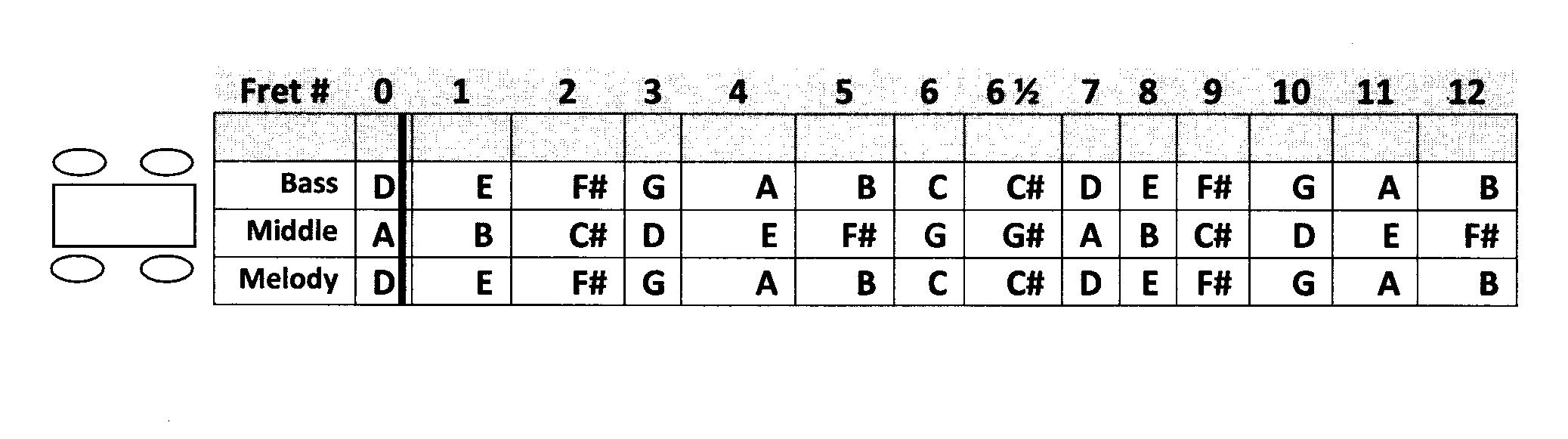
The uneven spaced notes can be an asset when learning the dulcimer. It makes it much simplier to memorize the fret numbers. Try to visualize and learn which frets are large. — These are frets “1” and “2” and frets “4” and “5”. Then, The small fret is fret “3”.
Tip 2: Learn melody patterns
Some frets are used more frequently than others in many tunes which I teach to beginning dulcimer players. These tunes include commonly include playing the “0”, “2”, “4” and “7” frets. (These notes are part of a “D” chord and they all harmonize nicely with each other and the drones of the dulcimer.) I suggest learning these frets first — without resorting to counting to find where they are located on the fretboard.
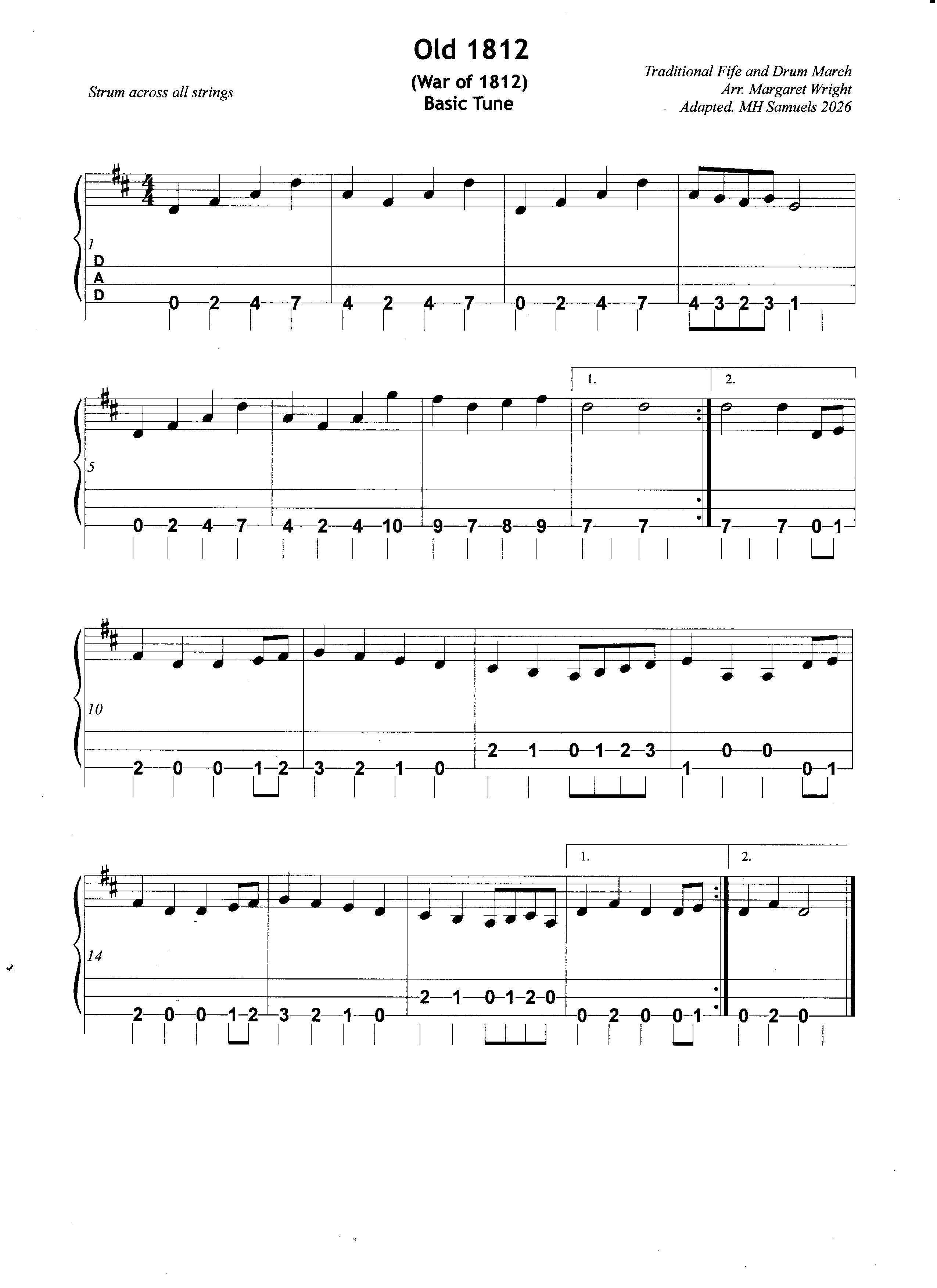
The tune, “Old 1812”, starts out by playing “0”, “2”, 4″ and “7”. It is a good song to start learning commonly included notes and frets. Practice and practice some more!
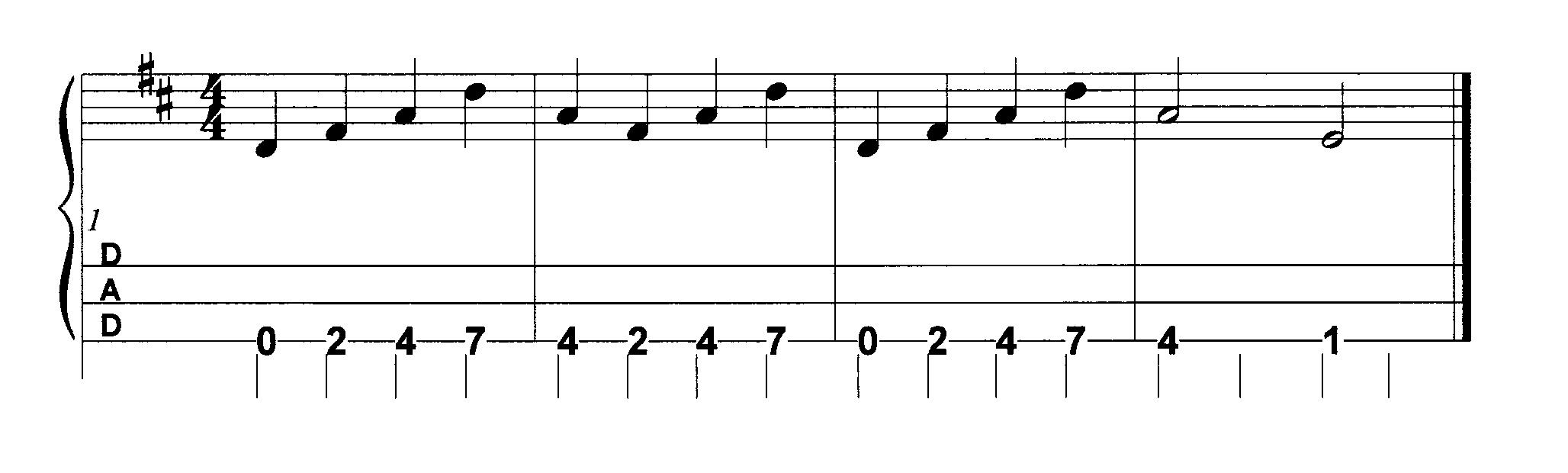
There are many other common patterns in tunes which we play on the dulcimer. I’ll cover some of these tunes in future posts.
Tip 3: For unfamiliar tunes, check out You Tube reels of the song including “Old 1812”
It is easier to play a tune on the dulcimer, especially for beginners, if you are familiar with the melody to the song and can sing along. However, “Old 1812” is not familiar to many folks. So, I suggest checking out You Tube reels of a group playing the song until you can get the basics of the tune into your memory. (See Reference for a reel of “Old 1812”.)
I found several recordings of “Old 1812”. It is played in the Key of D by the fifers, so you can play along with the You Tube reel. Of course, I had to slow down the tempo to keep up with the fifers!
About “Old 1812.” “Old 1812” is an old fife and drum march. It was played by the fifers in regimenary units to keep the soldiers together as they marched along. The melody of “Old 1812” dates to the popular Revolutionary War era tune, “Welcome Here Again.” “Welcome Here Again” was used in the movie, “The Patriot” with Mel Gibson. Clint Eastwood’s Civil War-era film, “The Outlaw Josey Wales,” uses the tune “Old 1812.” The tune was common in the Civil War — on both the North and South. It dates back at least to the War of 1812.
Fifers are were part of military units during the early modern era including the Revolutionary War. They were often young boys — too young to serve as soldiers in the military unit; often sons of non-commissioned officers. The fifers helped the infantry units keep marching pace. They were positioned on the right and the drummers in the center. These musicians relayed orders in the form of sequences of musical signals. They used signals to indicate changes in formations. Plus, the fife was used used to communicate orders during battle as its high pitched sound could be heard over the sounds of battle. In addition, fifers helped regulate camp formations and duties, and provided music for marching, ceremonies, and moral.
Tip 4: Simplify, Simplify
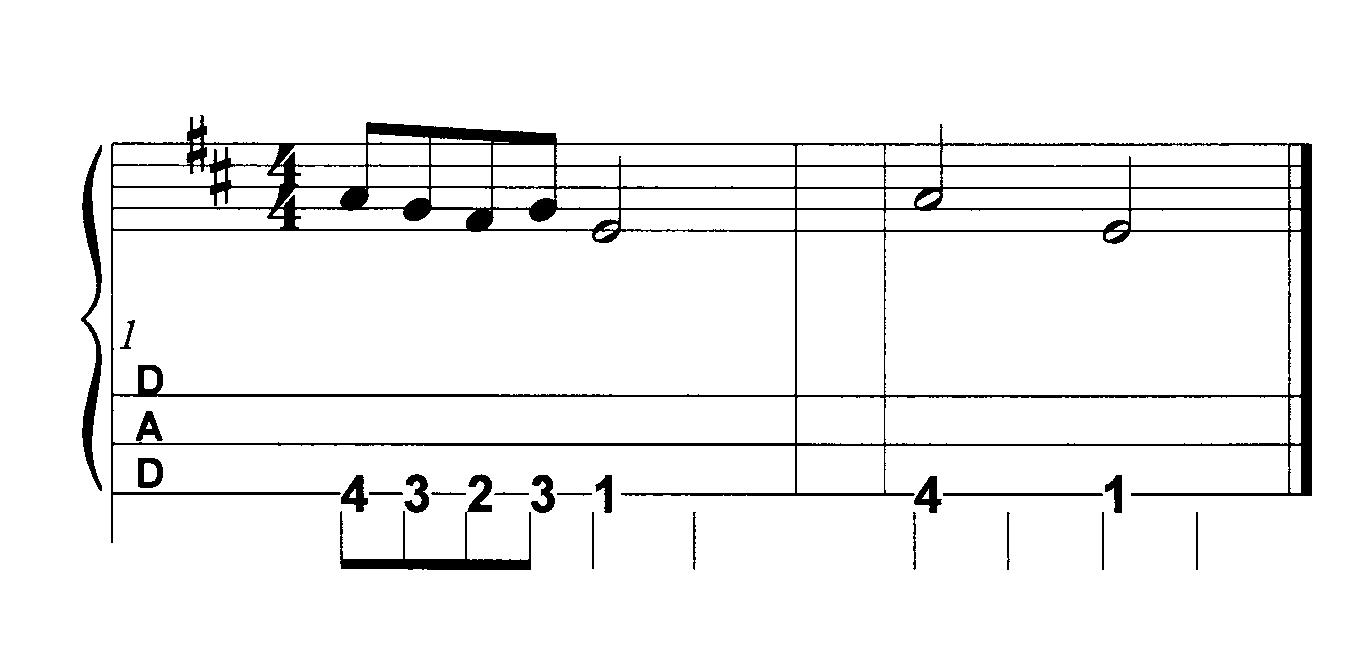
“Old 1812” is a catchy tune. It includes several eighth note runs which are easy to play on a fife. However, these are not so easy for dulcimer players. So, my suggestion is to omit some of the notes. (This technique is commonly used by Margaret Wright, dulcimer player and from Texas.) For example, in measure #4, rather than playing all of the eighth notes, just play the notes which fall on the downbeats — the 1st and 3rd notes of the measure.
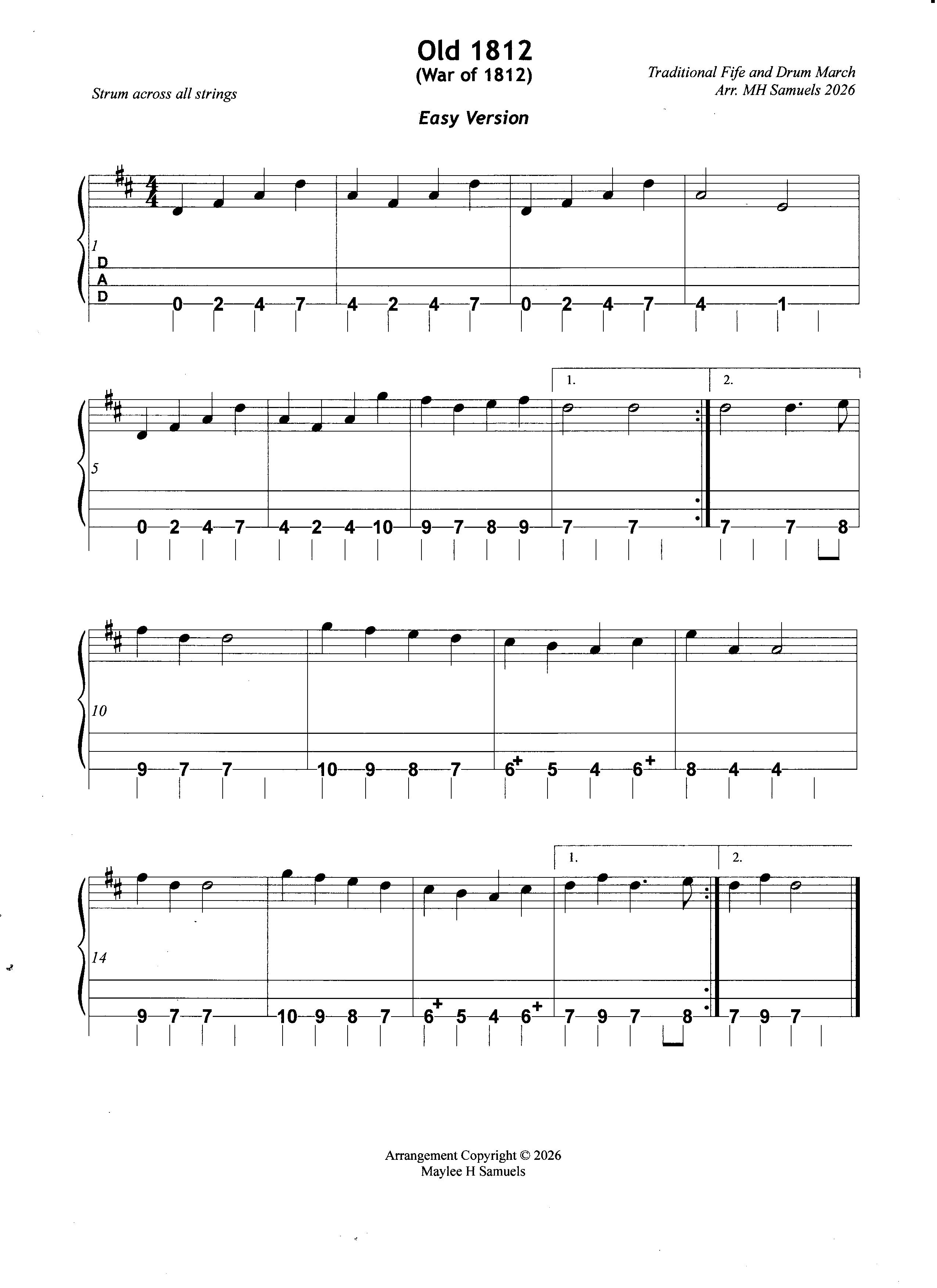
I have included an “Easy Version” with these and other changes. And, there is nothing wrong with simplifying a song — especially if you want to join a fast-tempo jam and want to keep up!
Tip 5: Change the octave
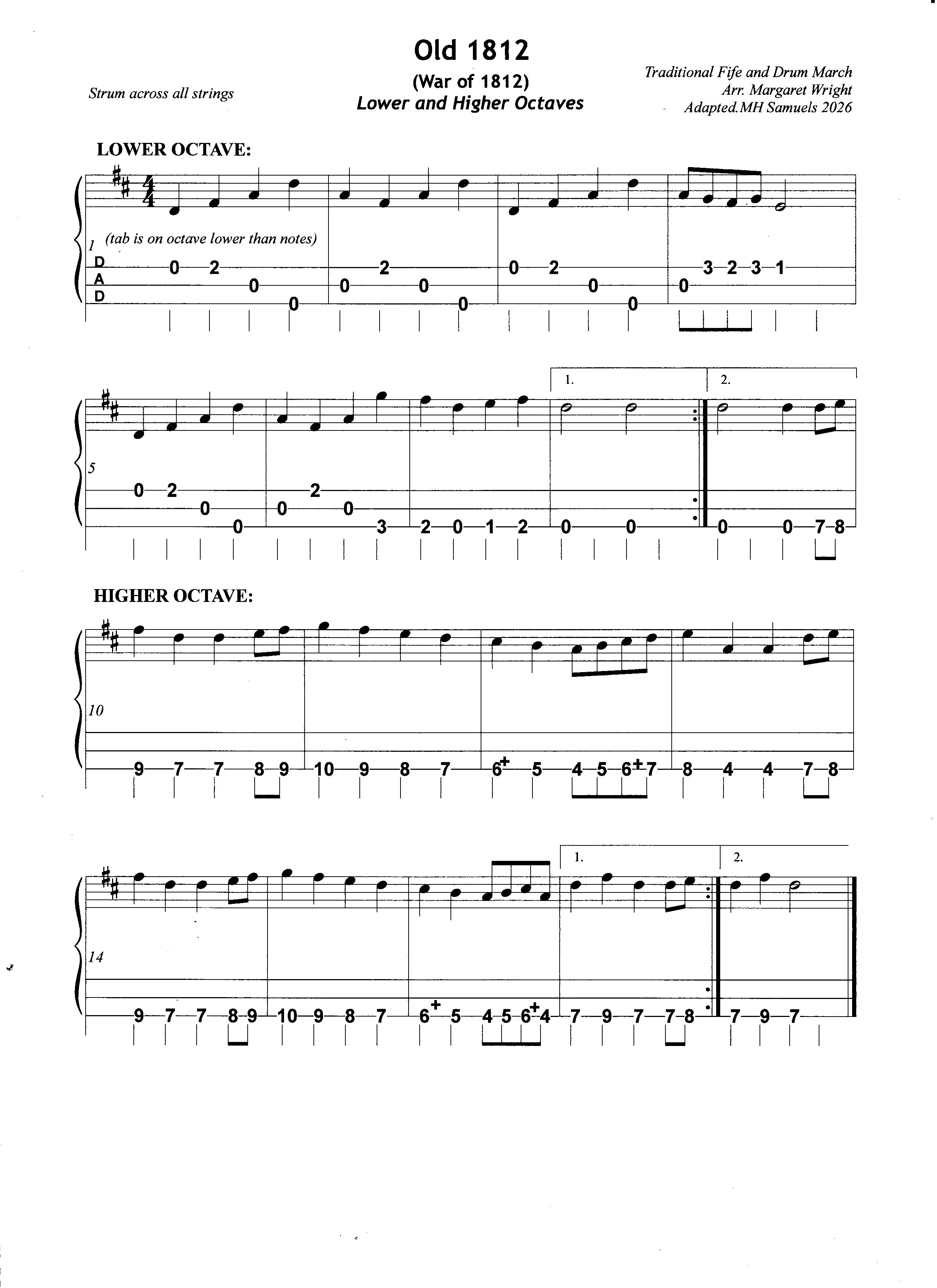
The first half of the tune, “Old 1812” is played on the lower register of the fife — or from “0” fret to “7” fret on the dulcimer. The second half of the song goes to the upper register on the fife. This makes for a pleasant contrast to the rather regimental and ‘harsh” march. However, oh those high frets ….so challenging to play on a dulcimer. The mountain dulcimer has the advantage of including the middle and bass strings which allow us to play low notes and low, low notes. So, for my basic tune, I tabbed the second half of the tune in the lower octave.
However, just because …. I we can play several more octaves on a dulcimer than a fife — and because I have computer software — …. I have a third version: The first part of the tune is played on the very low frets of the bass going to melody string. The second part of the tune is played on the higher melody frets — as with the original fife tune.
Tip 6: Mix and Match — Variety gives spice to a tune
Mix and match these versions…it gives variety to dulcimer music. The first two lines of the tune of each version match the other versions and can be played together; and the last two lines of each version match. This is a dronal tune…no chords or harmony notes…..and it can become very monotonous if you play the tune the same way all the time. Changing the octave — plus, adding or omitting notes — are ways to provide interest to your playing.
Tip 7: Strum with coviction
This is a very “dronal tune.” I did not include chords or harmony notes. However, the intent is to strum across all the strings. It is a march and needs a solid beat, especially on the first beat of the measure. And, it is played at a spritely tempo — those military infantry regiments really moved along.
According to A.I: “A standard military march tempo is typically 120 beats per minute (BPM), known as “quick time,” where each beat corresponds to a step, usually starting with the left foot.” To give reference, if you are walking (or marching along), that amounts to two steps per second.
250th Anniversary of our country
With the 250th Anniversary of our country approaching … this tune is a good, authentic tune to learn. “Old 1812” dates to the early era of our country including the Revolutional War and War of 1812. Let’s learn a new tune on the dulcimer for our summer celebrations!
Enjoy!
I have three versions of the tune, “Old 1812.”
1. “Old 1812” – Basic Tune,
2. “Old 1812” – Lower and Higher Octaves,
3. “Old 1812” – Easy Version
Here are Jpeg versions of the tunes followed by PDF versions which can be downloaded and printed. And, be sure to visit the Wright Family WEB site for all Margaret Wright’s tablature book arrangements.
Reference: for You Tube Reel
Civil War Talk:
https://civilwartalk.com/threads/introducing-catchy-tune-tuesday.195849/page-5

