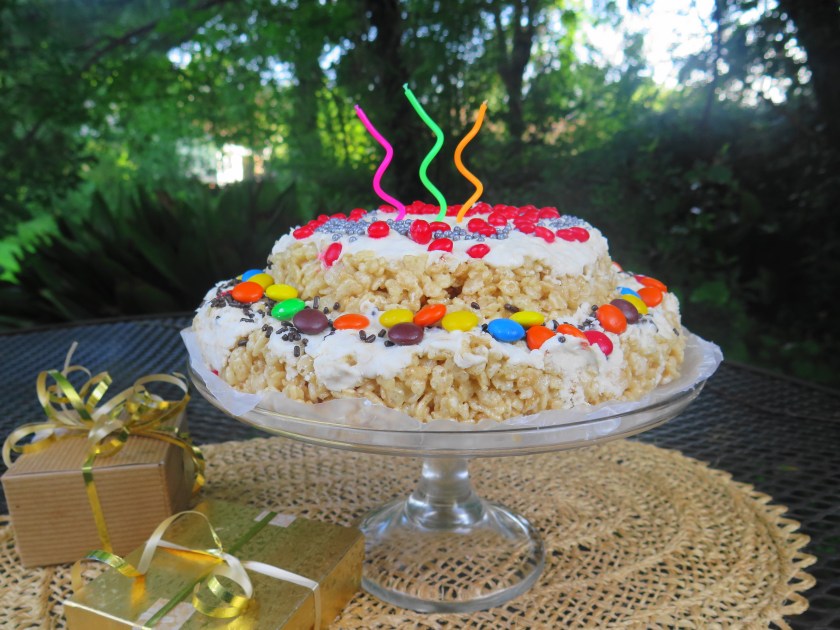
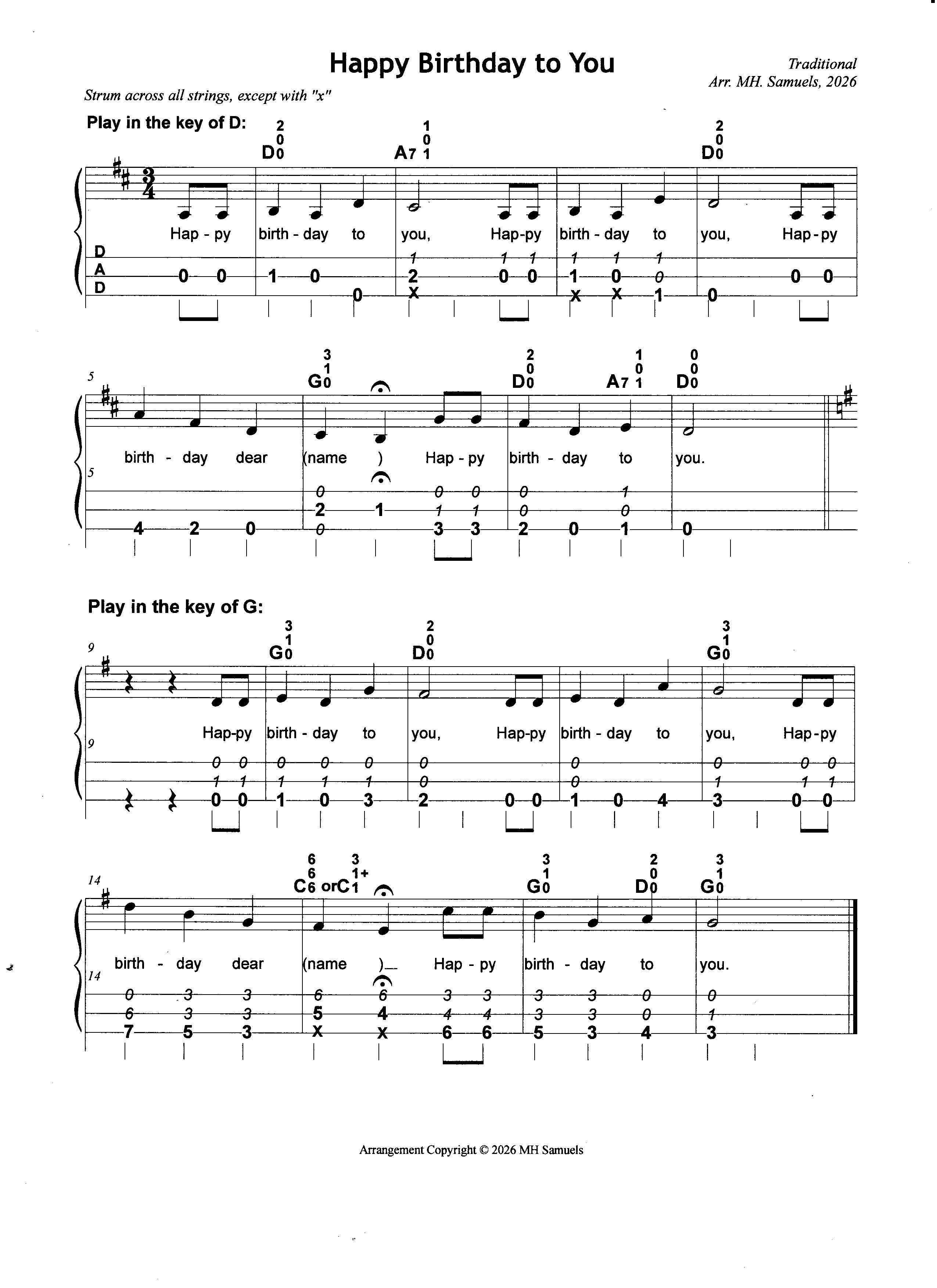
Well, well well. I always thought that the iconic birthday song, “Happy Birthday to You,” was copyrighted with hefty fees if you tried to publish or perform the song in public. And, after doing some internet snooping, I disovered that I’m partially correct. Warner/Chappell Music held a copyright to the song for many years and extracted large fees for anyone who wanted to use it — for example as a movie theme. A lawsuit, with judgement in 2016, declared differently and the song fell back into the public domain. I had no idea. With this new information in hand, I decided to write an arrangement of this song for the dulcimer. Surely, sometime in your playing career someone will ask you to play this song on the dulcimer at a birthday party. So, here is an arrangement which you can use. I tabbed it out in DAD tuning in the Key of D. Since this song is often sung in other keys, I also tabbed it out in the Key of G for DAD tuning. Here we go.
Copyright Issues
The song, “Happy Birthday,” origninates in with a song composed and published in 1893. Two sisters — Patty Hill, a kindergarten principal in Louisville, Kentucky, and her sister Mildred, a pianist and composer — were trying to come up with a song which would entice their youngsters to sing. They sourced a variety of songs and came up with, “Good Morning to All.” Gradually the words to “Happy Birthday to You,” were added becoming the popular and perhaps the world’s most well-known song. “Happy Birthday” first appeared in print in 1912. However, no copyright notice or credits were included. The Clayton F. Summy Company registered a copyright on the song in 1935. Warner/Chappell Music purchased that company in 1988 for $35 million including the copyright rights to “Happy Birthday.” Warner/Chappell began charging $700 or more per use in royalties to perform the song and garaned millions in fees.
In 2015, a lawsuit was filed stating that the lyrics and tune were in the public domain, preceding any copyright claims to the tune. The court agreed with the plaintiffs and stated that only a specific piano arrangement could legally be copyrighted. Warner/Chappell’s copyright was invalid and they did not have evidence of clear copyright ownership of the song; nor did anyone else. Therefore, the song reverted back in the public domain when the suit finalized in 2016.
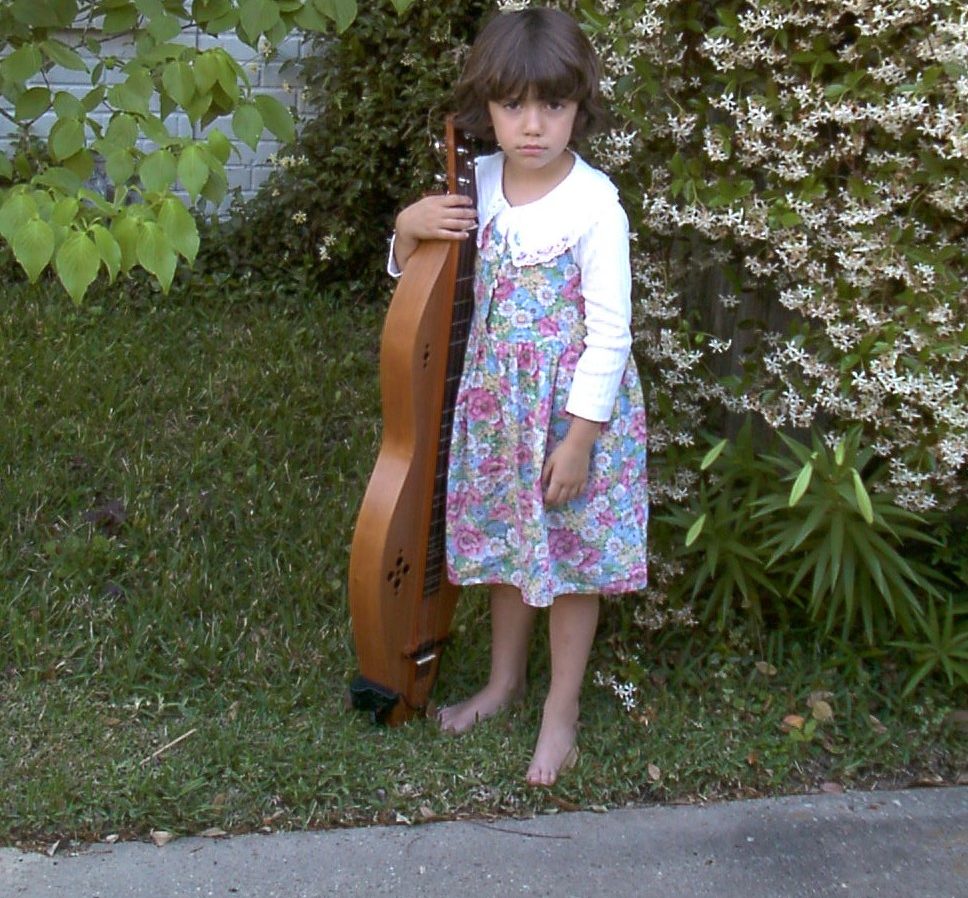
Ah, those birthday photos.
The picture tells the story….well, almost. Ever since my daughter was a tiny little girl, I took a photo of her holding the same dulcimer each year on her birthday. Over the years, it has made a wonderful montage of how she has grown. This particular year, however, my daughter wasn’t interested in taking photos and I had to pull some strings to get a decent one. Now, she sees the value in the photo sessions, and is more amenable to having her photo taken. One day, I’ll get them all organized and framed.
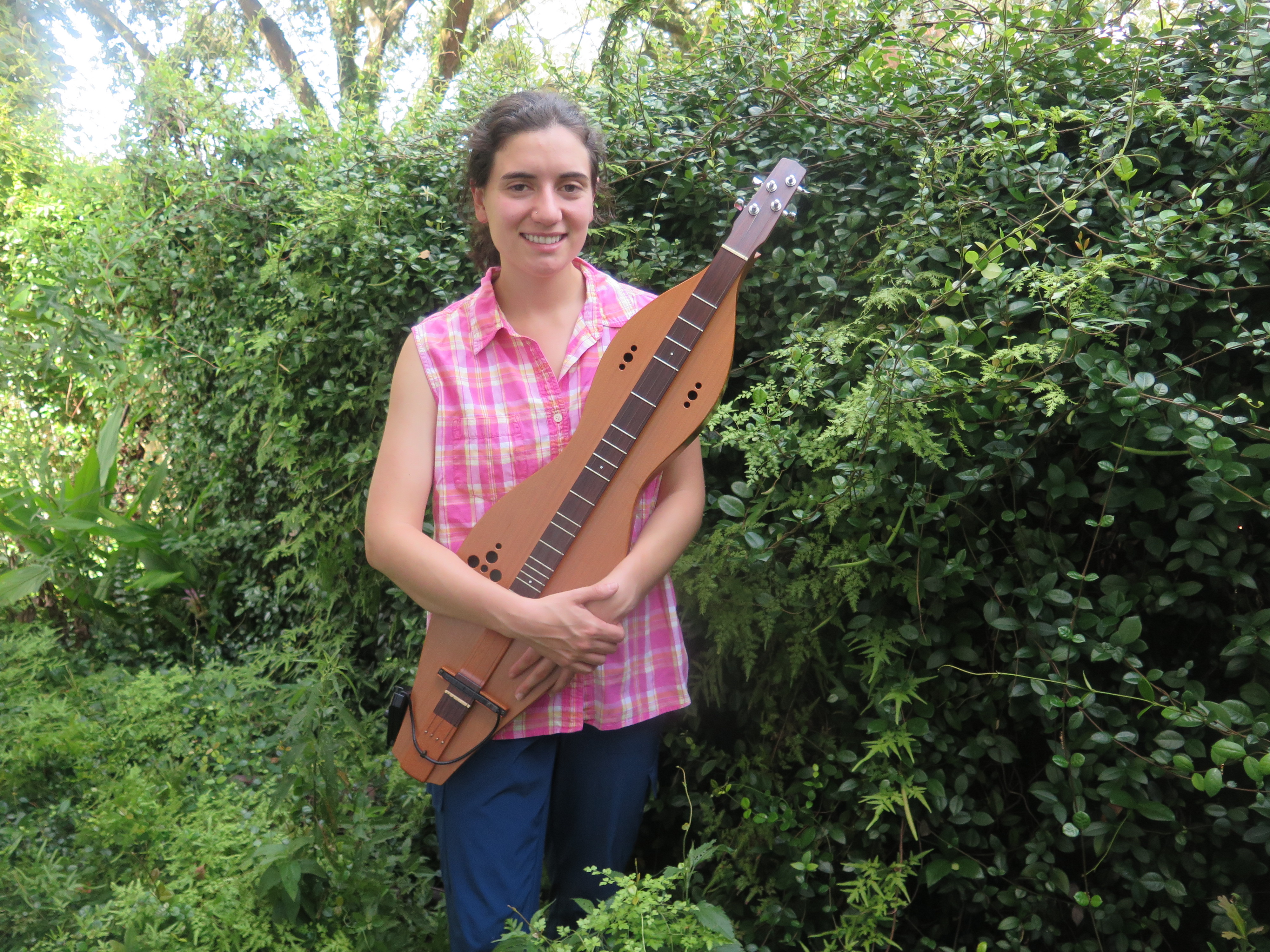
The point of the story is that birthdays are specially occasions. Singing “Happy Birthday to You” is an important part of the celebration and helps to capture the milestones of the years. Let’s play this song on our dulcimers.
Playing “Happy Birthday to You” on the dulcimer in the Key of G – No Drones.
The song, “Happy Birthday to You,” is often sung in keys other than the Key of D. The Key of D doesn’t fit everyone’s singing voice. So, here’s a situation where you can play the song in the Key of G while tuned to DAD. No need to add a capo 3 or retune the dulcimer. We can play the song in the DAD tuning in the Key of G. It is a little tricky to do, but any immediate dulcimer play should be able to handle it. The main idea to remember is there are no drones when playing in the Key of G while tuned to DAD. You must play enough harmony notes and chords to make things sound harmonious.
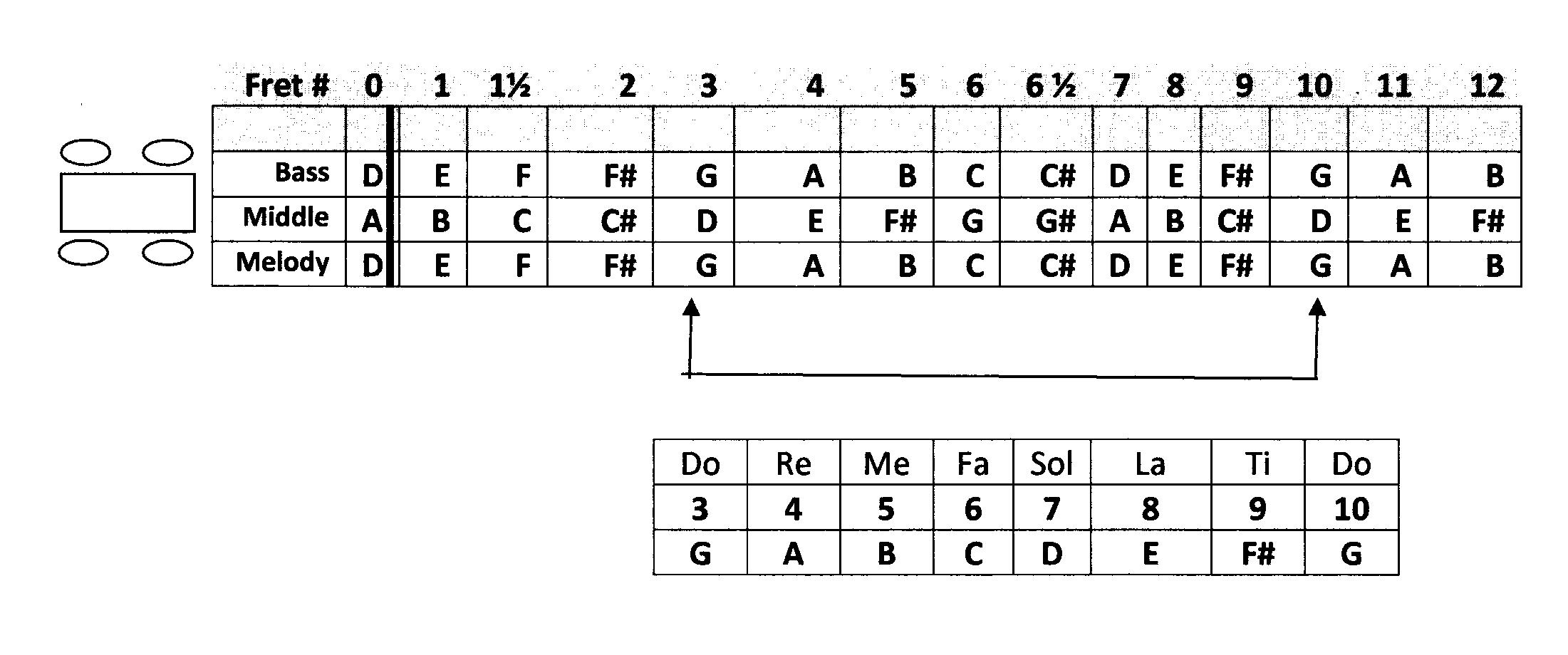
Here’s the Key of D — the scale goes from the “0” fret to the “7” fret on the melody string.
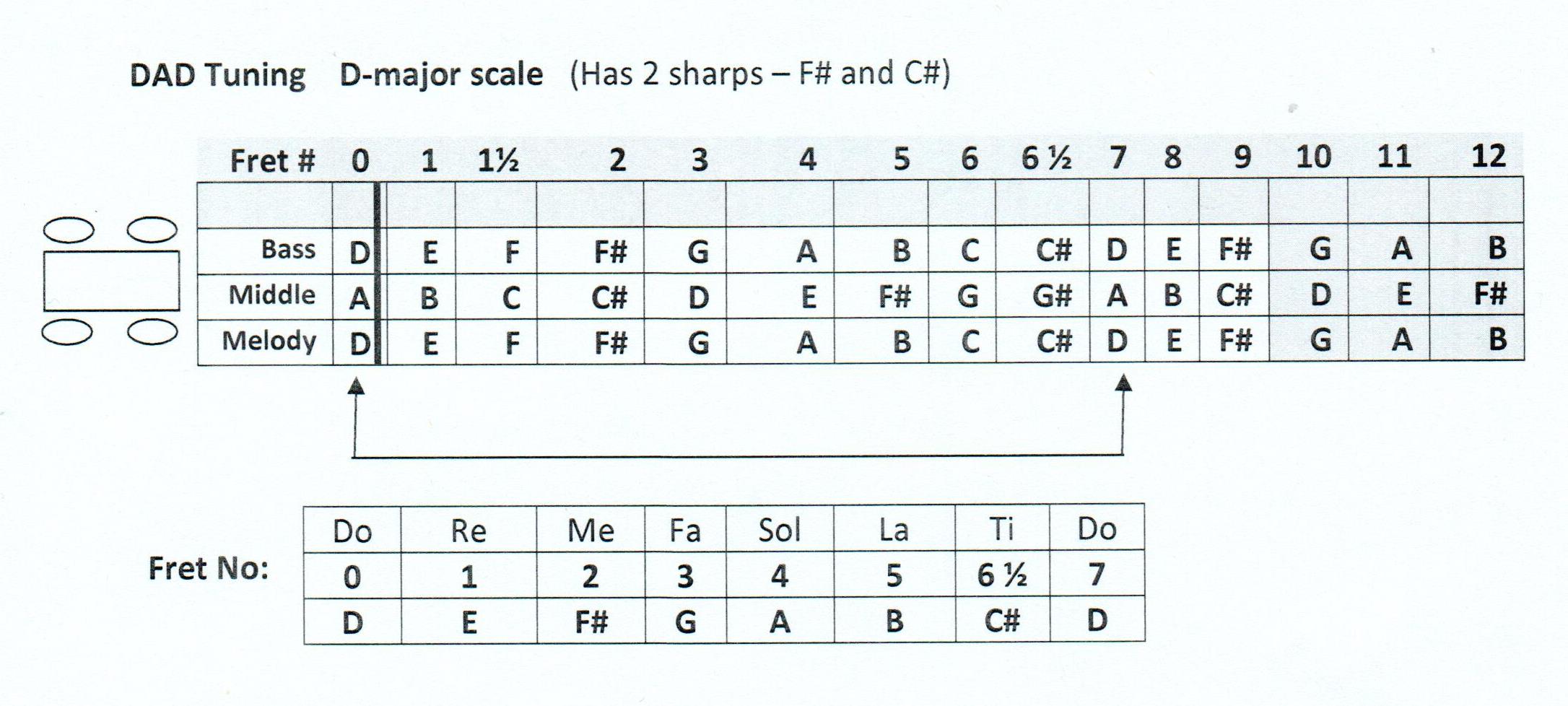
Surprise! You can also find and play the complete Key of G scale while tuned to DAD. The scale goes from the 3rd fret to the 10th fret on the melody string. This scale uses the 6th and not 6-1/2 fret. It has one sharp – F#. When you strum across the strings, playing the Key of G scale, the drones don’t harmonize. You must add harmony notes in order to make the song sound pleasing.
Chord along while singing “Happy Birthday to You”
Another option is skip playing the melody and just play the back-up chords in the Key of G and sing along. I have given suggestions for chords — these are written above the standard notation.
In the Key of G, the main chords which are played in many contemporary songs are G – C – D. The advantage of the dulcimer is that you can locate these chords — or parts of the chords — on many places on the dulcimer fretboard. Here are a few of my favorites fingerings.

If you have a 1-1/2 fret, playing the “C” chords is much simplier. However, there are several ways to play this chord without this fret.
Playing the Song with my Tablature
Strum this song. Alternatively use a combination of strumming and picking individual notes. With either style of playing — continue holding down a tab number until you get to a change in frets.
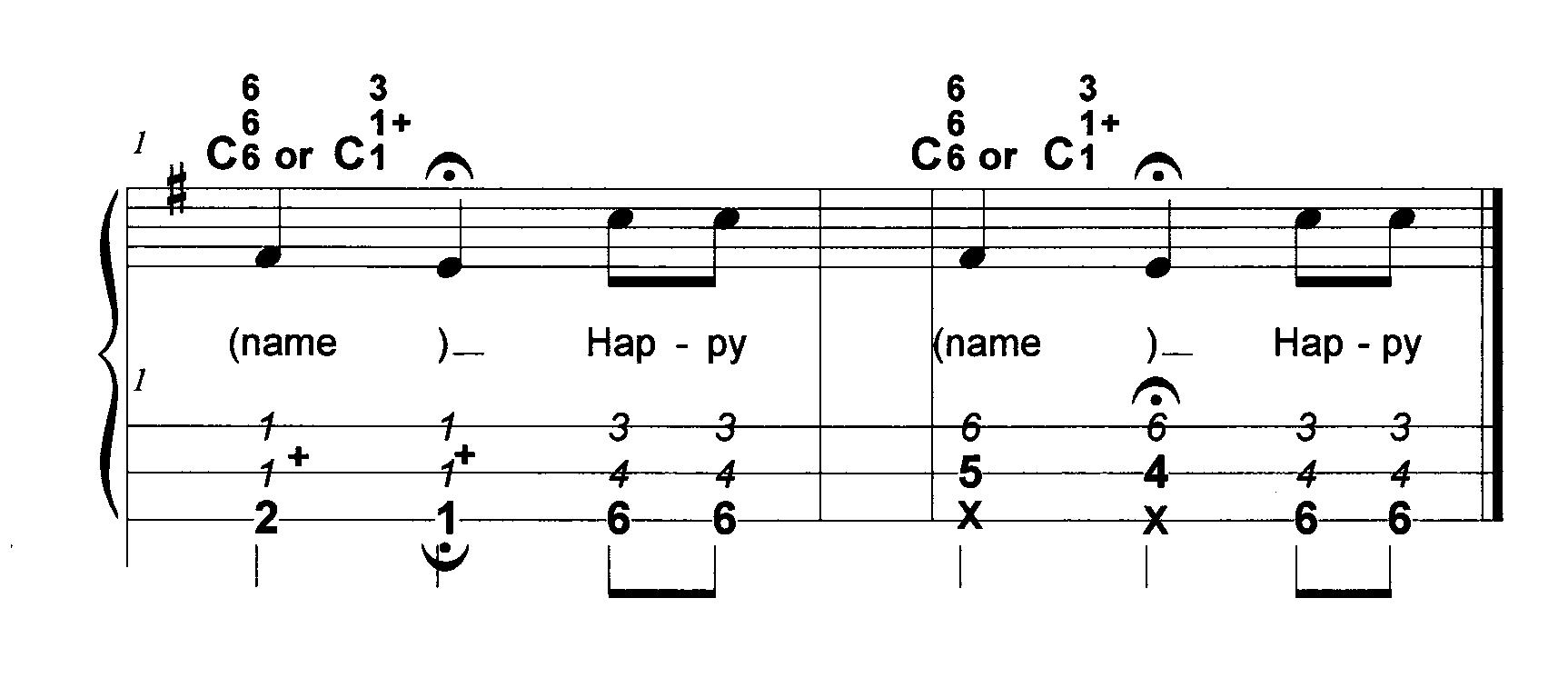
In my tablature arrangement, the larger, darker type shows the melody notes. Harmony notes are shown in italic, lighter type.
And “X” signifies not to play that string.
In the Key of G arrangement, there are two ways to play measure #15 which includes the “C” chord. If you have a 1-1/2 fret, you can play the notes lower on the fretboard. Without this extra fret, I like the sound better which includes the “C” note — this is found on the bass string. (Refer to the Key of G fretboard chart.) So the melody (darker type) is played on the middle string.
I am pleased with these arrangements. Any way that you play the tune, enjoy it and let’s celebrate birthdays!
I have included Jpeg images of the tune — both in the Key of D and the Key of G. Following, is a PDF file which you can download, print out and share. I just request that you don’t publish my arrangement — or upload it to a public internet site. Certainly the song and words are in the public domain and can be copied freely, but the arrangement is my own unique variation, and I appreciate acknowledgment for using it.
And, the PDF file:

