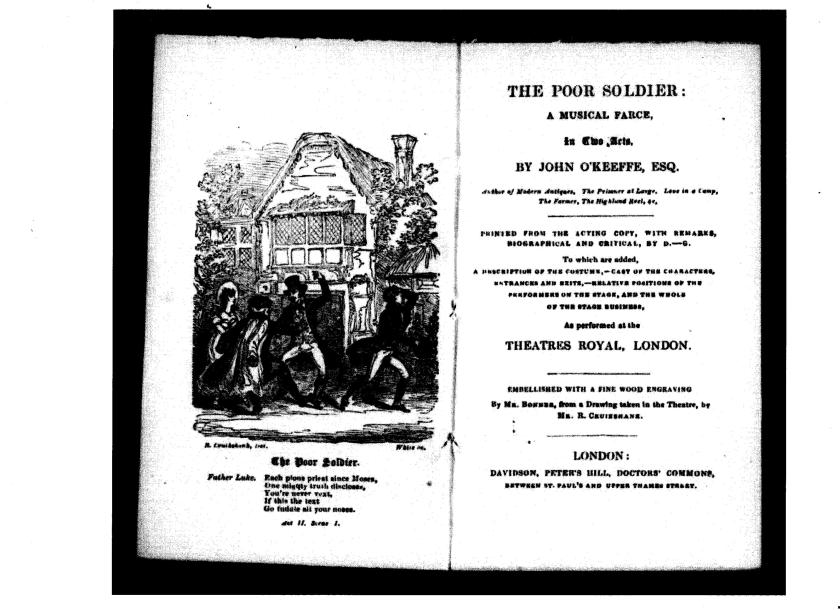
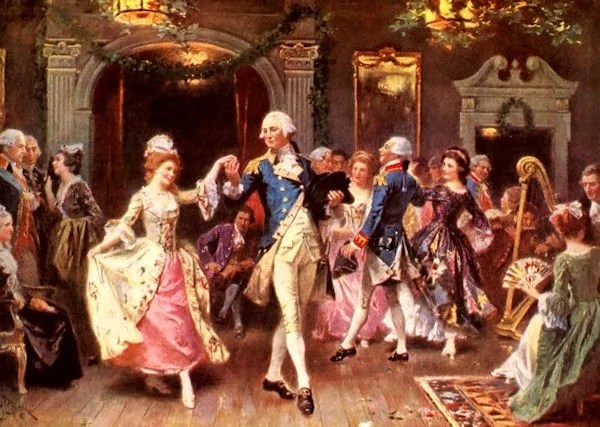
It is our country’s 250th anniversary; and I’m interesting in learning what music was played 250 years ago during the Revolutionary War Era. While searching for music, I came across the tune, “The Rose Tree.” This is a dance tune and was known in England, Scotland and Ireland under various titles during this time. In England, the tune is played as a reel, but in this country it is often noted as a polka in the 2/4 time signature and played as a fiddle tune. The tune was included in English composer William Shield’s comedic opera, “The Poor Soldier.” The song , “A Rose Tree in Full Bearing,” with lyrics written in 1782 by Irishman John O’Keeffe was included in the opera. This song is derived from the Irish version of, “The Rose Tree.” It is said that George Washington loved the opera and in fact attended the opening of the “The Poor Soldier” when it premiered in Philadelphia. George Washington also loved to dance — in those days dances were stately formal house dances. Apparently, he was was a skilled dancer (especially to the minuet) and would dance for hours at these balls — so it is likely that he knew the tune, “A Rose Tree.” And, here is George Washington dancing at The Victory Ball in 1781 as depicted by Jean Leon Gerome Ferris. I tabbed out the original tune and also a simplified version for mountain dulcimer. This song is very infectious and once you start playing; it is hard to stop.
About The Rose Tree Tune
There is plenty of documentation placing “The Rose Tree” in the Revolutionary War era — both in this continent and across the sea in England. As with so many early American tunes, this one — “The Rose Tree” — came from the British Isles. I found many citations of its inclusion in manuscript music books during this time period. For example, in this country, the Revolutionary War soldier and wealthy New York Colony landowner, Henry Livingston, Jr. — also a poet and musician — included the tune in his music manuscript book. His descendants have kept this and other manuscripts throughout all the years.
Here’s the original manuscript page from Livingston Jr’s book.
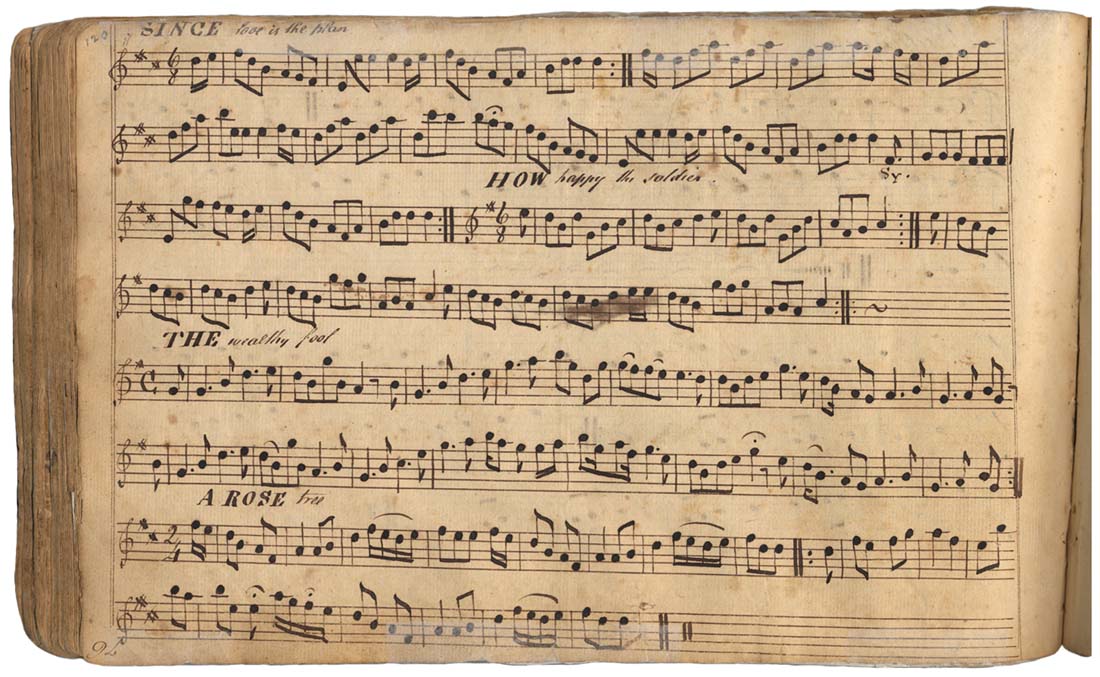
The tune was printed in New York in 1814 in ‘Riley’s Flute Melodies,” And, the tune was apparently used in Southern shape note hymnals, including the Kentucky Harmonist dating to 1817. Of course, it was used in the opera, “The Poor Soldier.”
Many, Many References in the British Isles (I like history, but skip this paragraph if you don’t enjoy reading all the details.)
In Great Britain, The Rose Tree is an old English, Irish or Scottish reel; a dance tune which went by many names. In Scotland the song is known as “The False Knight on the Road” and in Ireland as “Portlairge.”
The tune is included in several important manuscript books dating to the 1700s. For example, a manuscript of Scots collections lists the tune under the name of “The Gimblet” (Book 10, p 17). This is James Oswald’s Caledonian Pocket Companion (1745–1769) which is a major 12-volume collection of over 500 Scottish melodies featuring arrangements for flute or violin, showcasing 18th-century Scottish Baroque style.
Scottish music publisher and musician, John Brysson, published A Curious Collection of Favourite Tunes with Variation in Edinburgh in 1792. This work is a valuable primary source for 18th-century folk melodies, popular dances, and traditional music from the British Isles. It documents the era’s Scottish, English, and Irish tunes that were circulating in polite social circles and public gatherings of that era.
The tune shows up in Irish manuscript works, too. Thomas Moore used it for his song commencing “I’d mourn the hopes” in ‘A Selection of Irish Melodies’, #5, 1813. The tune is included in Thompson’s ’24 Country dances for the Year 1764′ under the title “The Irish Lilt”
About the plot of the opera, “The Poor Soldier”
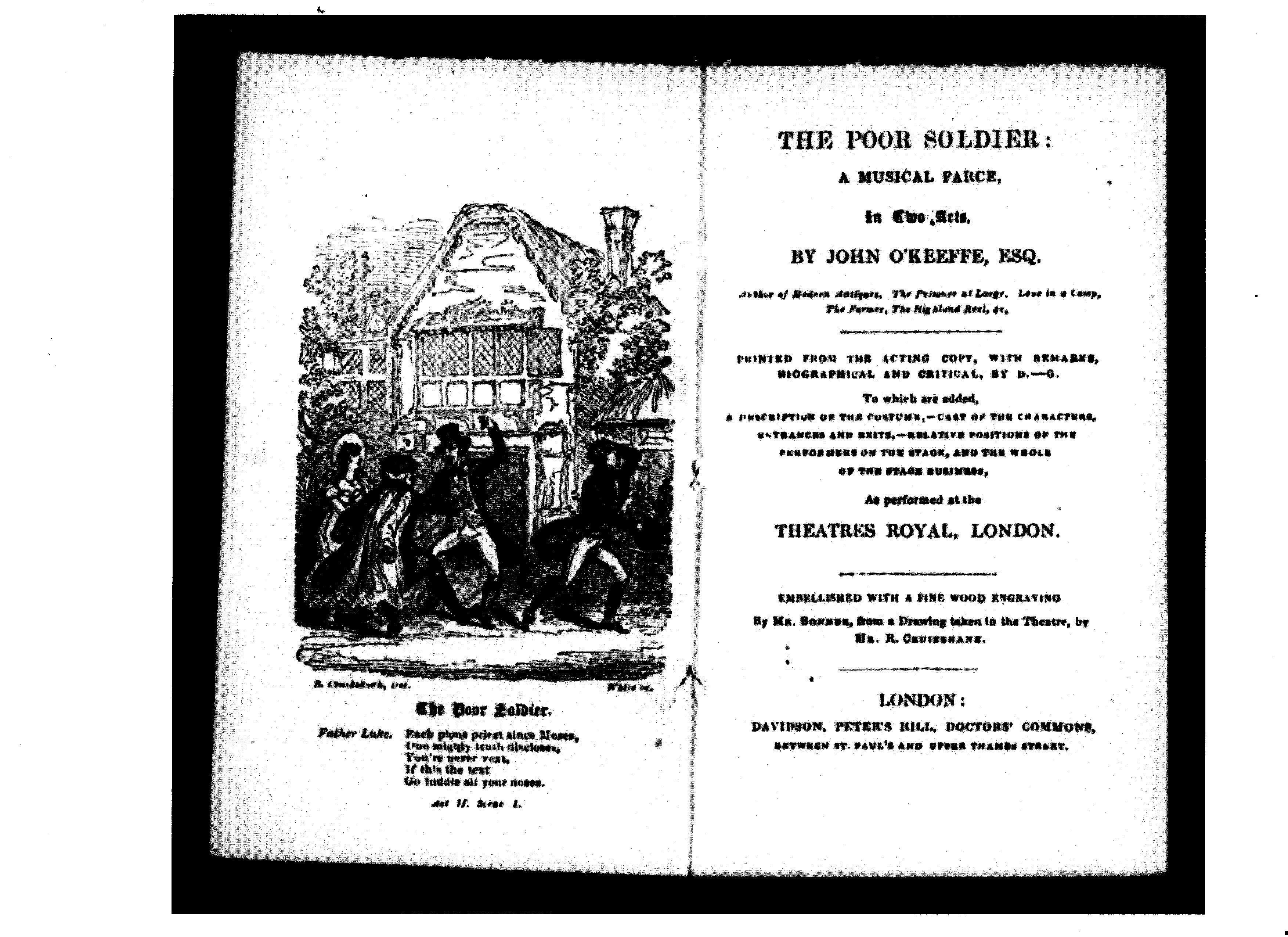
The Poor Soldier is a 1783 British pasticcio opera. A “pisticcio” is a work which is based on traditional songs or another composer’s music — not original music. The plot is a comedy set around Irish soldiers returning home after fighting in the British army in America during the Revolutionary War. An impoverished and humble Irish soldier, the poor Patrick, is vying for the love of Norah with Captain Fitzroy, a wealthy military officer. Unbeknown to Captain Fitzroy, Patrick had saved his life during an encounter during the war. When Fitzroy discovers Patrick’s valor and sacrifice, he drops his pursuit of Norah, and awards Patrick an officer’s commission and rise in social stature. The events are set entirely in a small Irish village called Carton, a few miles from Dublin. The opera was very popular in this country as well as England. The song in the opera, “A Rose Tree in Full Bearing,” is based on the tune, “The Rose Tree.”
This manuscript of “The Poor Soldier” can be found on the Library of Congress archives.
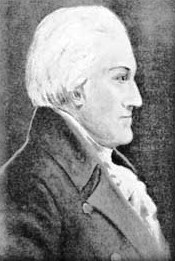
About Henry Livingston, Jr. — Revolutionary War Soldier
The melody appears in the music manuscript copy-book of Henry Livingston, Jr., a Revolutionary War soldier. Livingston served a six-month enlistment in 1775 as a Major in the 3rd New York Regiment. He was from Poughkeepsie in the Hudson Valley of New York. His regiment participated in Montgomery’s invasion of Canada in a failed attempt to wrestle Montreal from British control. Livingston kept a detailed diary of his daily activities during his enlistment, including drawings — quite interesting if you like history. Livingston, Jr. was also a poet, musician and a dancer. He was elected a Manager for the New York Assembly’s dancing season of 1774-1775, along with his 3rd cousin, John Jay, later U.S. Chief Justice of Governor of New York. (If only our modern state assembly could have a dancing manager!)
Henry Livingston, Jr. was a member of the powerful Livingston family of Irish and Dutch descent. He was able to purchase the estate of Locust Grove, Poughkeepsie, New York, in 1771 at the age of 23. An important land-owner in the Hudson Valley, Henry was also a surveyor and real estate speculator, an illustrator and map-maker, and a Justice of the Peace for Dutchess County.
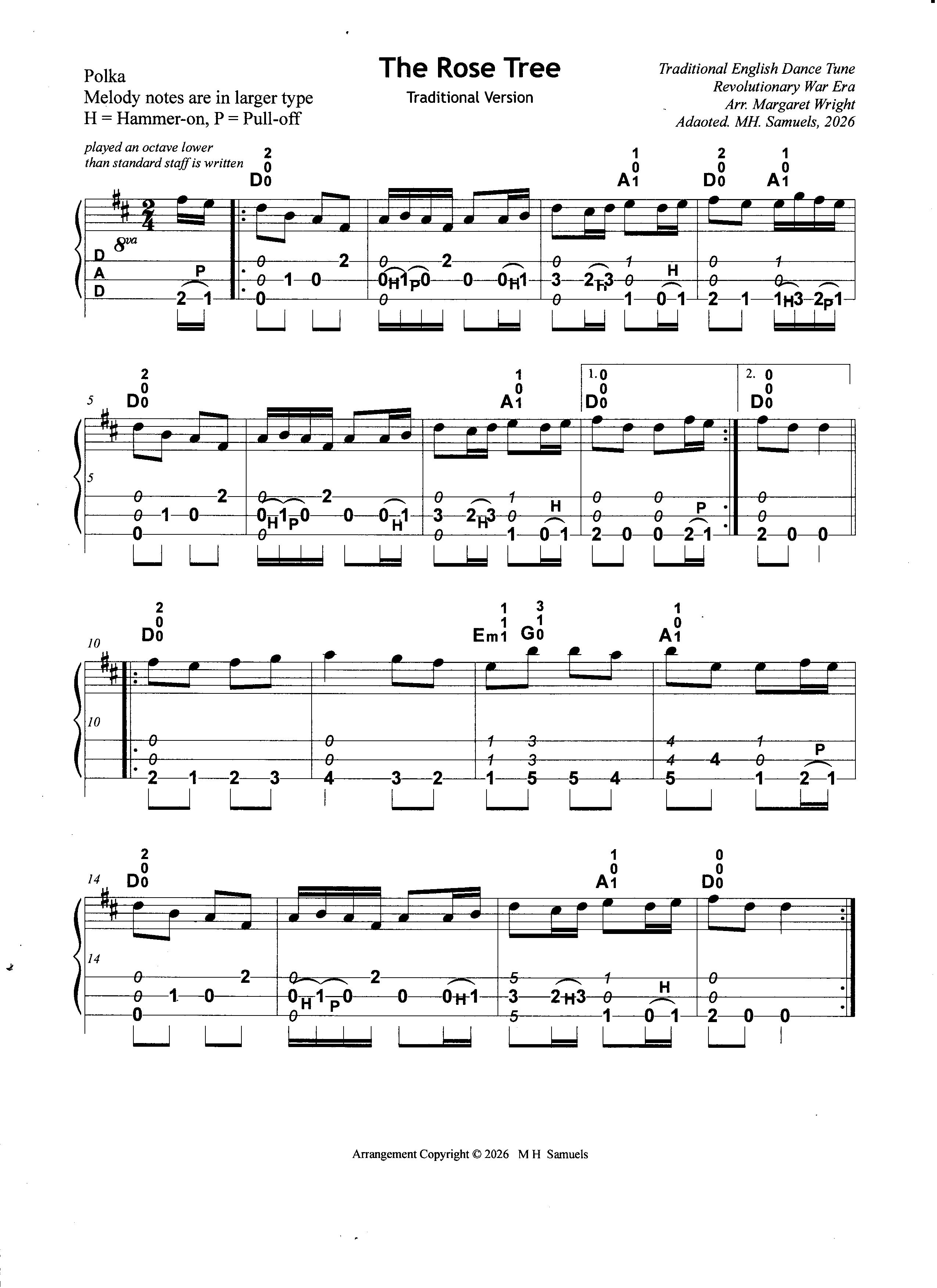
“The Rose Tree” arranged for Mountain Dulcimer
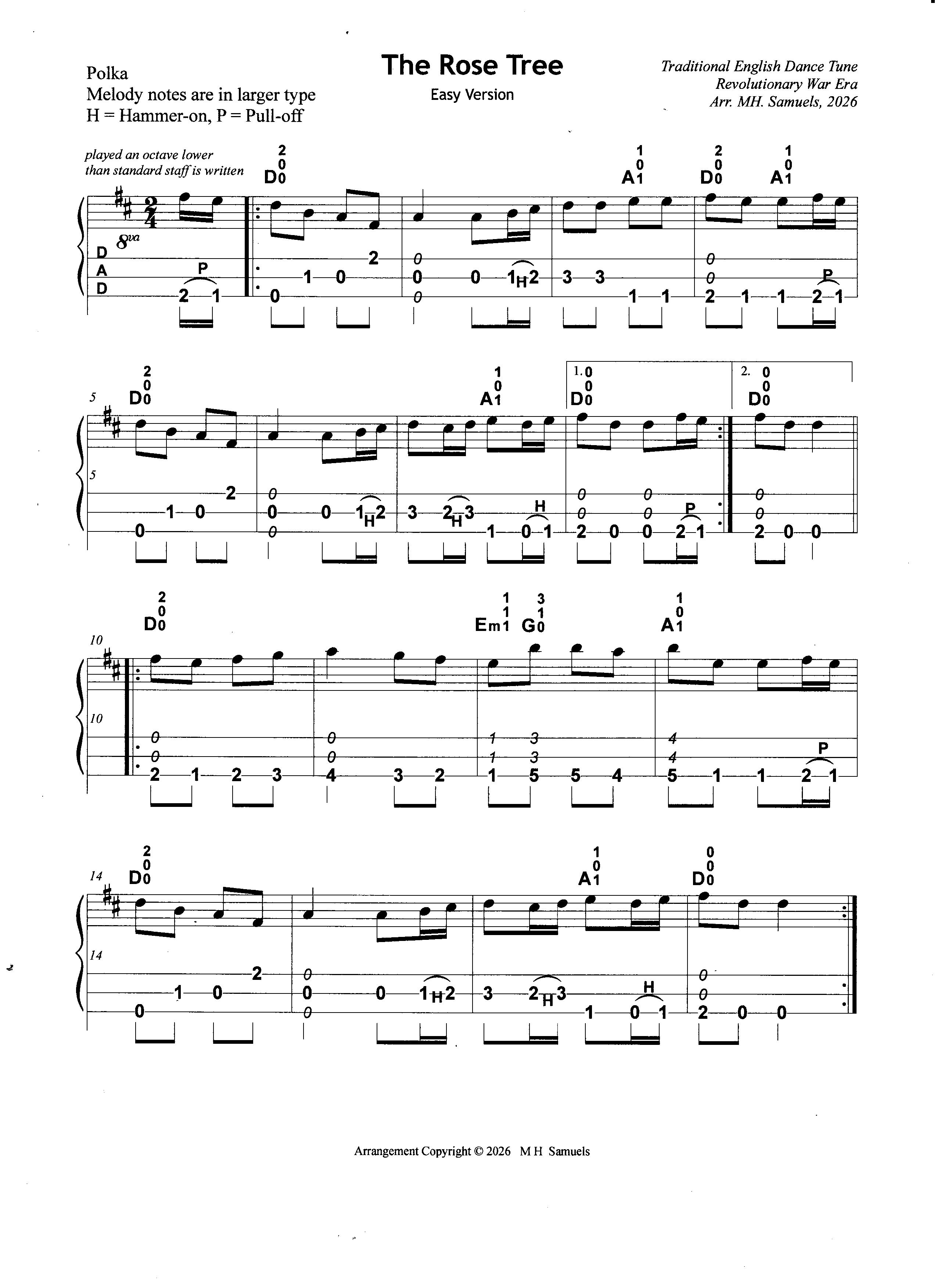
I used a combination of printed music from the internet site, “The Session,” — a popular community website dedicated to traditional Irish music with an extensive tune data base — along with You-Tube videos of the song to come up with an arrangement for the dulcimer. After making the arrangement, I discovered Margaret Wright’s tablature. It is almost identical to my own arrangement as well as tunes on You Tube videos. So, I’ve credited Wright on my traditional tablature.
I also have included a “scaled down” version, which skips some of the more difficult melody runs. This makes it easier to play while still keeping true to most of the melody.
In the “Easy Version,” measure #3 can be substituted for measures #7 and #16. Measure #3 omits several of the 16th note melody changes. This makes the measure is easier to play, but it does omit some of the fun of the melody which seems to “hop up” as you play along.
Key of D Tune. The tune shows up in the Key of D in arrangements on “The Session.” That makes it perfect for the DAD tuning of the dulcimer. However, the tune goes below the key note of “D” meaning that some of the notes must be played either on the middle or bass strings. (In my tablature versions, the standard music notes are an octave higher than the dulcimer tablature.)
Polka Tune. The versions listed on “The Session” are arranged as polkas with a 2/4 time signature. A polka is a peppy partner dance tune. The tempo is 100 to 120 beats per minute which is a lively tempo on the dulcimer. A polka has two beats per measure — and often the second beat is emphasized and accented giving a bouncy or “oom-oah” feel. It also means that most of the melody notes are eighth notes to get the feel of the cadence of this tune. Using hammer-on’s and pull-off’s help make the song flow smoothly. I’ve given suggestion for these ornaments in the tablature. Include them, if you desire.
Chords with suggested dulcimer fingersings are written above the standard music. A second person can play the chords as back-up.
Practice and Practice
I was not familiar with this tune until listening to versions played by fiddlers on You Tube. It took quite a bit of practice to get the “feel” of the song. However, after awhile, the song became infectious and it was difficult to stop playing!
I love learning about the history of the tunes which we play on the dulcimer. This song, “The Rose Tree,” definitely has connections to the Revolutionary War era. As a dance tune, it was apparently quite a well-known and popular song in colonial times. This tune has survived 250 years. Let’s learn it.
Attached are Jpeg versions of the traditional tune as well as an “easy” version. Following are PDF files which you can download, print, share with friends and play.
Enjoy!
Here are PDF files for downloading.


I never would have imagined Washington as a dancer. 🙂
LikeLiked by 1 person
Hi, it is an interesting bit of trivia I learned while researching this tune. Yes, George Washington apparently loved to dance and is known for dancing 3 hours without stopping. Plus, he always made a point to dance with every lady at the ball. He was especially skilled at dancing complex minuets, a France ball room dance. Regarding dancing, Washington said is was a welcome reprieve from riding horses and his other duties. So, there you go — so much trivia. Washington did many things, including exploring and caving. The mountains along the Shenandoah Valley have many caverns. Washington explored lots of them. Some are open to the public but others not. His name is engraved on one on private property..Now that’s some trivia.
LikeLiked by 2 people
Thank you. My primary image of him is an a boat crossing the Delaware. 🙂
LikeLike